Every Sunday, my mom sends a message in the family group chat that has not changed by a single word in ten years. Dinner at six. Bring tupperware. She likes things in order, and she likes us around her oak dining table where the linoleum has worn thin right under the spot where my brother Mark always pulls his chair out too fast.
She has never missed a week. Not when she had the flu two winters ago, and not even the Sunday after our dog died when she still managed to set out four plates and pretend the space on the floor by the stove wasn’t empty.
So when I opened my phone at ten in the morning and saw a message from her that broke the rhythm, I stared at the screen until the little blue dots stopped swirling. PLEASE DON’T COME TODAY. No emoji. No cheerful little sign-off. Just capital letters that looked jagged and loud against the bright white background of the group chat. I typed back immediately to ask if she was feeling alright, or if the oven had finally given out on her. She left me on read. That was the part that made the back of my neck prickle. Evelyn Vance does not leave people on read, especially not on a Sunday morning when the ham is already thawing in the sink.
Mark texted ten minutes later, his words bubbling up in a frantic little string of green blocks. I called Mom but she doesn’t pick up. Have you talked to her? I hadn’t. We became worried and rushed to Mom’s house. The drive took twelve minutes through the quiet streets of our Nebraska town, past the grain elevator and the Methodist church where the bells were just starting to wind down for the late service. My foot felt heavy on the gas pedal, and Mark was calling my cell every three minutes just so we could stay connected on the road, though neither of us said what we were actually afraid of finding.
I pulled into her gravel driveway first, the tires crunching loud enough to wake the dead, and threw the gearshift into park before the engine had even settled. I hopped out, my keys already jangling in my palm, and hurried up the three wooden steps to the front porch.
The porch geraniums were watered, sitting neat in their red clay pots, but the house behind the screen door was dead silent. I knocked twice, hard, with the side of my fist. No answer. The wind rustled through the lilac bushes by the driveway, and somewhere down the street a lawnmower sputtered to life and then died.
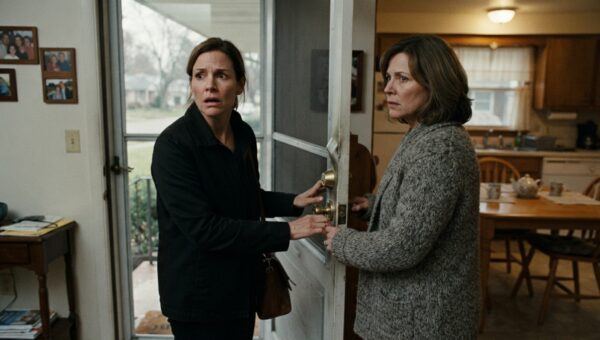
I had a spare key on my ring, the brass one with the little blue rubber cap she had made me put on it back when I bought my first sedan. I slid it into the lock, turned it until the deadbolt gave a dry, heavy clunk, and pushed the door open. I rushed inside, and I screamed when I saw what had happened to the kitchen.
The room looked like a tornado had touched down between the stove and the kitchen table. The salt shaker was shattered on the linoleum, white grains spilled across the floor like drifted snow, and two of the oak chairs were knocked clean on their sides.
On the counter, Mom’s cordless landline was busted to pieces, the plastic casing cracked and the battery pack sitting a foot away from the base. And there she was, huddled near the refrigerator, her breathing ragged and loud in the quiet house.
Mom was sitting on the floor with her knees pulled up, one hand pressed hard against her opposite wrist where a dark purple bruise was already blooming beneath her sleeve. She looked up at me with eyes so wide and bloodshot I barely recognized the woman who had packed my lunchboxes for twelve years. Her gray hair had come loose from its clip, falling in gray strands across her forehead.
“Get out,” she whispered, her voice cracking like dry timber. “You shouldn’t be here.”
Before I could cross the room to her, the back screen door banged shut with a hollow slam. Mark came bursting through the mudroom doorway a second later, breathing heavy, his eyes darting from the broken chairs to Mom on the floor. He dropped to his knees beside her so fast his knees hit the hard linoleum with a dull thud.
“Mom, what happened? Who did this?” Mark reached out to touch her shoulder, but she flinched away, her jaw tight.
“Nobody,” she lied, her voice shaking so hard the syllables blurred together. “I just tripped over the rug. I’m clumsy, you know that.”
“You didn’t trip over any rug,” I said, my voice sounding thin and small even to my own ears. I pointed down at the floor near the pantry door where a man’s brown leather wallet lay half-open, spilled out onto the tiles. A crumpled receipt from a gas station three towns over and a faded driver’s license peeked out from the dark leather pocket.
Mark reached over and picked the wallet up before Mom could lunge for it. He flipped it open, and the color drained right out of his face. He didn’t even have to say the name out loud for me to know. Arthur. The man whose picture had been burned in a fireplace fifteen years ago, the man whose shadow had hung over our front door long after his clothes were cleared out of the cedar closet.
“He was here,” I said, and the words tasted like copper in my mouth. “Arthur was here.”
Mom buried her face in her hands, her shoulders shaking with the kind of dry, heavy sobbing that comes when you’ve run out of tears hours ago. She didn’t look like the matriarch who ran Sunday dinners with an iron fist anymore. She looked small, sitting there among the broken salt and the overturned chairs, trying to hold together the pieces of a life she thought she had finally buried.
“He found where I bank,” she whispered into her palms, the words muffled and thick. “He came through the back door before I had the deadbolt thrown. He wanted money, kids. He said he knew where you both lived, where you worked, everything. He said he’d make sure your lives were ruined if I didn’t hand over the savings from the sale of the lot.”
Mark sat back on his heels, his hands balled into tight fists at his sides. “And you texted us to keep us away.”
“I didn’t want him near you,” she said, finally dropping her hands and looking up at us with fierce, desperate eyes. “You have your jobs, your families, your peace. I didn’t work fifteen years keeping him out of our lives just to let him walk back in and take the rest of you down with me. I thought I could handle him. I told him I’d call the bank tomorrow, anything to get him to walk out that door before you pulled into the driveway.”
“You can’t handle him alone anymore,” I said, dropping down beside Mark and taking her uninjured hand. Her skin felt cold, papery and fragile against my palm, but her grip tightened around my fingers with a sudden, fierce strength that surprised me. “We’re not fifteen anymore, Mom. You don’t have to carry this by yourself.”
“He broke my phone,” she said, staring down at the cracked plastic pieces on the counter. “He knew I couldn’t call for help once he smashed it.”
“He left his wallet,” Mark said, holding up the leather billfold like evidence in a courtroom. “And he left his car keys on the counter by the bread box. The police are going to have a field day with this.”
We stayed on that kitchen floor for a long time, the three of us huddled together in the wreckage of the Sunday morning routine, waiting for the sirens to wind down our street. When the deputies finally arrived, they took the wallet, dusted the back door handle, and wrote down every word Mom said while Mark stood over the kitchen table keeping watch by the window.
The report was filed before the sun went down behind the grain elevator, and the temporary protective order was signed by a judge who picked up his phone on a Sunday afternoon when the sheriff called him at home. Arthur didn’t get his money, and he didn’t get past the new deadbolt Mark installed before the sun went down.
By the following Sunday, the broken salt shaker had been replaced, the linoleum scrubbed clean, and the oak table was back in its exact spot with the worn place right where Mark liked it. Mom stood by the stove stirring a pot of green beans, her wrist wrapped in an elastic bandage she tried to hide under her sleeve, though neither of us pretended we couldn’t see it.
When six o’clock rolled around, she wiped her hands on her apron and looked at the two of us sitting in our usual chairs.
“Dinner’s ready,” she said, her voice steady and clear again. “Bring your tupperware.”