The smell of cold linoleum and yesterday’s pot roast always lingers in the hallway around four in the morning, right when the house gets so quiet you can hear the ice maker in the fridge settle down the block. I sat at the kitchen island with a mug of chicory coffee that had gone lukewarm twenty minutes ago, watching the faint blue light of the stove clock blink 4:12.
My cheek still throbbed where Julian’s ring had caught the bone just below my right eye the night before, a dull, steady ache that felt less like a bruise and more like a period at the end of a very long, very exhausting sentence.
For thirty-one years I gave that boy every single thing he asked for and half the things he didn’t. When his father passed away with nothing left behind except a rusted out Dodge and three thousand dollars in medical debt, I worked double shifts down at the county records office and cleaned houses on Saturdays so Julian could go to college without taking on loans he could not pronounce. I thought I was building a man. I honest to goodness thought I was making something solid out of the two of us.
Instead, I built a stranger who looked down his nose at the very floors that carried him here.
The trouble really started climbing about six months ago when Julian got himself engaged to Clara Vance.
Her father, Arthur Vance, owns half the commercial real estate between here and Columbia, and Arthur likes self-made men who talk big and carry themselves like they own the county courthouse. Julian figured out early on that a mother working a clerk’s desk didn’t fit the picture he was painting for his new high-society friends. So in all the country club circles and Sunday dinners up on the ridge, Julian became the sole provider for an ailing, dependent parent who couldn’t balance a checkbook without his charity. He told them he paid the mortgage. He told them he kept the lights on. He even told Clara that I was losing my memory, just to explain why I didn’t get invited to their little gatherings down at the yacht club.
And yesterday evening, the whole rotten structure finally hit the wall.
Julian had come home right around seven, smelling of expensive bourbon and tailor-made wool, carrying a thick leather folder under his arm.
He didn’t even take off his coat before he slammed the folder down on the kitchen table right where I was chopping celery for soup.
“I need your signature on these papers tonight, Mother,” he had said, his voice clipped and thin the way it always got when he was nervous about money. “It is just a standard quitclaim deed for the refinance. My partners need the house as collateral for the merger with the Vance group. You don’t need this much square footage anyway. I’m moving you into that assisted living cottage on Elm Street next month.”
I didn’t reach for the pen. I just picked up a stalk of celery, rinsed it under the tap, and wiped my hands on my apron. I told him no. I told him that the house was the only thing I had left from forty years of standing my ground, and I wasn’t signing away the roof over my head so he could buy his way into a country club syndicate.
That was when the thin veneer of his polished life cracked right down the middle.
His face went hot and dark, the veins in his temples bulging out against his skin like earthworms after a heavy rain. He didn’t yell, which was almost worse. He just leaned across that Formica table, his breath hot with whiskey and cold ambition, and his hand came across the space between us faster than a striking copperhead. The crack of his signet ring hitting my cheekbone echoed right off the pantry door.
“You stubborn old fool,” he hissed, his eyes wide and wild. “You are going to ruin everything I’ve built.”
I didn’t cry. I didn’t scream or throw a plate or try to hit him back. I just stood there with my hand pressed to my face, letting the silence stretch out until the air between us felt heavy enough to choke on. Julian stared at me for three long seconds, waiting for me to break, waiting for the trembling waterworks he was used to turning on and off whenever he wanted to make me feel small. When I didn’t give him the satisfaction, he turned on his heel, stomped up the stairs, and slammed his bedroom door so hard the framed photograph of his high school graduation fell off the hallway wall and cracked right down the glass.
I stayed at that kitchen table for a long time after he went upstairs. I listened to the heavy thud of his footsteps overhead as he paced back and forth, probably on the phone with his fancy friends, comforting himself with the thought that he had finally put me in my place.
Around 2:30 in the morning, I got up and made two phone calls.
The first was to Arthur Vance. The second was to Clara. I didn’t yell at them or play the weeping victim. I simply told them that if they wanted to understand the real financial arrangements behind Julian’s upcoming wedding and business merger, they should be sitting at my dining room table by 6:30 in the morning for coffee and fresh biscuits, and that they might want to bring their checkbooks and their patience.
By 5:00 AM, the kitchen smelled like butter and hot flour. I pulled out the good china, the set of Limoges porcelain with the faded gold leaf trim that my own mother had given me on my wedding day, the plates I had kept packed in tissue paper in the sideboard through every lean month and every unpaid electricity bill because I was saving them for something that mattered. I set four places. I brewed a pot of Colombian roast that filled the whole downstairs with a rich, dark aroma.
At 6:15, a sleek black sedan pulled quietly into the gravel drive instead of parking out on the street.
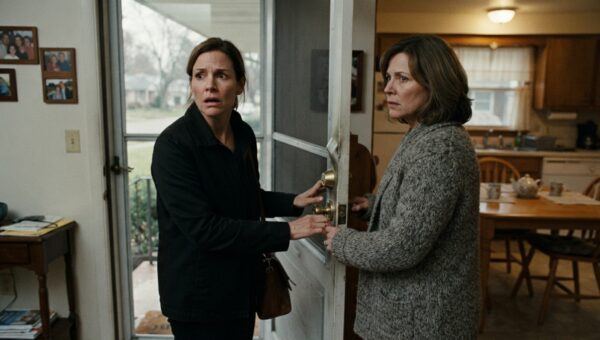
Arthur Vance got out first, looking stern and immaculate in an overcoat that cost more than my first car, followed by his wife Eleanor and Clara. Clara looked tired, her eyes red-rimmed and hollow under her eyeliner, as if she hadn’t slept a wink either. When I opened the front door, Clara saw the ugly, purple-yellow swelling across my cheekbone immediately. She stopped dead on the welcome mat, her breath catching in her throat.
“Mrs. Miller,” Clara whispered, her hand flying up to cover her mouth. “What happened to your face?”
“Come on in out of the draft, honey,” I said, my voice steady as a plumb line. “The coffee’s hot and we’ve got some paperwork to look over before the sun gets too high.”
We sat around the long dining table in the dim, early morning light. Eleanor Vance kept her purse clutched in her lap like a shield, and Arthur looked around the room with sharp, assessing eyes, taking in the framed family portraits and the peeling wallpaper near the corner of the ceiling. I poured the coffee into the thin porcelain cups, the small china saucers rattling just a tiny bit against the wood because my fingers were finally starting to shake now that the waiting was over.
We didn’t have to wait long.
At exactly 6:52, the floorboards creaked upstairs. Then came the familiar, heavy tread of Julian coming down the steps, wearing his silk robe and his morning face of effortless superiority. He reached the bottom of the landing, smoothing back his dark hair with one hand, looking every bit the young lord of the manor ready to issue his morning commands.
“So… you finally learned to stay in your place,” Julian called out toward the kitchen, his voice dripping with that lazy, arrogant sarcasm he used whenever he thought he had won an argument.
He strode down the short hallway and turned the corner into the dining room, his mouth still curled into that smug, self-satisfied smirk.
Then he lifted his eyes from the floor and saw who was sitting at the table.
The smirk died on his lips instantly. The color drained right out of his face, leaving him looking chalky and gray under the chandelier light. The ceramic coffee mug he had been holding in his left hand slipped straight out of his fingers and hit the hardwood floor with a sharp, explosive crack, shattering into a dozen white shards while dark liquid splashed all over the cuffs of his expensive wool trousers.
“Clara?” Julian choked out, his voice cracking into something high and thin like a frightened boy’s. “What… what are you doing here? How did you…”
Arthur Vance didn’t stand up, but he leaned back in his chair and crossed his arms over his chest, his eyes turning as cold as river stones in winter.
“Your mother called us, Julian,” Arthur said, his voice deep and level. “She invited us for breakfast. And I have to say, the hospitality is a good deal more honest than what we’ve been hearing from you over the past six months.”
Julian turned his panicked gaze toward me, his chest heaving under his silk robe. “You didn’t,” he whispered, taking a half-step backward toward the hall. “Mother, you didn’t tell them anything.”
“I didn’t have to say a word, Julian,” I answered softly, reaching down to pick up the manila folder from the extra chair beside me and sliding it across the polished mahogany table toward Arthur. “The numbers speak for themselves. Here are the bank statements for the past eight years. Here is the deed to this house, paid for in full by my own labor, with zero liens and zero assistance from my son. And here, right on top, is the loan application Julian tried to get me to sign last night, the one where he claims he owns this property outright and supports me out of his own pocket.”
Arthur opened the folder with deliberate slowness. He didn’t rush. A man who builds real estate empires knows how to read a column of figures in his sleep. Eleanor leaned over his shoulder, her lips pressed into a hard, white line as she scanned the deposit slips and the title history.
Clara just sat there staring at Julian, the tears finally spilling over her lashes and running down her cheeks without making a sound. She looked at Julian’s face, then down at the purple bruise on my cheek, and then back at Julian as if she were seeing a ghost crawl out of an open grave.
“You lied to me,” Clara said, her voice shaking so hard the china cup on her saucer rattled again. “You told me your mother was senile. You told me you bought this house for her so she wouldn’t have to worry.”
“Clara, wait, let me explain,” Julian stammered, lunging forward with his hands out, his composure completely shredded. “It’s not what it looks like. My mother is confused, she’s under a lot of stress, “
“Stop right there, Julian,” Arthur Vance said, standing up from the table with a quiet finality that shut every sound out of the room. He closed the manila folder and set it squarely in front of him. “I’ve backed a lot of men in my time, and I’ve seen plenty of ambition. But I have never yet partnered with a liar who strikes his own mother and tries to steal the roof over her head to fund a speculative merger. Our business arrangement is terminated as of this second. And as for my daughter, your engagement was officially over the moment you opened your mouth in that hallway.”
Julian stood frozen in the middle of the room, surrounded by the brown puddles of spilled coffee and broken porcelain, looking like a king whose castle had just burned down around his ankles. He looked at Arthur, he looked at Clara, and finally he looked at me, his eyes begging for the old mercy that had kept him safe for thirty-one years.
“Mother…” he muttered, taking a step toward the table. “Please.”
I didn’t yell. I didn’t even look angry anymore. I just reached down beside my chair, picked up the cardboard packing box I had taped together earlier that morning, and set it right on the edge of the sideboard.
“Your keys are on the hook by the back door, Julian,” I said, my voice barely louder than a whisper in the quiet room. “You have until noon to get your things out of my house. And don’t bother coming back for Sunday dinner.”
Arthur, Eleanor, and Clara stood up together, murmured quiet goodbyes to me, and walked out the front door without once looking back at the man who had tried to build an empire out of sand. The heavy oak door clicked shut behind them, sealing the house back up in a deep, clean silence.
By nine o’clock, the front driveway was completely empty except for Julian’s car driving off down the road with the trunk tied shut with twine.
I walked back into the kitchen, turned on the tap until the water ran steaming hot, and picked up a fine Limoges saucer that had survived the morning. I washed it carefully, circle by slow circle, rinsing away the last traces of yesterday’s bitter coffee. Then I placed it back into the velvet-lined box on the counter, bathed in the clean, bright morning sunlight pouring through the window, and for the first time in thirty years, the house was entirely my own.