Six hundred and forty-two thousand dollars. That was the precise figure wired from my business account to the liquidation desk of Pacific Mutual Bank on a rainy Tuesday morning six months before the party.
My parents had lost the house where we grew up because my brother-in-law talked them into a bad second mortgage for a trucking venture that went belly-up in less than a year.
My father was too proud to look at the numbers, and my mother spent her entire life believing that whatever Vanessa wanted, Vanessa deserved. When the foreclosure notice was nailed to the oak front door, my mother called me not to ask for help, but to complain that the neighborhood was losing its standards.
I didn’t argue with her. I just called Arthur Vance, my corporate real estate attorney, and told him to buy the debt outright under my holding company’s name.
We set up a clean lease-purchase agreement that allowed my parents to live there rent-free, protected from their own bad decisions, while Vanessa was listed as the local signatory proxy because I didn’t want the daily headache of dealing with my family’s endless drama. I figured letting Vanessa sign the papers would stroke her vanity enough to keep her quiet. I was wrong about that, like I was wrong about a lot of things back then.
Three months passed in a blur of quiet resentment. Vanessa started telling every relative within a fifty-mile radius that her new investment portfolio had finally paid off and she had rescued our parents from the street. My mother ate it up with a spoon, bragging at every family dinner about her brilliant older daughter. I kept my mouth shut because I thought keeping the peace mattered more than my own ego. I should have known that letting someone build a castle out of your silence only gives them higher walls to drop things on you from.
The party was supposed to be a celebration of my parents’ diamond wedding anniversary, though everyone knew it was really just an excuse for Vanessa to show off the house she hadn’t paid a single dime for. Two hundred people crowded onto the back lawn under white silk tents that smelled faintly of damp grass and expensive caterer’s beef.
Maya, my eight-year-old, was sitting quietly on the edge of the stone patio near the azalea bushes, coloring in a small notebook I had packed in her bag. She reached for her paper cup of punch, her small fingers missing the rim by half an inch, and a bright red splash hit the hem of Vanessa’s cream-colored designer shoes.
Vanessa stopped mid-sentence while talking to my uncle, looked down at her foot, and her whole face twisted into something ugly.
Before I could even take a step forward, Vanessa swung her foot outward and caught Maya square in the shoulder, sending my little girl sprawling sideways onto the gravel.
“Do you have any idea how expensive these are, you useless brat?” Vanessa screamed over the murmur of the crowd.
The music under the tent kept playing for a second, horribly cheerful, before someone finally hit a switch and killed the speakers.
Maya was on her knees, crying quietly, her small palm scraped raw against the sharp stones. I dropped my glass on the flagstone, the sound sharp as a gunshot, and scooped Maya up against my chest.
“You don’t kick a child, Vanessa,” I said, my voice shaking so hard I could barely form the syllables. “Especially not over a pair of shoes.”
“Don’t you dare talk to my daughter like that,” my mother hissed, stepping out from the circle of relatives with her hands trembling. “You’ve been jealous of her since the day she got her first promotion. You planned this. You brought that girl here just to ruin this party.”
“I didn’t plan anything,” I said, trying to keep my voice down for Maya’s sake. “She kicked my daughter.”
My mother didn’t hesitate. Her palm cracked across my cheek with a force that sent my glasses sliding off my nose into the dirt. The silence under the tent was complete, heavy as wet cement.
“What have you ever done for this family?” my mother shouted, her finger shaking inches from my face. “Get out!”
I wiped the warm smear of blood from my lip where my tooth had caught it, set Maya gently on her feet, and pulled my phone from my pocket. My hands were remarkably steady as I dialed Arthur’s direct line.
“Cancel the contract,” I said into the screen.
Arthur didn’t ask questions. He knew my voice when the line had snapped. “Executing stop-order now. The lease-purchase is void as of this second.”
“Make sure the sheriff serves them in the morning,” I added, turning my back on the crowd that had spent my money while cheering for my humiliation.
The drive home was quiet except for Maya’s soft sniffles in the backseat. I didn’t try to explain it to her; she was too young to understand the heavy arithmetic of family pride and broken trust. I just reached back, let her small fingers wrap around my thumb, and drove straight through the dark desert exurb toward our own small, quiet place that was paid for with my own sweat and nobody else’s.
By 8:30 the next morning, Arthur’s courier had delivered the formal notices of occupancy revocation and contract termination to the front door of the family home.
My phone started ringing before I had even finished my first cup of coffee. First it was my mother, her voice pitching up into that shrill, panicked register she only used when reality finally broke through her denial. Then it was Vanessa, screaming obscenities about bank holds and frozen escrow accounts, demanding to know why her signature wasn’t holding up against the title search.
I let every single call go to voicemail. I didn’t listen to the messages. I already knew what they sounded like.
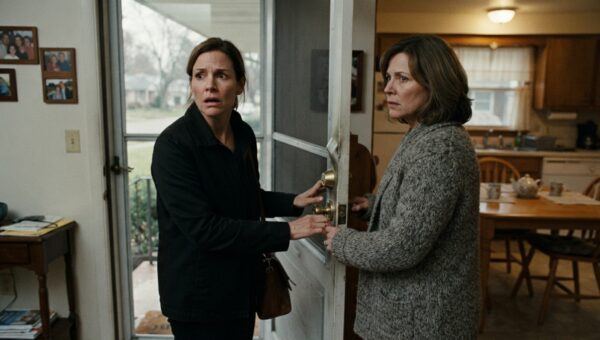
Two days later, my mother showed up on my front porch, pounding on the screen door with the flat of her hand until the wood rattled in its frame. I opened it just enough to keep her from pushing her way inside. She didn’t look triumphant anymore; she looked small and gray, her hair uncombrushed, her breath smelling of stale mints.
“You can’t do this to us,” she said, her voice dropping into a rough whisper. “The bank is already saying the deed reverts to your company. Vanessa’s name isn’t on anything. She… she lied to us about the paperwork, Maya. She told us she bought it.”
“I know she lied,” I said, leaning against the doorframe. “You helped her do it.”
“She’s your sister,” my mother pleaded, her eyes watering up in a way that used to work on me when I was twelve years old. “We have nowhere to go. The movers are coming on Thursday.”
“Then I suggest you help her pack,” I said, and closed the door.
The final meeting took place in Arthur’s conference room on a Thursday afternoon. The smell of old carpet and floor wax hung thick in the air. Vanessa sat at the far end of the long mahogany table with her arms crossed tight over her chest, looking like she wanted to set the building on fire with her mind. My mother sat beside her, staring down at her own worn leather purse like she expected it to save her.
Arthur slid three heavy folders across the polished wood. Inside were the original wire transfer records from my holding company, the cancelled debt-relief certificates, and the signed lease-purchase agreement where Vanessa’s name appeared only as an authorized tenant proxy, not an owner.
“The property reversion is complete,” Arthur said, his voice flat and professional. “The mortgage defaults have been reassigned to the third-party developer I brought in this morning. The sale closes on Friday.”
Vanessa looked up, her face pale under her makeup. “You can’t do that. We live there. We have rights.”
“You have thirty days under the eviction notice served by the county sheriff,” Arthur replied without looking up from his legal pad. “After that, you’re trespassing on corporate property.”
Vanessa lunged across the table toward me, her fingernails clawing the air before Arthur’s paralegal stepped between us with a hand on her shoulder. “You bitch!” she screamed, her voice cracking. “You let us live there just to pull the rug out! You planned this whole thing to humiliate us!”
“I bought the house to keep you off the street,” I said, looking right into her eyes for the first time since the party. “You turned it into a stage for your lies. And then you put your foot on my child.”
My mother reached out and grabbed Vanessa’s arm, but Vanessa jerked away, her face twisting with venom. “Tell her!” Vanessa snarled at my mother. “Tell her it’s her fault for being such a cold, ungrateful witch!”
My mother looked between us, her mouth opening and closing like a fish out of water, finally realizing that the fairy tale she had lived in for three years had run out of money. She didn’t look at me. She didn’t apologize. She just started crying into her hands, small, dry sobs that didn’t sound like they belonged to a mother at all.
I stood up, buttoned my coat, and picked up my bag from the extra chair.
“The keys are with Arthur,” I said, walking toward the heavy frosted glass door. “Don’t call me again.”
The house sold to a private developer forty-eight hours later for nine hundred and twenty thousand dollars, netting a clean profit that went straight into Maya’s college fund. My parents moved into a small two-bedroom rental on the north side of town, paid for by whatever scraps Vanessa had left from her credit cards before the banks finally locked her accounts down for good. I haven’t spoken to either of them since that afternoon in the lawyer’s office, and the silence doesn’t feel heavy anymore.
Saturday morning was bright and clear, the desert sun already warming the top of the garden fence. Maya was sitting on the grass near the hose, filling a plastic watering can and letting the excess spill out over the edge of the flower bed, watching the dark earth drink it up without a care in the world. I stood on the porch with a cup of black coffee in my hand, watching her small shoulders rise and fall as she laughed at something a sparrow did in the pepper tree. The ground under my boots felt solid and deep, and for the first time in years, the house belonged entirely to the people who actually lived in it.