The back room of the hardware store always smelled like old paper, machine oil, and the damp cardboard boxes we never quite got around to throwing out. I sat at my desk with three dozen applications spread across the scarred laminate surface, looking for someone reliable to sweep the aisles and haul out the cardboard. Most of them were kids looking for summer money or older guys trying to patch together a work history after a rough spell. Then I turned the page and my hand just stopped moving.
The applicant was twenty-six years old. He had a prison record for a non-violent property offense, a string of addresses that bounced around the county line, and a mugshot-style ID photo that made my chest tighten until I couldn’t draw a breath. I had not looked at an eleven-year-old face in fifteen years without seeing the gray granite marker at the edge of the churchyard, but this kid had the same high cheekbones, the same slight turn in the left earlobe, and the exact stubborn set of the jaw that Barry used to get whenever he refused to wear his winter coat.
I stared at that little two-by-three-inch square of glossy paper for five full minutes. My throat felt dry. I didn’t care about the prison record or the gaps in his work history because my brain had sort of stalled out on the way the light hit his eyes.
His name was Leo. I picked up my phone and called the agency that sent the batch over, telling them to send him down for an interview on Tuesday morning.
When Leo walked through the front doors of the store at 8:00 AM sharp, the resemblance was even harder to shake. He was taller than Barry ever got to be, standing broad-shouldered in a faded denim jacket, but he moved with that same slight bounce on the balls of his feet. I hired him right there before he even finished filling out the tax forms. I didn’t even care that he had served eighteen months for fencing stolen tools. I just knew I wanted him around the place.
Elena was furious when she found out that evening. She dropped her car keys on the kitchen counter hard enough to make the ceramic bowl rattle. “You hired an ex-con off a stack of resumes without running a proper background check through my brother?” she asked, her voice tight and sharp the way it got whenever she felt like she was losing control of the house.
I told her I checked what I needed to check, and that the boy needed a break. “We don’t need charity cases, Marcus,” she said, turning her back to start dinner. “Especially not ones that walk in off the street looking for handouts.”
Over the next six months, Leo proved her wrong about the work, at least. He showed up fifteen minutes early every single morning, unlocked the side rolling door, and swept the back bays until the concrete shone. He didn’t talk much, but when he did speak, his voice had that same low gravelly cadence that used to echo down our hallway when Barry was small. I found myself staying late just to help him stack pipe fittings or sort carriage bolts, listening to him talk about how hard it was to find a landlord who didn’t slam the door in your face once they saw a felony on your record.
“People don’t want to give you a second chance once you make a mess of things,” he told me one Thursday afternoon while we were wiping down the oil shelves. “They look at you like you’re already gone.” I looked at his hands, scarred across the knuckles from some old scrap, and I felt a strange, heavy ache behind my ribs. I told him he had a steady paycheck as long as he kept his head down, and he just nodded, his eyes dropping to the floor the exact way Barry used to do when he got caught tracking mud on the rug.
The tension in our house grew thicker every week. Elena stopped coming down to the store entirely, and whenever Leo’s name came up over supper, she pushed her food around her plate without eating a bite. I told myself she was just being cautious because of the break-in we had back in ninety-eight, but deep down I knew it was something else. She watched him whenever he carried supplies out to our delivery truck from the alley, her face pale and drawn like she was looking at a ghost she had tried very hard to bury.
The breaking point happened on a Tuesday in November. We had finished a late inventory count, and I invited Leo to stay for pot roast because the weather had turned sour and freezing rain was coming down hard against the windows. Elena had the serving platter on the table when we walked in, and she froze the second she saw him step through the foyer with his jacket damp from the sleet.
She didn’t say anything for a long, heavy minute while the wind rattled the back screen door. Leo stood there awkwardly in his work boots, holding his cap in his hands, looking around our dining room like he didn’t belong in a house with framed pictures on the wall. “I can eat in the truck, Mr. Miller,” he mumbled, turning toward the coat rack. But Elena didn’t let him move.
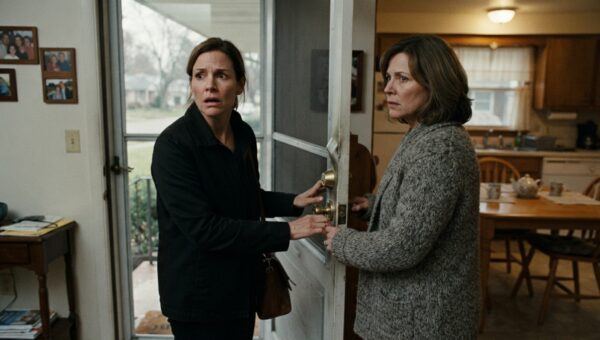
“Sit down,” she said. Her voice wasn’t loud, but it had a strange, brittle edge that made my skin go cold. Leo sat down slowly on the edge of the spare chair by the sideboard. Elena stood at the head of the table, her hands flat on the wood, her knuckles turning white until her skin looked translucent. She looked straight at me, then down at Leo, and her breath came out in a ragged gasp.
“You think you’re so smart bringing him here every day, don’t you?” she whispered, her chest heaving under her wool sweater. I told her to calm down, that he was just a kid who needed a hot meal, but she cut me off with a sharp wave of her hand. “Tell him,” she shouted, her voice cracking as tears spilled over her lower lashes without warning. “Tell him what you did to his real son!”
The kitchen went dead silent except for the hum of the refrigerator in the corner. Leo looked from Elena to me, his brow furrowed in deep confusion. “My dad died when I was six,” Leo said, his voice dropping to a low rumble. “In that wreck on Route 4.” I sat there with my fork half-raised toward my plate, my mind refusing to line up the pieces she was throwing down. “Elena, what are you talking about?” I asked, my voice sounding thin even to my own ears.
She covered her face with her hands and began to shake, great racking sobs that tore right out of her chest. “Twenty-six years ago,” she choked out through her fingers, “at the private clinic across the county line. I didn’t just have Barry. I had twins. We couldn’t afford the bills, Marcus. You were working seventy hours a week and drowning in debt from the shop, and I was terrified.” She dropped her hands and stared right at me with eyes full of a terror I had never seen in all our years together. “I gave one of them away. Through a private agency. Without telling you. Because I couldn’t bear another mouth to feed when we were losing the roof over our heads.”
The room seemed to tilt sideways. I looked at Leo, whose mouth was slightly open, his eyes wide and unblinking as the words settled into the space between us. “You gave me away?” Leo whispered, his voice shaking as he stood up so fast his chair scraped loudly against the hardwood floor. “You’re saying… you’re my mother?”
Elena shook her head frantically, backing up until her spine hit the pantry door. “No. No, I gave you to the family that took you in. But then they passed you around, and the foster system chewed you up, and when Barry died fifteen years ago in that crash…” She pointed a trembling finger at me. “You forgave the drunk driver. You said we had to be the bigger people while our only boy was in the ground. But I knew the driver was his uncle. I knew why Leo ended up where he did.”
Leo didn’t yell. He didn’t curse or throw his plate against the wall. He just stood there by the table, looking at Elena like she was a stranger he had met on a bus. “I spent five years in a facility for kids who didn’t have nobody,” he said, every word slow and flat. “And then I spent eighteen months in Mansfield for taking tools I didn’t even own because I was starving. And you lived in this big house… with him.” He pointed a scarred finger at me, then looked back at Elena. “You knew who I was the second I walked into that store, didn’t you?”
“I saw the application,” Elena sobbed, sliding down until she was sitting on the floor with her knees pulled up to her chin. “I saw your face. And I couldn’t breathe.”
Leo turned around and walked out the back door without putting his jacket back on, letting the screen slam shut behind him with a sharp bang that echoed out into the dark yard. I didn’t chase him right away because my legs wouldn’t obey me. I sat there at the table for a long time while the rain beat against the glass, listening to Elena cry herself out on the kitchen floor until her breath came in small, ragged hitches.
The next morning, I didn’t go down to the store at 7:00 AM. I drove straight to the county records office downtown, pulling up old files from the private clinic on Church Street that had closed down back in the nineties. It took me three hours of sitting with a tired clerk and showing my marriage license from thirty years ago before she slid a manila folder across the counter with yellowed intake sheets and twin birth certificates bearing Elena’s maiden signature. There was no mistake. Leo was Barry’s twin, hidden away out of panic and poverty twenty-six years ago, and then forgotten while we grieved the son we kept.
I found Leo sitting on an empty wooden crate behind the loading dock of the hardware store when I finally got back around noon. He had a broom in his hand, though he wasn’t sweeping. He was just staring down at the sawdust between his boots, his shoulders hunched against the damp November air. I walked up slowly and sat down on the crate next to him, placing the manila folder and the original photograph of Barry between us on the wood.
“You don’t have to stay here, Leo,” I said quietly, looking out across the empty alley where the delivery trucks usually parked. “And you don’t have to call us anything. But you’re not a charity case. And you weren’t an accident.”
Leo reached out slowly and picked up the hospital birth record, his thumb tracing the edges of the old paper where the ink had faded to a dull purple over the decades. He didn’t look at me for a long time. “Does she still hate me?” he asked, his voice rough.
“She doesn’t hate you,” I told him, feeling the heavy weight of all those lost years settle into my bones. “She just didn’t know how to look at what she broke.”
He sat there in silence for another minute, the wind whistling around the corner of the tin roof. Then he laid the paper back down, stood up, and picked up his broom. “I’ve got three aisles left to sweep before the morning shipment gets here,” he said, his voice clearing up just a bit as he looked toward the side door. “You want me to get the hand truck ready?”
I stood up and nodded, feeling something inside my chest loosen for the first time in fifteen years. We walked back inside together through the heavy metal door, leaving the past out in the cold rain where it belonged.