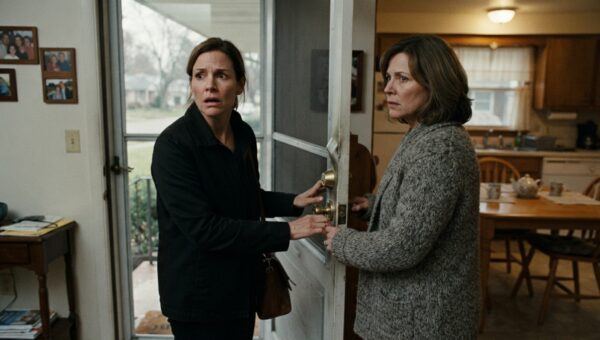
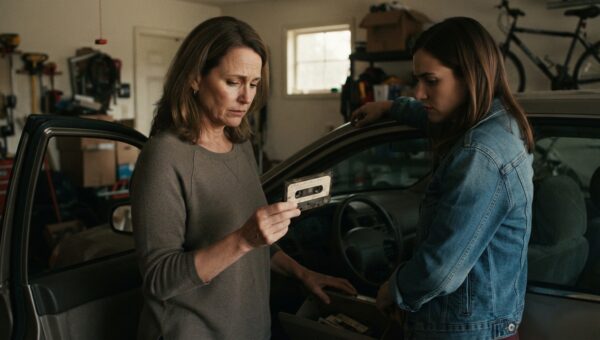
The brass key had a sharp, clean edge that caught the kitchen light when I pulled his sweaty workout clothes out of the nylon zipper pocket.
It was a Tuesday afternoon, right around three o’clock, when the house was usually quiet enough to hear the old refrigerator compressor cycling on and off. Mark usually took his gray gym bag off the passenger floorboard of his pickup the second he got home from his job at the supply yard, but this time he had left it slumped right by the basement door.
I didn’t think much of it until I reached down to bundle his socks and gym shorts together for the laundry room. My fingers hit something hard and metallic near the bottom lining, tucked away from the main compartment where he kept his deodorant and spare towels.
I pulled it out by the jagged tooth. It was a brand-new Yale-style Kwikset key, bright polished brass without a single scratch or smudge on the bow.
I stood there by the kitchen counter for a long second, turning the metal over in my palm. We had lived in our split-level house on Maple Street for fourteen years, and every lock on the exterior doors had been installed by my own father back when we first moved in. I knew the weight of our keys. I knew the specific notch of the backdoor deadbolt and the slight wobble in the front door knob.
So I walked through the house, testing that bright brass key in every lock we owned.
I tried the front door first. The bolt wouldn’t even turn in the cylinder. I tried the kitchen exit leading out to the deck, and it jammed halfway into the tumbler with a dry, metal-on-metal scrape. I went down to the side entrance by the workshop and got the exact same stubborn resistance. None of our locks matched. It was a key to a house that didn’t belong to us, or at least a house I wasn’t supposed to know about.
By Wednesday morning, the weight of that little piece of brass was sitting heavy in my coat pocket. I drove down to the hardware store on Main Street where old man Henderson had been running the locksmith counter since before we got married. He peered over his wire-rimmed glasses at the metal tooth, turning it under his magnifying desk lamp with dry, calloused fingers.
“This is for a Kwikset deadbolt. Residential,” Henderson said without looking up. “Standard grade. Mass-produced box store lock. You can buy ’em by the gross down at the building supply.”
“Is it common?” I asked, my voice sounding a little too thin in the echoing aisle.
“Common as gravel,” he grunted, handing it back across the scarred wooden counter. “Anybody puts in a new front door on a rental or a tract house, that’s what comes in the box.”
I thanked him and walked out into the cool morning air, but the small town felt suddenly narrow and strange around me. Mark had worked down at the commercial supply yard for nearly ten years, moving up from inventory clerk to regional manager, but he didn’t manage residential tract houses. He dealt with massive steel-beam orders and municipal concrete contracts.
The gap between what I knew about his days and what that key represented started to feel like a chasm.
I didn’t say a word to him that evening when he came home smelling of machine oil and cheap coffee.
I watched him drop his keys into the ceramic bowl by the front door, but the brass one stayed buried deep in his pocket until he carried the bag down to the mudroom. I spent three days watching him move through our kitchen like a stranger in his own boots, kissing the top of my head while he poured his morning coffee, asking how my church committee meeting went, all while carrying a secret in his gym bag.
Saturday arrived with a gray, steady mist that blurred the edges of the maple trees along the road.
Mark’s alarm went off at precisely 5:00 AM, just like it did every Saturday when he claimed he met his old college buddy Vance for an early lifting session across town at the community center. I heard the shower running down the hall. I heard the heavy thud of his work boots hitting the linoleum. At 5:42 AM, his truck backed out of the gravel driveway, tires crunching softly against the damp stones.
I pulled my sedan out five minutes later, keeping my headlights off until I turned the corner onto the highway.
The rain picked up as I kept two hundred yards of dark asphalt between his tail lights and my hood. He didn’t turn toward the community center on the east side of town. Instead, he took the old industrial bypass, heading fourteen miles out past the abandoned brickworks toward the south county line where the newer suburban infills gave way to patchy timberland.
My hands felt cold on the steering wheel, stiff and awkward against the rubber grip.
He slowed down near the edge of Crane Avenue, a quiet stretch of duplexes built back during the housing boom ten years ago. The properties were narrow, two-story units with vinyl siding and small, gravel-strewn parking pads out front. Mark pulled his truck neatly behind a faded blue sedan in the driveway of 414 Crane, cutting his engine before the headlights even had time to fade.
I parked three houses down, tucking my nose behind a high boxwood hedge that blocked the view from the road.
I watched through my windshield as he stepped out of the truck, pulling the collar of his jacket up against the drizzle. He didn’t look up or check the street. He walked with that easy, familiar stride I had watched for nearly two decades, marching right up the concrete steps of the right-hand unit.
He didn’t knock. He reached into his pocket, pulled out the exact brass key I had found in his gym bag, and slid it into the deadbolt with a clean, familiar motion.
The heavy timber door swung open before he even had time to twist the knob. A woman stood in the warm yellow light of the hallway wearing a plush white bathrobe, her dark hair pinned up loosely with a plastic clip. She reached out and caught him by the lapel of his jacket, pulling him across the threshold before the door clicked shut behind them.
I sat alone in my car for forty minutes while the windshield wipers ticked back and forth in a slow, monotonous rhythm.
During that time, I pulled my phone out of my coat pocket and took eleven clear photographs through the condensation on the glass. I caught his truck parked right beneath their front window. I caught the house number bolted to the wooden porch post. I caught the exact angle of the front door where he had vanished into a life that didn’t include our fourteen years of marriage, our joint taxes, or the quiet mortgage we had paid down together month by painstaking month.
By the time I drove home, my face felt stiff and dry, like old parchment left out in the sun.
Monday morning found me sitting in the plush gray office of Sarah Sterling, the real estate and family law attorney whose office smelled faintly of lemon polish and old paper. Sarah didn’t blink when I laid the printed photographs across her glass-topped desk, nor did she look surprised when I explained the locksmith’s verdict on the Kwikset deadbolt.
“People leave tracks, honey,” Sarah said softly, her fingers already flying across her keyboard. “They think cash or distance hides things, but the county register doesn’t lie.”
She spent twenty minutes clicking through the public property databases while I stared out the window at the courthouse square below. Then she turned her screen around so I could read the bold black text near the top of the browser window.
Crane Avenue duplex, Unit B. Purchased in June of 2023.
The purchase price was listed at $167,000, paid in full at closing with a cashier’s check drawn directly from a regional lending institution. But it was the line below the price that made the room tilt slightly on its axis.
Owner of Record: Mark Alan Henderson. Sole and separate property.
“How?” I whispered, my throat tightening until the words barely made it past my teeth. “We don’t have $167,000 in savings. Every extra dollar we’ve made goes into the supply yard business or our joint retirement accounts.”
Sarah leaned back in her leather chair, her expression grim and professional. “They didn’t use savings. Look at the secondary lien recorded three days before the deed was filed.”
She pulled up another document, a scanned PDF with official county stamps and embossed seals. It was an application for a Home Equity Line of Credit drawn against our primary residence on Maple Street.
There was my name, spelled correctly in neat cursive across the bottom signature line. There was my birthdate, my social security number, and a notarized stamp from a bank branch across town where I had never set foot in my life.
“That’s not my signature,” I said, my voice dropping to a flat, level whisper. “I never signed a HELOC application. I didn’t even know we had a line of credit on this house.”
“I know you didn’t,” Sarah said quietly. “Because whoever signed this used a shaky hand to mimic your middle initial, and the notary public who stamped it retired six months ago and moved to Florida. This isn’t just a messy divorce asset dispute. This is bank fraud and felony forgery, punishable by up to ten years in federal penitentiary for the loan documents alone.”
The silence in the office grew very deep, broken only by the low hum of the ceiling vent overhead.
I spent Tuesday and Wednesday moving through the motions of my normal life like a ghost, but underneath the quiet exterior, my mind was operating with a cold, terrifying clarity. I visited two different bank branches with Sarah’s legal subpoenas tucked into my leather tote bag. I secured certified copies of the notarized HELOC papers, the bank signature cards, and the transfer receipts showing $167,000 moving directly from our joint equity into the escrow account for the Crane Avenue duplex.
Brenda wasn’t just a weekend distraction. She was a former regional accounts manager who had worked with Mark back in 2022 before she took a job consulting for a commercial builder on the south side.
Mark had been funding her lifestyle, her rent-free duplex living, and his double life using the equity I had spent fourteen years helping to pay off brick by brick.
By Thursday evening, the legal paperwork sat inside a heavy manila folder on the kitchen island right beside the mail.
Mark came home around six o’clock, carrying his gray gym bag over one shoulder and whistling softly under his breath. He tossed his keys into the ceramic bowl with a familiar rattle, walked over to the stove where I was stirring a pot of beef stew, and leaned down to kiss the back of my neck.
“Smells good, honey,” he said, rubbing his hands together. “Rough day down at the yard. The municipal shipment got delayed by the rail strike.”
I didn’t turn around. I let the wooden spoon rest against the edge of the pot, watching the thick brown gravy bubble slowly in the center.
“Take a seat at the table, Mark,” I said.
He paused, his hand halfway to the refrigerator door for a beer. “What’s wrong with you? You sound like you’re reading a deposition.”
“Just sit down.”
He walked over to the kitchen table slowly, his brow furrowing as he noticed the heavy manila folder resting squarely in the middle of the place mat. He pulled out his chair and sat down, dropping his hands onto the wood with an uneasy, artificial smile. “All right. What’s this about? Did something happen with the tax assessment?”
I picked up the folder, opened the flap, and slid three items across the polished oak surface one by one.
First came the eleven printed photographs from Saturday morning, showing his truck parked outside 414 Crane Avenue with the gray mist clinging to the windshield.
Next came the county property deed for the duplex, bearing his name alone as sole owner.
Finally, I placed the forged HELOC application right on top, pointing directly at the clumsy, trembling signature at the bottom of the page where someone had tried to copy my handwriting.
Mark’s color didn’t drain away instantly the way it does in the movies. Instead, his jaw just tightened, his eyes darting from the photographs to the deed with a slow, calculating hardness that made my stomach turn.
“Where did you get these?” he asked, his voice dropping an octave into that cold, defensive register he used when he was cornered at the office.
“I found the key in your gym bag on Tuesday,” I said, my voice remarkably steady. “I took it to Henderson. I followed you on Saturday. And Sarah pulled the land records on Monday.”
He leaned back in his chair, folding his arms across his chest with a heavy, dismissive sigh. “Look. This got out of hand. Brenda had some financial trouble with her credit after her mother passed away, and she needed a place to bridge the gap. It was just a temporary arrangement. It didn’t mean anything to us, okay? We’ve been married fourteen years. We can sort this out with the lawyers, sell the duplex, and put the money back.”
“Sell it?” I asked, looking right into his eyes. “With whose money?”
“Our equity,” he said, waving a hand impatiently. “We refinance the house again, clear the line, and we move past this. People make mistakes, Helen. You’re blowing this way out of proportion over a little real estate.”
“A little real estate,” I repeated quietly.
I reached into the folder and pulled out two final pages, sliding them across the table until they touched his coffee mug.
“This is a quitclaim deed transferring your half of this Maple Street house entirely into my name,” I said, my voice hard as river stone. “This second document is a complete marital separation agreement indemnifying me from every single dollar of that $167,000 HELOC debt. You take the duplex on Crane Avenue. You take the debt. And you sign over every claim to my retirement accounts and our primary residence before eight o’clock tomorrow morning.”
Mark let out a short, sharp laugh, shaking his head. “Are you out of your mind? I’m not signing away everything I worked for just because you caught me having a little arrangement on the side. You can’t force me out of my own house.”
I leaned forward across the table, resting my weight on my palms so he had to look at every line in my face.
“I’m not forcing you out with a divorce petition, Mark,” I said softly. “I’m giving you a choice between signing those papers tonight or letting Sarah hand this forged bank application and the notary fraud evidence over to the federal prosecutor on Monday morning.”
The color finally drained out of his cheeks then, leaving his skin a gray, pasty white under the kitchen light. He stared at the signature line on the HELOC application, his lips parting slightly as the reality of ten years in a federal penitentiary finally overtook his arrogance.
“You wouldn’t,” he whispered.
“Try me,” I said.
He sat there in total silence for nearly three minutes, the ticking of the kitchen wall clock sounding like a hammer hitting an anvil. Then he reached into his shirt pocket, pulled out his fountain pen, and signed his name to both documents without another word.
By midnight, his truck was gone from the driveway, and all his clothes were packed into black plastic trash bags sitting by the garage door.
Two days later, a local locksmith stood on my front porch with a heavy canvas tool bag slung over his shoulder, twisting a brand-new brass deadbolt into the front door of my house.
He handed me the fresh set of gleaming keys on a simple metal ring, and I felt the cold, solid weight of them in my palm. I slipped one into the lock, turned it to the right, and listened to the heavy brass bolt click firmly into place.