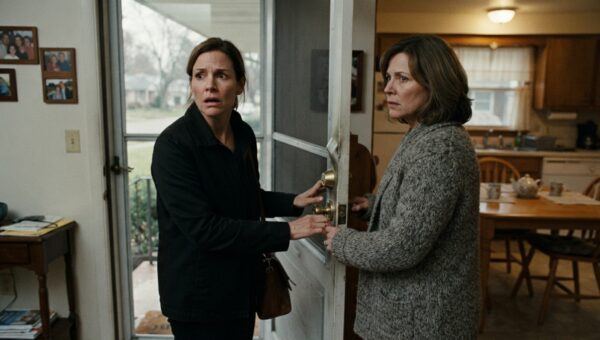
I came home from another woman’s bed at 4:17 in the morning and found a SOLD sign planted in my front yard. My wife was gone. Our baby was gone. And inside the empty nursery, she had left me one bill no billionaire could ever pay.
My name is Daniel Whitman, and that was the moment my perfect life collapsed.
The first thing I noticed was the pickup truck in the driveway. For one stupid second, I thought it belonged to a contractor. Then my headlights swept across the lawn of our Westport, Connecticut, home, and I saw the sign standing beneath the bare maple tree.
SOLD.
My hand froze on the gearshift. “No,” I whispered. “No, no, no.” My phone lit up in the cupholder. Three unread texts from Olivia Bennett. You were amazing tonight. Wish you could’ve stayed. Tell your wife the Chicago client kept you late again. My mouth went dry.
I killed the engine and sat in the dark for a long minute. The silence of the neighborhood felt heavy, almost deliberate, like the world was holding its breath to watch me fail. I got out of the sedan, my dress shoes crunching loudly on the gravel drive, and walked past the real estate sign with its bold red lettering.
The front door unlocked too easily. When I pushed it open, the heavy, familiar scent of lavender and baby powder was gone, replaced by the hollow, echoing smell of empty rooms.
I didn’t turn on the lights. I walked through the living room, my hand sliding along the drywall where family portraits used to hang. The nail holes were empty. The sofa was gone. Even the area rug we bought in Providence had been rolled up and taken away. The whole place felt sterile, stripped down to the studs of my own making.
I climbed the stairs two at a time, my heart hammering against my ribs. Maya’s nursery was at the end of the hall. The door stood wide open. When I stepped inside, the moonlight cut across the bare oak floorboards, illuminating the white crib in the corner. The mattress was entirely bare. There were no fitted sheets with little yellow ducks, no stuffed animals, no mobile turning in the draft.
Resting right in the center of the mattress was a single, heavy sheet of cream-colored stationery. I walked over, my knees feeling strangely weak, and picked it up. My name was written at the top in Claire’s precise, sharp handwriting.
Beneath it was an itemized ledger. It wasn’t a financial invoice. It was a breakdown of every single lie, every fabricated business trip, and every missed milestone over the past six months. October fourteenth: missed Maya’s first rolling over, location listed as a downtown hotel with Olivia. November third: skipped dinner for an alleged board meeting, logged at a lounge in Manhattan. December nineteenth: lied about a flight delay while staying forty blocks from home.
At the bottom, Claire had tallied the total. One thousand, four hundred and twenty hours. That was the exact amount of time I had traded away from my daughter’s infancy for a series of meaningless hotel rooms and convenient lies.
Beneath the tally lay a full packet of divorce papers and a formal custody petition demanding sole legal and physical custody based on habitual abandonment.
My hands started shaking so badly I almost dropped the paper. I pulled out my phone and dialed Claire’s cell phone number. It rang twice before going straight to voicemail. I tried again, my thumb slipping against the glass. Voicemail. I called our family law attorney, Arthur Vance, waking him up at 4:30 in the morning.
Arthur answered on the fourth ring, his voice gravelly and thick with sleep. “Daniel? Do you know what time it is?”
“Claire sold the house,” I blurted out, pacing back and forth across the bare nursery floor. “She’s gone. She took Maya. The house is sold, Arthur. You have to fix this. File an injunction. Do whatever it takes.”
There was a long pause on the other end of the line. I could hear the rustle of bedsheets as Arthur sat up. “Daniel, slow down. What do you mean she sold the house?”
“There’s a SOLD sign in the front yard. The place is completely empty.”
“Well,” Arthur said slowly, his tone shifting from sleepy confusion to professional coldness. “If she used the prenuptial ownership clause, she didn’t need your permission. The Westport property was deeded strictly in her name prior to the marriage as part of her family trust. You signed off on those terms when we drafted the asset protection agreement five years ago, remember?”
“I signed a piece of paper, I didn’t think she’d actually use it!” I shouted into the phone, my voice echoing off the bare walls. “She can’t just pack up my daughter and walk away in the middle of the night.”
“She didn’t walk away, Daniel. She executed a legal separation and a property transfer using a cash buyer trust. My hands are tied if the title is clean. Call me at my office at nine o’clock.” The line went dead.
I stood in the dark nursery for a long time, the paper crinkling in my clenched fist. My phone buzzed again against my leg. Another text from Olivia. Are you still coming over for breakfast tomorrow? We need to talk about next weekend.
I looked down at the screen, staring at the cheerful little notification bubble. For months, I had convinced myself that Olivia was just an escape, a harmless distraction from the endless pressure of corporate acquisitions and domestic routine. Now, looking at the empty crib and the itemized ledger of my daughter’s stolen hours, the contrast was sickening. Olivia didn’t know the first thing about my life. She didn’t even know my daughter’s middle name.
I didn’t text her back. Instead, I dialed her number directly and hit send.
She answered on the first ring, her voice bright and breathless. “Hey, stranger. I thought you fell asleep.”
“Don’t call me that,” I said, my voice dropping flat and cold. “We’re done.”
“What? Daniel, what are you talking about? You were just here two hours ago whispering, “
“I said we’re done, Olivia. Lose my number.” I ended the call before she could answer, powering the phone off entirely and dropping it into my jacket pocket. The silence in the house rushed back in, heavier than before.
I spent the rest of the night sitting on the hardwood floor of the master bedroom, leaning back against the bare wall where our bed used to be. My mind raced through a dozen different scenarios, each one more hopeless than the last. I was a senior executive, a man used to controlling boardrooms, managing multi-million-dollar portfolios, and bending negotiations to my will. Yet here I was, completely outmaneuvered by a woman who had simply watched, waited, and collected her evidence with terrifying patience.
Claire had known about Olivia for months. While I thought I was being clever, slipping away between conference calls and weekend getaways, Claire had been quietly documenting every discrepancy. She didn’t scream when she found out. She didn’t throw plates or demand explanations. She just gathered her facts, secured her legal standing, and waited for the exact right moment to pull the rug out from under me.
By 8:30 in the morning, I was parked outside Arthur Vance’s office building in downtown Hartford. I sat in my sedan for twenty minutes, watching the morning commuters walk past with their coffee cups and briefcases, looking like people who still had normal lives. When the office doors finally unlocked at nine, I walked straight past the receptionist and let myself into Arthur’s private conference room.
Arthur looked up from a stack of folders, adjusting his wire-rimmed glasses. He didn’t look surprised to see me looking haggard and unshaven. “Sit down, Daniel.”
“I want to see my daughter,” I said, leaning both hands on the mahogany table. “I want a court order for visitation by noon today.”
Arthur opened a leather-bound folio and slid a single document across the table toward me. “Claire’s attorney filed for temporary sole custody an hour ago. Given the documentation provided, hotel receipts matching your fabricated travel logs, financial statements, and sworn affidavits from household staff regarding your repeated absences, the judge granted the emergency motion. You have supervised visitation rights every other Saturday, starting next week at a neutral facility in Stamford.”
I stared at the paper. My name was typed neatly at the bottom, alongside the court stamp. “Supervised? I’m her father. I live in that house.”
“You did live in that house,” Arthur corrected gently. “The property sale went through escrow at 3:00 AM via digital wire transfer. The proceeds have been placed into a restricted trust for Maya’s education. You don’t own the roof over your head anymore, Daniel. Claire owns the trust, the equity, and the narrative.”
“There has to be something we can contest,” I muttered, shaking my head. “The preup, the asset division, we can challenge the validity of the transfer.”
“We could,” Arthur said, leaning back in his chair and folding his hands. “And in doing so, we would enter all of Olivia Bennett’s text messages, corporate expense account fraud, and your documented pattern of abandonment into the public record. Your board of directors would have your resignation on their desks by Monday afternoon. You’d lose your position, your reputation, and whatever dignity you have left.”
The office went completely quiet. Through the tall glass windows, I could see traffic moving steadily down the avenue, indifferent to the fact that my entire world had just been dismantled.
I didn’t say anything for a long time. The anger I had walked in with slowly drained away, leaving behind a cold, hollow realization that I had built every single trap I had just fallen into. My wealth hadn’t protected me. My corporate success hadn’t saved me. I had traded the only things that actually mattered for late-night texts and convenient lies, assuming everyone else would just stay put while I played my games.
I reached across the table, picked up the pen sitting next to Arthur’s legal pad, and flipped to the final signature page. My hand didn’t shake this time. It felt steady, heavy, and completely numb.
“Where do I sign?” I asked.
Arthur pointed to the bottom line with the tip of his pen. Right there.
I signed my name, each letter sharp and clear against the white paper. When I finished, I handed the pen back, stood up without another word, and walked out of the office into the bright morning sun.
Now, sitting alone in a quiet, bare apartment with the faint smell of fresh paint on the walls, I don’t look at my phone anymore. It sits on the kitchen counter, dark and silent. I hold a single sheet of cream-colored nursery paper in my hands, tracing the number 1,420 written in Claire’s clean hand. Across the room, a small framed photograph of Maya sits propped up against a stack of cardboard boxes. Her blue eyes look right out at me, bright and entirely unaware of what her father traded away.