Seven hundred and thirty days. That was roughly how long Arthur had been taking over every single trip to the local market, stepping out of our quiet routine with a yellow canvas tote and coming home with neatly bagged produce, always making sure the cash register tapes went straight into the outside trash barrel before I ever had a chance to put the cans away.
I used to think it was just a sweet old-age habit. We had been married forty-one years, and after my mother passed away in that rented hospital bed in our spare room, months of me changing damp sheets and spooning broth past dry lips, my nerves were worn down to wire. Arthur saw the dark circles under my eyes back then. He watched me jump at every creak of the floorboards. So when he started handling the heavy lifting, the canned goods, the pharmacy runs, the milk jugs, I thanked God for him and let him do it.
The landline phone sat on the maple desk in the hallway, right beneath the framed picture of our wedding down in Cairo. It was a sturdy old thing with big black buttons. When it rang at 2:14 in the afternoon, I picked it up without looking at the small plastic caller ID screen.
“Hello,” I said, wiping my flour-dusted hands on my apron.
“Is this the residence of Arthur Vance?” a crisp, efficient woman’s voice asked. “Calling from Miller’s Pharmacy on Main Street. Just following up on the refill notice for Arthur. His memantine is ready for pickup whenever he wants to swing by, but we wanted to make sure since it’s past the usual refill date by three days.”
I stood there in the quiet hallway for a second, my thumb catching on a frayed seam of my apron. “What was that name again?”
“Memantine,” she said, her voice dropping into that polite, automated cadence they teach girls in medical offices. “For the cognitive management. Just let us know if he needs delivery.”
I didn’t say goodbye. I just set the heavy black receiver back on its cradle with a dry, hollow click.
My feet felt clumsy as I walked over to the tall oak bookshelf in the den where we keep the old encyclopedia volumes and the box of tax receipts.
My hands were shaking so badly I dropped the small pocket dictionary twice before I managed to flip the thin pages to the M section. M-e-m-a-n-t-i-n-e. The definition wasn’t even long. It was right there in black and white ink, tucked between melanoma and meningitis. A medication used to slow the progression of moderate to severe dementia.
The weight didn’t drop into my stomach. It settled right on top of my chest, heavy as a wet wool blanket left out in the rain.
Two years. Two whole years of him kissing my forehead before he walked out the front door with his canvas tote, two years of him smiling through his tea in the mornings, two years of him hiding his own mind slipping away behind a wall of canned peas and discount paper towels.
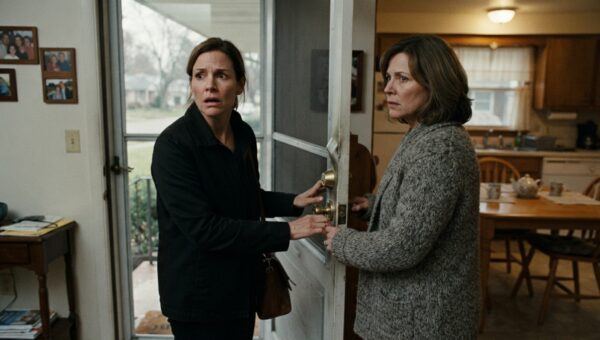
When the latch on the back screen door clicked at 4:10, I was sitting at the kitchen table with the small amber pill bottle in my palm.
I hadn’t gone to the pharmacy. I didn’t need to. I had found his duplicate receipt tucked deep inside the lining of his old canvas bag where he thought I’d never reach. $260. Every single month, paid in cash from a separate savings account we’d opened back when the mill closed down.
Arthur stepped into the kitchen carrying two bulging brown paper sacks, his shoulders slightly rounded under his flannel shirt. He smelled faintly of dry autumn leaves and car exhaust. He set the bags down on the yellow formica counter with a soft thud, right beside the toaster.
When he turned around and saw me sitting there under the hanging copper pans, his eyes didn’t dart toward the door or look for an excuse. They just stopped. He looked at my hand, at the amber plastic cylinder catching the gray light from the window, and the last bit of color seemed to drain right out of his cheeks.
“The girl called from Miller’s,” I heard myself say. My voice sounded thin, like dry paper tearing in the wind. “She said your refill was waiting.”
Arthur didn’t move. His hands stayed flat on the edge of the counter, his knuckles pale and swollen with arthritis. He let out a long, ragged breath that sounded like a tire losing its air on a gravel road.
“I wanted to give you a few more good years before you had to…” he said softly.
He didn’t finish the sentence. He didn’t have to. The rest of those words hung in the warm kitchen air between us, smelling of yeast and old wood, heavy with the memory of my mother’s dying rattle and the months I spent weeping into a basin of cold water. He had carried the whole dark thing inside his own head, walking around our small town, forgetting where he parked the Buick sometimes, sitting alone in Dr. Aris’s examining room, all so I wouldn’t have to look down that long, narrow hallway twice in one lifetime.
I stood up from the wooden chair. The legs scraped against the linoleum, a harsh, ugly sound that made us both flinch.
“You idiot,” I whispered, and my voice cracked right down the middle. “You absolute, stubborn idiot.”
Arthur took one slow step toward me, his boots dragging slightly on the floor. “I couldn’t watch you go through that again, Clara. I couldn’t do it. Every time you looked tired, every time you rubbed your temples after dealing with Mama’s bedpans, I told myself I’d handle the first part alone. Just the first part.”
“It’s not your part,” I said, taking two steps across the kitchen until I was close enough to smell the cheap laundry soap on his collar. “It’s our house. It’s our life. You don’t get to lock yourself in a room and leave me outside knocking on the door.”
He reached out then, his fingers trembling just as much as mine, and touched the side of my face. His palm was warm, calloused from thirty years of handling timber and iron down at the county sheds, but his touch was as light as a moth landing on a screen door.
“It scares me, Clara,” he whispered, and that was the first time in forty-one years I had ever heard real terror in his deep voice. “Some mornings I wake up and I don’t know if the calendar says Tuesday or 1994. I look at the coffee maker and for ten seconds I don’t know what it’s for. I couldn’t bear the look in your eyes if you saw me do that over breakfast.”
“You think watching you disappear in secret is easier?” I asked, pressing my forehead against his chest right beneath his shirt pocket where his heartbeat felt too fast, too thin. “You think sitting here tonight knowing you’ve been carrying this in your pockets for twenty-four months makes me feel rested?”
He let out a shaky sigh that turned into something very close to a sob, though Arthur was a man who hadn’t cried since his own father was lowered into the clay at St. Jude’s. His arms came around my back, awkward at first, then tightening until I could feel the hard buttons of his shirt pressing into my cheek. We stood there by the grocery bags for a long time while the kitchen grew dim and the refrigerator gave its familiar metallic hum in the corner.
When we finally pulled apart, neither of us wiped our eyes. We didn’t need to put on a brave face anymore. The house felt different now, not smaller, exactly, but clearer, like the air after a hard thunderstorm when the dust has finally been knocked out of the sky.
“Show me,” I said quietly, pointing toward the small workshop out back through the glass of the back door. “Show me where you keep the rest of it.”
Arthur nodded once, his chin dipping toward his chest. He didn’t try to hide anything now. He walked over to his old oak roll-top desk in the corner of the den, slid open the narrow bottom drawer that always stuck on the left side, and pulled out a thin, black-ruled composition book with black tape binding the spine.
We sat together at the kitchen table under the single yellow lightbulb. He turned the pages slowly, his thumb smudging a pencil mark here and there. Inside were columns of neat, increasingly shaky handwriting. Dates of appointments with Dr. Aris. Notes on how many times he had lost his keys at the hardware store. A list of expenses, $260 for the pills, $45 for the blood work, small items tallied up with the meticulous care of a man trying to balance a ledger that he knew was going to end in the red.
“You’ve been tracking every bit of it,” I said, running my finger down a column of numbers that ended in October.
“I wanted to keep the house straight,” he said, staring down at the paper. “So you wouldn’t have to guess where the deeds were.”
“We’re going to call Dr. Aris tomorrow morning,” I said, my voice steady now, anchored by something harder and deeper than pity. “We are going to put my name on those forms as your proxy, and we are going to go to the office together. Not because you’re broken, Arthur, but because we’re married. That was the deal we made when Eisenhower was in the White House.”
He looked up at me, a tiny, tired ghost of his old slow grin touching the corners of his mouth. “You always were too bossy for your own good, Clara.”
“Somebody has to be,” I said. “Now help me put these groceries away before the ice cream melts on the counter.”
We stood side by side in the sunlit kitchen, our shoulders brushing against each other as we lifted the cans of soup and the bags of flour out of the brown paper sacks. I reached for a tin of crushed tomatoes, and his hand came down right over mine on the cool metal lid, his fingers settling naturally between mine as we set it down on the shelf together.