The coffee pot had just finished its second cycle when the landline on the kitchen wall let out that sharp, metallic ring that always made my shoulders hitch. I didn’t rush to answer it because Tuesdays were usually quiet, just me and the hum of the refrigerator while I folded laundry from the Monday wash. A man from the dealership called on a Tuesday.
He had a smooth, professional voice that sounded like it belonged in a glass office downtown rather than out here where the gravel roads ate tires for breakfast.
Mrs. Reardon, the minivan’s ready for pickup, he said.
I stood there with a dish towel in my hand, staring out the window at the empty gravel lane where Forrest usually parked his rig on the weekends. We don’t own a minivan. Forrest drives a truck. I said there must be a mistake, figuring he had dialed a wrong digit or pulled the wrong card from a box of service tickets. The man didn’t miss a beat. He rattled off a legal description, a house number, and a street name I had never heard in the thirty-two years I lived in this county. It wasn’t ours.
For sixteen years Forrest drove freight three nights a week. Three nights a week he packed a canvas duffel with fresh socks, kissed my forehead right by the kitchen door, and climbed into the cab of his Peterbilt to haul canned goods and auto parts down toward the state line.
Every single month he handed me an envelope with our household money, always short by a little bit here and there, which he blamed on diesel prices and company insurance hikes. Thirteen hundred dollars a month I never saw. It was sitting somewhere else, paying for something else, while I patched his work shirts at the kitchen table and wondered why we never had enough saved to put a new roof over the back porch.
I didn’t yell at the phone. I just told the man he had the wrong person and hung up the receiver. My hands felt cold, not the kind of cold you get from January wind, but the kind that starts behind your ribs and works its way out to your fingertips. I walked down the narrow hallway toward our bedroom, past the framed photograph of us at the state fair back when his hair still had some red left in it.
I went to his closet and felt along the top shelf behind the stack of heavy wool blankets we only used when the furnace went out in the dead of winter. My fingers brushed against cardboard. A folder. It was a thick manila envelope tied with a red string that hadn’t seen the light of day in a long time. I pulled it down and sat right on the floor with the folder in my lap, leaning my back against the edge of the mattress because my knees suddenly felt like they were made of dry twigs.
The string came loose with a dry snap. Inside was a lease on Birch Street, signed in Forrest’s neat, sloping hand with a date from eight years back. Behind it were two boys’ school pictures, both with his ears, that exact same sharp tilt of the cartilage that my brother always swore came from our side of the family.
A woman named Sherry was listed as the tenant and the wife on a supplemental insurance form clipped to the back. The little one’s birthday was the June we spent at the lake, the summer Forrest said he had to pull double shifts because the warehouse was short-handed on mechanics.
I sat on the floor for a long time, listening to the grandfather clock in the hall tick off the minutes like small stones dropping into a tin bucket. The math wasn’t hard to do. Sixteen years of three nights a week, thirteen hundred dollars tucked away into a separate account, birthdays missed under the excuse of flat tires and bridge tolls. I didn’t cry right then. When you find out your whole life is built on a foundation of hollow wood, you don’t scream; you just check to see if the roof is falling in.
I stood up, brushed the dust off the knees of my slacks, and put the folder right back into my handbag. I didn’t leave it on the bed and I didn’t hide it under the mattress. I walked out to my sedan, turned the key, and let the engine idle until the temperature gauge moved off the peg.
The drive across town took twenty minutes through the old part of the borough where the houses sat close together and the yards were mostly crabgrass and rusted swing sets. Birch Street was narrow, lined with large maples that dropped sticky leaves all over the pavement. Number 114 had a faded blue minivan parked in the gravel drive, the exact vehicle the dealership man had called about an hour earlier. A tricycle with a missing wheel lay on its side near the front steps, and a pair of small muddy boots sat on the welcome mat.
I cut the engine and sat there for a minute, watching the front window of the house. A curtain twitched, and then the front door opened an inch. A boy of about ten years old poked his head out, his hair sticking up in the back the way Forrest’s always did when he first rolled out of bed. He looked down at my car, then walked slowly down the wooden steps, his hands shoved deep into the pockets of his jeans. He stopped right by my driver’s side window and looked up with those familiar hazel eyes.
Are you Daddy’s… he started, then stopped, his small brow furrowing as he tried to find the right word.
I rolled the window down an inch, the rubber seal sticking before it gave way with a small pop.
Are you Daddy’s other friend from work? the boy finished, his voice dropping slightly as if he wasn’t quite sure he was supposed to be talking to strangers at all.
The words sat in the air between us, heavy and small, carrying all the weight of sixteen years of manufactured absences. I looked at his ears, at the curve of his chin, and I knew without asking another question that Forrest hadn’t just been visiting; he had been living two separate lives, dividing himself down the line like a man cutting a deck of cards in half.
I’m not from work, honey, I said, and my voice sounded steadier than I felt inside. Is your mother inside?
The boy pointed a thumb toward the screen door. She’s in the kitchen. She’s baking.
A woman appeared behind him then, wiping her hands on a floral apron that looked like the one I had thrown out three summers ago when the hem frayed. She had light brown hair pulled back with a clip and a look on her face that was half-curious, half-defensive, the look of someone who spent her life waiting for the other shoe to drop. She pushed the screen door open and stepped onto the porch, her eyes moving from my face to the car and back again.
Can I help you with something? she asked, and her tone wasn’t mean, just tired, the kind of tired that comes from raising two boys on a tight budget while a man is supposedly hauling freight across three states.
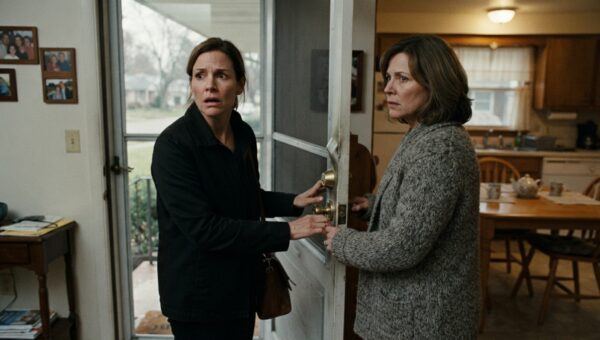
I stepped out of the car, my bag clutched under my arm like a shield. My name is Martha Reardon, I said, and the silence that followed was so complete I could hear a blue jay screaming in the maple tree overhead.
Sherry didn’t flinch right away. She just stared at me for three long seconds while the color slowly drained out from under her skin until she looked like parchment left out in the sun. She reached out and grabbed the edge of the porch railing, her knuckles turning white as porcelain.
You’re Forrest’s wife, she whispered. The real one.
He told you he was divorced sixteen years ago, didn’t he? I asked, and I didn’t need her to answer because I could read the whole story in the way her jaw dropped. He told you the paperwork was held up in the county seat. He told you he had to sleep in the cab twice a week because the runs were long and the pay was steady.
Sherry let go of the railing and stepped back against the screen door, her eyes filling with hot, sudden tears that she didn’t bother to wipe away. He said his first wife was a bitter woman who stayed out in the country, she said, her voice shaking so hard the words barely came out straight. He said she didn’t want any children and that he stayed with her only because of the property lines.
He didn’t stay with me because of property lines, I said, and for the first time my own voice cracked just a little bit. He stayed because it was convenient. Because I kept the house clean and never asked why his duffel bag smelled like fabric softener I never bought.
I pulled the manila folder out of my bag and laid it on the hood of my car right there in the gravel drive. I didn’t yell. I didn’t curse her or the boys watching from the dark of the hallway. I showed her the marriage certificate from the courthouse in Madison, dated thirty-two years back, and the tax returns with both our names signed in the corner. Sherry looked down at the papers, her breath coming in short, ragged gasps, and then she covered her face with her apron.
He told me he bought this house for us so we’d have a future, she sobbed into the cotton fabric. He said he was putting away thirteen hundred every month for the boys’ schooling.
That thirteen hundred was our grocery money, Sherry, I told her quietly. That was the roof over my head in the township.
We stayed out there on that gravel drive for twenty minutes, two women comparing notes on a man who didn’t deserve either of us. When I got back into my car, my hands didn’t shake anymore. The numbness was gone, replaced by something cold and hard that felt almost like strength.
The sun was dropping low behind the ridge by the time I pulled back into our own lane. Forrest’s semi was parked by the barn, the big diesel engine ticking as it cooled down in the evening air. The back door of the house was unlocked, just the way he always left it when he came off a long run, expecting a hot plate of pork chops and a clean kitchen waiting for him.
I walked inside and set the manila folder right in the middle of the laminate kitchen table, right next to the salt shaker and the napkin holder. The house smelled like stale coffee and old floor wax, the same smell it had had for ten years.
Forrest walked through the back door a minute later, carrying his canvas duffel over one shoulder and wiping his forehead with a grease-stained rag. He looked tired, the gray at his temples looking deeper than it had on Sunday night when he packed his things.
Hey, Marty, he said, tossing his keys onto the counter with a familiar metal clatter. Long run down through the valley. Traffic was backed up all the way past the bypass.
He stopped talking when he saw the folder sitting there by the salt shaker. His eyes dropped to the red string, then moved up to my face. He didn’t move his feet. He just stood there by the refrigerator with his duffel bag still slung over one shoulder like he was ready to turn around and run right back out to the truck.
What’s that? he asked, and his voice dropped an octave, losing that easy, rumbling tone he used when he wanted to smooth things over.
I sat down at the table and poured myself a cup of lukewarm water from the pitcher. I went to Birch Street today, Forrest. I talked to Sherry. I saw the boys.
Forrest didn’t yell. He didn’t try to make up a story about a brother or a cousin or a misunderstanding. He just let the duffel bag slide off his shoulder onto the linoleum with a heavy thud that rattled the baseboards. He pulled out the chair across from me and sat down very slowly, looking like a man who had finally run out of road.
How much did she tell you? he asked, and his voice was flat, almost small.
She told me about the minivan, I said. And she told me about the sixteen years you spent splitting yourself between two different kitchens.
He rubbed his face with both hands, his palms coming away gray with road dust. Marty, I meant to fix it. I just… things got complicated down the line and then the boys came along and I couldn’t just walk away from them either.
You walked away from our life every time you lied about where you were sleeping, Forrest, I said. You didn’t split your life; you stole mine to pay for theirs.
He tried to reach across the table, his fingers twitching toward my hand the way they used to do when we were young and first starting out in that little rental down by the creek. I pulled my hand back and laid it flat on the wood.
Don’t, I said.
The divorce papers were drawn up by Thursday morning through a lawyer down at the county seat who didn’t waste time with small talk. Forrest didn’t contest the house or the truck or the accounts; he signed what was put in front of him without looking up once, and by Friday afternoon his rig was gone from the lane for good. Sherry didn’t call me, and I didn’t call her, but I heard through the township clerk that she had packed up the blue minivan and taken the boys back up north to her sister’s place near the lake.
The house is quiet now, almost too quiet sometimes when the wind comes up off the fields and rattles the loose tin on the machine shed. But it’s my house. Every square foot of it belongs to me and the life I actually lived, not the one that was kept in a folder on the top shelf.
Today the sun came through the kitchen window just right, catching the edge of the clean glass and warming the wood where the old salt shaker used to sit. I sat at my kitchen table with a hot cup of coffee, looking out at a clean, quiet driveway free of Forrest’s truck and all those years of deceit, and for the first time in sixteen years, the morning felt entirely my own.