Fourteen years. That is how long I carried the weight of being a mother who started before she even knew who she was. I was fifteen when Jolene was born. My own mother cried for three days straight, and then she helped me buy a crib with money she saved from cleaning motel rooms. I dropped out of high school, earned my GED at night while Jolene slept in a basket beside my chair, and eventually put myself through community college to get a dental hygiene license.
I did it all by myself. I built a life out of drywall dust, cheap coffee, and pure stubbornness.
By the time Jolene hit ten, I had married Mark. Mark is a good man, a machinist down at the rail yards who loved me and took my past without flinching. We bought a small brick house with a patch of green grass in the back, and we raised his two kids from his first marriage alongside Jolene. We had family dinners. We went camping in the mountains. I thought, foolishly, that the passage of time would smooth out the rough edges of my youth. I thought if I just loved Jolene hard enough, the venom her biological father poured into her ears every other weekend would eventually wash away.
I was wrong about that. Derek never forgave me for leaving him when Jolene was a baby, and he spent every single weekend of her life turning her into a weapon.
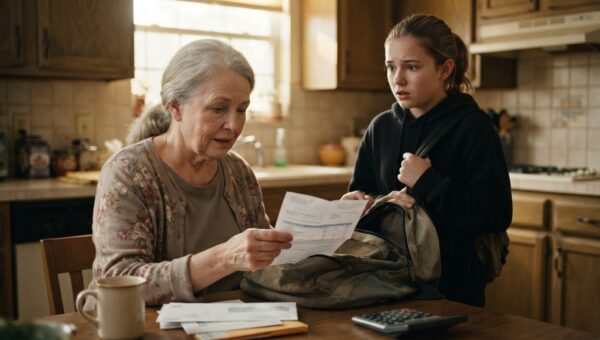
Every year without fail, a caseworker from child services would show up at my front door because Derek filed another anonymous report claiming neglect, malnourishment, or abuse. Every year, I handed over tax records, medical charts, and school report cards to prove my home was safe. Every year, I spent thousands of dollars on family court lawyers just to keep my name clean. Mark never complained about the legal bills, but I could see the strain in the lines around his eyes when the mail carrier brought yet another court summons.
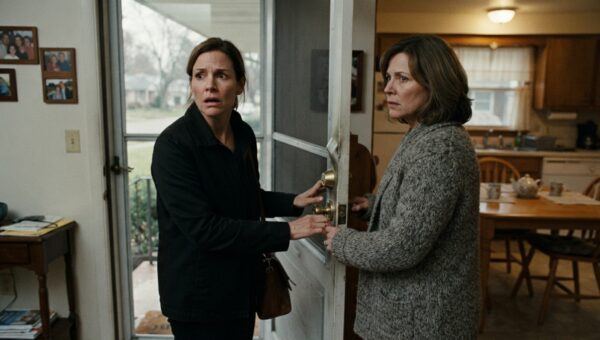
The turning point did not happen in a courtroom. It happened on a rainy Tuesday afternoon in October when a state investigator walked into my kitchen unannounced.
“Mrs. Callahan,” the woman said, holding a clipboard against her chest. “We received an urgent report from Jolene’s school counselor. She stated that you left her locked inside the house alone for three days while you went on a weekend vacation with your husband.”
I was standing right by the stove stirring a pot of soup. Mark was at the plant. My stepkids were at track practice. I stared at the woman, and for a second, my brain just stopped working.
“A vacation?” I said, my voice barely above a whisper. “I have not left this house since Sunday morning. I was sitting right at that kitchen table doing my quarterly bookkeeping yesterday.”
“Jolene told her teacher you packed your bags on Friday and told her you were going to the coast,” the investigator replied, her pen poised over the paper. “She said she had to eat dry cereal for breakfast because there was no food in the pantry.”
I did not scream. I did not cry. I walked slowly into the hallway and pointed up at the small white dome mounted in the corner of the ceiling.
“Look at that camera,” I told the investigator, my hand shaking so hard I could barely point. “Pull up the app on your phone right now.
I will give you the login. Watch the footage from Friday, Saturday, Sunday, and this morning. You will see me walking through every room in this house every single hour of the day.”
That video saved me from an immediate arrest for child neglect. The timestamped HD footage clearly showed me folding laundry in the living room, cooking dinner at the stove, and helping my stepson with his algebra at the exact times Jolene claimed I was three hundred miles away at the beach. The caseworker closed the file within two hours, but as she packed her papers into her briefcase, she looked at me with genuine pity.
“Mrs. Callahan,” she said quietly before walking out the front door. “If she escalates these allegations to the local police department instead of the school, video logs might not be enough to stop an automatic arrest procedure. You need to talk to a family attorney today.”
I called Marcus Vance by 2:00 that afternoon. Marcus had represented me through three different custody modifications over the years, and he always tried to find a middle ground. This time, there was no middle ground left. We sat in his cramped office on Main Street while he slid a thick manila folder across the laminate tabletop.
“Derek is not trying to win custody anymore,” Marcus said, tapping his pen against the yellow legal pad. “He knows Jolene is fourteen now, and a judge will listen to her preferences. What he is doing is building a criminal record against you. Every false report is a brick in a wall. Eventually, one of these lies is going to stick, and when it does, you are looking at felony child endangerment charges. Your license, your marriage, your home, it will all be gone.”
“She is my daughter,” I said, and the words tasted like iron in my mouth. “I raised her when I had nothing. I slept on a cot in a studio apartment with her sleeping on my chest.”
“She is legally fourteen,” Marcus answered gently, and the harshness of his tone cut right through my denial. “And right now, she is an instrument being used to dismantle your life. You cannot protect someone who is actively trying to pull you into an open grave. You have to cut the rope.”
I went home to an empty house that afternoon. The silence felt heavy, pressing down on my chest until I could barely draw a breath. Mark was still at work, and the kids were at their grandmother’s house for the evening. I walked from room to room, looking at the family photographs hanging on the walls. There were pictures of Jolene at her eighth-grade graduation, smiling that tight, guarded smile Derek taught her to wear whenever she was around me. I remembered the last time I told her I loved her before she packed her bags to go to her father’s house for the weekend. She had not even looked up from her phone.
“Whatever,” she had muttered under her breath, her eyes fixed on the screen. “Just leave me alone.”
The final conference took place in the neutral mediation room at the county courthouse on a cold Thursday morning in November. Derek sat across the table with his high-priced attorney, wearing that familiar, smug look of a man who thought he had finally cornered a rat. Jolene sat beside him, her arms crossed over her chest, refusing to make eye contact with me.
“My client is prepared to drop all pending family court motions,” Derek’s lawyer said, sliding a document across the polished oak surface. “Provided my daughter’s mother signs an immediate and permanent relinquishment of all parental rights and custody claims. No visitation, no contact, no future obligations.”
Derek leaned back in his chair, smiling openly now. He thought he had broken me. He thought the word “surrender” would destroy my soul. He did not understand that when you have spent fourteen years fighting for your life against a ghost with a megaphone, letting go is not a defeat. It is the only way to breathe.
I looked across the table at Jolene. She looked smaller than fourteen in that oversized gray hoodie, her shoulders hunched the exact way Derek’s used to when he was trying to pick a fight. For a fraction of a second, I wanted to reach across the table and shake her, to ask her when she decided to become her father’s shadow. But then I thought about Mark. I thought about my stepkids coming home to a house with police cruisers in the driveway. I thought about the security cameras humming quietly in every corner of my home, recording our lives like we were inmates in our own sanctuary.
I picked up the heavy black pen resting beside the paperwork. My hand did not even shake.
“Where do I sign?” I asked.
The lawyer blinked, clearly surprised that I did not put up a fight. He pointed a manicured finger to the bottom line of the third page. I signed my maiden name first, then my married name, pressing down hard enough to tear the thin paper slightly at the edge. I slid the folder back across the table, stood up straight, and looked down at Derek one last time.
“She’s all yours,” I said.
Derek opened his mouth to say something clever, but the words died in his throat when he saw the look on my face. There was no rage left in me. There was only a cold, vast emptiness that felt remarkably like peace.
That evening, I drove home alone while the autumn sun sank below the tree line in a streak of bruised purple and gray. Mark was waiting for me on the front porch, holding two mugs of hot coffee. He did not ask how it went. He just wrapped his arms around me and held me tighter than he had in ten years of marriage.
We walked inside together into the quiet warmth of the house. I set my keys down on the entryway table, walked over to the corner of the living room, and reached up to the white dome on the ceiling. With a gentle twist, I unclipped the indoor security camera from its magnetic mount. I pulled the small power cord from the wall outlet and coiled it neatly in my hand, setting the whole apparatus down on the wooden floorboards.
I walked into the kitchen, poured myself a fresh cup of coffee, and sat down at the table where I had survived fourteen years of invisible wars. For the first time since I was a teenager, the house was entirely quiet. I took a deep, slow breath, listening to the hum of the refrigerator and the steady ticking of the clock on the wall, knowing that the battle was finally over.