The gravel out by our back gate has this dry, rattle-trap sound whenever a heavy pickup rolls over it, like loose teeth in a tin cup. I heard that sound for twelve straight years while Arthur was wasting away in the front bedroom, coughing into linen rags that I bleached twice a week until my knuckles stayed red through Sunday supper.
I am Loretta, and if you had asked me back when Arthur first took to his mattress what I was doing, I would have told you I was being a good wife. I would have told you that marriage means staying through the dry rot and the damp winters.
Arthur died on a Tuesday morning in October, quietly enough that the hospice nurse didn’t even drop her clipboard when she called time. He left me the ranch house on Route 4, four acres of dry scrub, and a ledger full of overdue utility notices that looked like shorthand for ruin. His son Toby, who we had raised since he was six years old like he was dropped from my own ribs, didn’t shed a tear at the gravesite. Toby was eighteen then, wearing a suit Arthur bought him with my grocery money, and he spent the entire service checking his phone for text messages from his buddies in town.
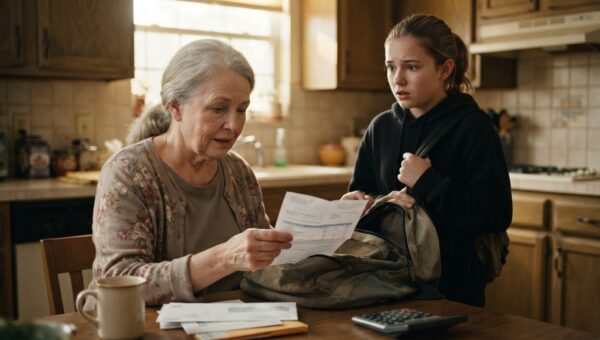
By the second week of November, the pantry was so empty I was eating saltines and tap water for lunch just to keep the electricity humming. I figured Toby needed a reality check now that his father was gone, so I caught him by the kitchen sink while he was rinsing out an energy drink can. I had the electric bill right there in my hand, showing a balance of $892.40 that had been sitting in red ink for two months.
“Toby,” I said, keeping my voice down because my nerves were already frayed like old twine. “We have to talk about how we are keeping the lights on. I need you to pitch in $5,500 for your share of the back property taxes and the propane refill. I can’t carry this alone anymore.”
Toby didn’t even turn around from the faucet. He just shook the aluminum can, let out a dry, barking laugh that bounced off the tile, and looked at me over his shoulder with eyes so cold they didn’t look human.
“You’re childless. I’m your retirement plan-it’s your job to support me,” he said.
Those words didn’t make me angry right away. They just sat there in the warm kitchen air, heavy as a sack of wet feed, while the refrigerator hummed its steady, maddening drone. For years I had rubbed Arthur’s aching back, sold my mother’s silver brooch to pay for his oxygen tanks, and told myself we were a family pulling through the hard stretch. Hearing Toby say those exact words made something inside my chest snap, clean and final like a dry pine bough under a boot heel. I didn’t yell. I didn’t even argue. I just walked past him out the back door, got the spare set of deadbolt keys from the shed, and spent the next hour swapping out every lock on the ranch house while he was out parking his truck down by the creek.
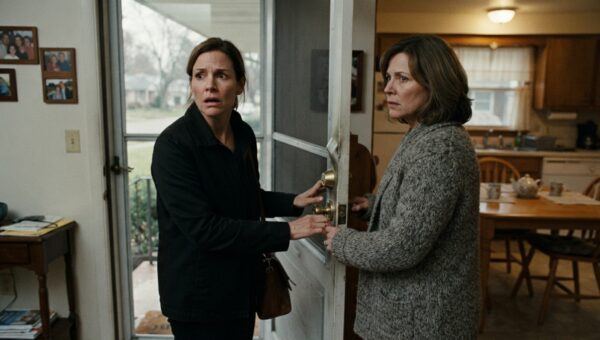
When Toby came banging on the front door around five o’clock shouting about his missing keys, I told him through the oak paneling that he had until sundown to clear his truck out of the drive or I was calling the county constable. He swore at me through the wood, his voice cracking with ugly teenage rage, before his truck tires tore up the gravel and he went roaring down toward the highway.
It was already pitch black outside when I finally dragged myself down the narrow hallway to clear out his bedroom. I wanted every trace of him gone before I went to sleep, every sneaker and soda bottle out of my sight. The room smelled like stale laundry and cheap cherry body spray. I yanked the striped comforter off the twin mattress and shoved my hand under the frame to check for hidden trash, and my fingers hooked into something heavy and canvas.
The black duffel bag was wedged right up against the wooden bed slat, stuffed so tight it barely budged. My name, Loretta, was written across the front flap in thick, permanent black marker, the letters hurried and jagged like someone writing in the dark. My stomach tightened into a hard, cold knot the second I unzipped it. Because inside wasn’t clothes or junk, it was a heavy stack of bank envelopes, legal folders, and rubber-banded bricks of hundred-dollar bills that smelled faintly of a bank vault.
I sat right down on the dusty carpet with the zipper pull still in my hand, staring into that black mouth like I was looking down an abandoned well. I pulled out the first envelope. It was a withdrawal slip from the First National Bank in town, dated six months before Arthur died, showing a cash pull of $12,000 from our joint savings account. The signature at the bottom wasn’t mine, though someone had made a sloppy, trembling attempt to copy my loop-de-loops. Below that was a receipt for a custom hunting rifle, and another for a set of high-end truck rims, all paid for in crisp twenties and fifties.
As I dug deeper into the bag, my fingers brushed against a stiff leather folder bearing the seal of a local notary public. I opened it under the harsh light of Toby’s bare ceiling bulb and found a draft quitclaim deed, dated just after Arthur’s diagnosis, designed to sign the entire four-acre homestead and the house over to Toby the day he turned eighteen. My signature on it was a total forgery, shaky and thin, traced over a light box by the look of it. Page after page of bank statements tumbled out onto the floor, proving that over the last twenty-four months of his illness, Arthur and his precious son had systematically drained $120,000 out of the reserves I had built up from my inheritance before we even married.
The house wasn’t left to me out of love or mercy. It was just an empty shell they hadn’t finished carving the meat out of yet. Toby had kept $45,000 in cash hidden under his bed because he was too arrogant to deposit it all at once, figuring his soft-headed stepmother would never look twice under his mattress. He thought he had me cornered, reduced to a unpaid nurse maid living in a house that legally belonged to him on paper.
I didn’t sleep that night. I sat at the kitchen table with the black bag between my feet, drinking black coffee until my heart felt like a trapped bird beating against my ribs. By 7:30 in the morning, I had every single document sorted into neat piles on the oilcloth. I packed the bag into the trunk of my sedan, locked the front door behind me with a steady hand, and drove straight down to the offices of Miller and Vance, the estate attorneys whose shingle hung over the brick building by the courthouse.
Mr. Vance was an old man with yellowed fingers and spectacles that slipped down his nose every time he looked over a ledger. He didn’t say a word while I laid the cash bundles and the forged quitclaim deed across his walnut desk. He just put on his reading glasses, pulled a magnifying glass from his vest pocket, and spent twenty minutes studying the ink patterns and the notary seal.
“Mrs. Hayes,” he finally said, leaning back in his leather chair and letting out a long, wheezing sigh. “This notary stamp was canceled three years ago when the man retired to Florida. And this signature isn’t yours by a long shot. Arthur was many things, but committing forgery to cheat his own wife out of her homestead is a federal matter if we want to push it.”
“I don’t want to put him in prison,” I told him, my voice sounding flat and distant even to my own ears. “I just want my name clear, my house unencumbered, and that boy off my property forever.”
Mr. Vance nodded slowly, pulling a fresh pad of yellow legal paper toward him. “Then we let him walk into his own trap. He thinks he holds the winning hand because of these papers. Let’s see what he does when he finds out the house was never legally his to take.”
It was nearly two o’clock by the time I drove back up the gravel lane. As I killed the engine, I saw Toby’s red truck idling near the cattle guard, with the local sheriff’s deputy, young Deputy Miller, sitting in the cruiser right behind him. Toby jumped out of his truck before I could even get my purse off the passenger seat, his face flushed red and his chest puffed out like a banty rooster. He stalked across the dirt, slamming his hand down on my car hood.
“You’re done, you old witch!” Toby screamed, his voice cracking with ugly triumph. “Open this gate right now or I’ll have the deputy haul you off in cuffs for stealing my property! That house is mine under the law!”
Deputy Miller climbed slowly out of his patrol car, looking uncomfortable as he adjusted his duty belt and walked over. “Morning, Loretta,” he said, tipping his hat. “Toby here tells me you’ve locked him out of his lawful residence and stolen personal belongings out of his room. He’s got paperwork saying he owns this land.”
I didn’t rush. I opened my car door, swung my legs out onto the gravel, and reached into the back seat to pull out the heavy manila envelope Mr. Vance had prepared for me. I handed it right past Toby to the deputy.
“Read page four, Bobby,” I said softly, looking straight at the boy who had sat at my kitchen table for twelve years. “Read what your father and you signed away before the ink even dried on the hospital discharge papers.”
Deputy Miller flipped open the legal packet, his eyes scanning the certified letter from Miller and Vance attesting to the forged notary seal and the invalid deed transfer. He looked up at Toby, then over at me, and his expression hardened visibly.
“Toby,” the deputy said, his voice dropping an octave. “This deed is a fake. Mr. Vance has already filed an injunction down at the courthouse. If you step foot on this property again without a judge’s direct order, I’m arresting you for trespassing and attempted property fraud.”
Toby’s face went slack, the color draining right out of his cheeks until he looked like curdled milk. He looked from the deputy to me, his mouth opening and closing like a landed bass. “He said… my dad said it was all set up,” he stammered, all that arrogant swagger evaporating into the dry afternoon air. “He said she didn’t need it.”
“Your father is gone, and you are eighteen,” I said, stepping past him toward the front porch. “Go find someone else to be your retirement plan.”
I walked inside, bolted the heavy oak door behind me, and listened to the gravel crunching under his truck tires as he finally turned around and sped down the lane for good. The house was quiet. The sun was dipping low behind the western hills, painting the kitchen wall in long, amber slashes of light. I walked over to the corner where the heavy metal lockbox sat on the bottom shelf of the pantry, the key cold and heavy in my apron pocket.
I opened the lid, took the stamped and paid property tax receipt I had just picked up from the county clerk, and slid it neatly inside right next to the clean, unencumbered deed bearing only my name. I clicked the metal lid shut, turned the key until it caught, and left it sitting there in the quiet room.