The cedar mulch out behind the loading dock always smelled the same after a summer rain, heavy and rotting down at the bottom of the pile where the water settled into the gravel. I stood by the side door of the store with a clipboard in my hand, looking down at an application that had been sitting on the breakroom table since Tuesday morning.
His name was Barry. He was twenty-six years old, and the little square box where he had to check whether he had ever been convicted of a felony had a messy checkmark beside the word yes. Most folks in our town threw those papers straight into the wire trash basket by the register. I didn’t. I looked at the small black-and-white photocopy of his driver license stapled to the corner, and my chest seized up so hard I had to lean my shoulder against the doorframe.
Fifteen years ago, our boy Barry was eleven when the lake took him. The sheriff’s department spent three days dragging the north cove before they found him tangled in the old sunken dock pilings where the water stayed cold even in July. After that, the house went completely silent. Elena stopped baking on Sundays. She packed up his red Schwinn bicycle and his box of plastic dinosaurs without shedding a single public tear, sealing them away in two heavy cardboard cartons up in the attic crawlspace like she was burying evidence.
We never had another child. The doctors told us the grief had closed doors inside us that wouldn’t ever open back up, and after a while, we just stopped talking about it altogether. We just ran the hardware store, kept our heads down, and grew old around the edges.
So when that young man walked into the shop on a Wednesday afternoon asking about the night janitor opening, I could not breathe. He had the exact same stubborn set to his jaw. He had the same crooked way of biting his lower lip when he was trying to figure out a measurement on a tape measure. When I called him back for an interview, Elena took one look at him across the counter and her face turned the color of skim milk. She dropped a box of price tags onto the linoleum and walked right into the back office without saying a single word.
“I know my record looks rough, Mr. Miller,” he said, standing there with his hands shoved deep into the pockets of a faded canvas jacket. “I made some stupid mistakes when I was nineteen, living down in Grand Rapids with folks who weren’t looking out for me. But I can clean floors. I can fix your broken shelving units. I just need a clean break.”
“You start Monday,” I told him, my voice sounding hollow in my own ears.
Elena fought me every single evening after the store closed. We would sit at the laminate kitchen table with our cold coffee, the house so quiet you could hear the refrigerator hum clear down the hall, and she would tear into me with a quiet, shaking fury.
“You are inviting a criminal under our roof,” she whispered across the table, her fingernails digging deep into the oilcloth cover. “You do not know what kind of blood runs in that boy.
Get rid of him, Tom. Call him tomorrow and tell him the position is filled.”
“No,” I said, and for the first time in fifteen years, I didn’t back down. “He works hard, Elena. He stays late to sweep the back aisles. Let him be.”
He stayed late every night. Within three months, he wasn’t just emptying trash cans; he was rebuilding our old inventory tracking system, staying on his own time to show me how the computer spreadsheets worked. He felt like a ghost walking around the store in daylight, moving among the boxes of galvanized nails and PVC pipes, but a good ghost. A warm one. I found myself lingering after closing just to talk to him about how he wired a three-way switch or what kind of oil he used on his truck.
Then came last Tuesday. We were sitting at the kitchen table eating pot roast. Young Barry had finished his shift early and dropped off the weekly invoice folder by the back door, and I had asked him to stay for a plate. He sat across from us, quiet and polite, cutting his meat with the small silver fork we used to use for family holidays when our other Barry was still small enough to sit in a booster seat.
The air in the kitchen was thick. Elena hadn’t said three words since we sat down, her fork scraping against her stoneware plate with a high, thin screech that made my teeth ache. I reached for the water pitcher.
“The boy does good work,” I said, trying to clear the heavy silence. “He reminds me of, “
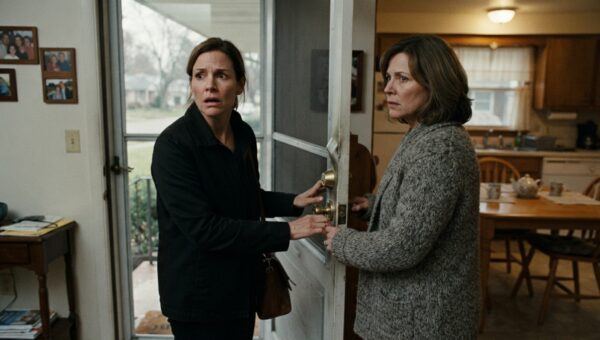
Elena’s chair hit the hardwood floor with a sharp crack that made the water glasses rattle. She stood straight up, her hands flat on the table, her knuckles stark white against the grain of the wood. Her chest was heaving like she had just run up a steep hill in the dead of winter.
“Don’t you say it,” she choked out, her voice shaking so hard the water in my glass trembled. “Don’t you dare finish that sentence.”
“Elena, what is wrong with you?” I set the pitcher down, the glass bottom clicking hard against the wood.
She turned her wild, terrified eyes from me to young Barry, who had frozen with his fork halfway to his mouth, his face going completely blank.
“Tell him!” she screamed, her voice cracking into something ugly and high-pitched. “Tell him what you did to his real son!”
The kitchen went dead silent. The refrigerator hum seemed to fill the whole house, loud and grinding. Young Barry slowly lowered his fork to the plate, his fingers trembling just a little bit against the handle.
“My what?” he asked, looking from Elena to me. “What is she talking about, Mr. Miller?”
“Nothing,” I said, standing up and reaching for her arm. “She’s not well. Elena, go upstairs right now.”
“Don’t touch me!” she yelled, jerking away from my hand like I was burning her. She looked down at young Barry, tears finally spilling over her eyelids, cutting tracks through the powder on her cheeks. “Twenty-six years ago. Before we lost our boy. You had a girl down in Lansing. You left her, and you left that baby in a basket on a stranger’s porch while I was visiting my mother.”
The room tilted. My knees felt weak, like someone had kicked the props out from under the floorboards.
“That’s a lie,” I whispered. “I was never in Lansing back then. We weren’t even, we hadn’t had that rough patch until after we moved here.”
“You were gone for four months!” she shouted, her voice breaking into a sob as she backed away toward the hallway. “You went away to work the construction job, and you came back wearing a different ring, and I found the letters in your truck. But that wasn’t the worst of it. When our Barry died, when God took him away from us because of the sin in this house, I found out where that boy from Lansing had ended up. I paid a lawyer to keep him buried in the system so you would never find him. I kept him away from you on purpose.”
She turned and ran down the dark hallway, the heavy bedroom door slamming shut a second later with a hollow thud that shook the framed pictures on the wall.
Young Barry didn’t move. He sat there under the overhead kitchen light, his head bowed, staring down at his plate like he was looking at the bottom of a deep well.
“Is that true?” he asked very quietly. He didn’t sound angry. He just sounded tired, like a man who had walked ten miles too far in the dark.
“I don’t know,” I said, and for the first time in my life, I meant it. My mind was spinning back through decades, trying to find a door I had locked and thrown away the key to. “I honestly don’t know, son.”
“Don’t call me that yet,” he said, standing up from the table without touching his napkin. He didn’t look at me as he walked toward the back door. “Just… don’t call me that until you find out.”
The door clicked shut behind him. I sat alone at the table for a long time, listening to the clock on the wall tick off the seconds in the empty room.
When I finally got up, I didn’t go down the hall to Elena’s room. I went straight to her mahogany vanity by the window. I knew where she kept the things she thought nobody else could reach. At the very bottom of the cedar-lined drawer, tucked beneath old winter scarves and baptismal napkins from thirty years ago, sat a small metal lockbox with a brass key hanging right off its handle on a piece of yellow yarn.
I didn’t hesitate. I turned the key.
Inside lay a hospital discharge paper from St. Lawrence Mercy in Lansing, dated November fourteenth, twenty-six years ago. Beside it was an original birth certificate with my own signature scrawled across the father line in blue ink I hadn’t used since I worked the highway department. There were adoption agency letters, receipts for fees paid in cash, and a court order from when he was twelve years old, placing him into the state foster care network after the people who took him in decided they couldn’t handle his temper.
My handwriting. My name. My blood.
The next morning, the store was closed. I didn’t unlock the front doors at eight o’clock like I had every single day for thirty years. I sat on a stool behind the counter with the metal box open between the display racks of brass screws and plumbing tape, waiting.
At 8:14, the gravel out by the back gate made that dry, rattle-trap sound of an old truck engine cutting out.
Young Barry walked in through the side door, carrying a cardboard box of ledger books he had taken home the night before. He stopped by the counter, looking down at the papers spread out across the laminate. He didn’t say anything for a long time.
“You found it,” he finally said.
“I found it,” I told him, my throat so tight I could barely get the words out. I stood up from the stool, looking at the way his shoulders sat against the dim light coming through the front window. “I swear to God, Barry, I never knew. If I had known, “
“I know,” he said softly, looking down at the hospital paper with my name on it. He reached out one calloused finger and touched the corner of the birth certificate. “I spent ten years in group homes wondering who threw me away. Then I saw your name on the store license online when I got out of Jackson. I just wanted to see what kind of man you were.”
“I’m sorry,” I said, and the words felt small and useless against everything that had broken between us. “I am so sorry.”
He looked up then, and for a second, I wasn’t looking at an employee or a stranger from the county records. I was looking at the boy we buried in the north cemetery, grown up into a hard, weathered man who had fought his way back home through the dirt.
“Well,” he said, clearing his throat and shifting the box in his arms. “The morning delivery truck is waiting outside. You want me to help you unload the lumber, or are we going to stand here all day?”
We went out to the loading dock together. The sun was coming up over the ridge behind the town, turning the pine trees gold against the pale Michigan sky. We didn’t talk about Elena, and we didn’t talk about the fifteen years of silence that sat between us like a wall of old stone. We just worked side by side, lifting heavy timbers off the flatbed trailer, one board at a time, until the truck was empty and the store was ready for the day.
Later that afternoon, after Elena had packed her bags and gone to stay with her sister down in Coldwater, young Barry and I climbed up the old wooden A-frame ladder outside the front entrance with a tin of black paint and a stiff bristle brush. We worked in silence until the sun started to dip behind the hardware store roof, painting over the faded white letters on the wooden sign above the door until the old name was gone. Then, with his steady hand guiding mine, we painted a new line right beneath the old one, clean and sharp in the evening light.