Mama had her hair done every Friday at nine o’clock for thirty years, same chair, same girl. Mama passed last June. I kept meaning to call the salon, but I kept not doing it. A year it took me.
Yesterday I finally walked in to cancel the standing appointment, and the shop went quiet the way church does. The bell above the glass door gave that familiar little high-pitched chime I had heard thousands of times since I was a kid tagging along in my sneakers.
The smell hasn’t changed in three decades. It is always a thick mix of Aqua Net hairspray, warm perm solution, and cheap coffee grounds bubbling in the back room.
Renee came around the chair and held both my hands. She didn’t say anything for a second, and honestly that felt worse than words. Her fingers were dry and warm, smelling faintly of lavender hand lotion.
“We never gave away her slot,” she said. “Fridays at nine, we just… let the chair be.”
Then she went to the drawer at her station and took out an envelope, soft from being moved and saved and moved again. It was a plain manila envelope, the corners bent down from living at the bottom of a supply tray under clips and combs. “She left this with me two summers ago. She said, give it to my girl when she comes.”
It said my name right across the front in Mama’s careful, slanted cursive.
My chest tightened up so hard I thought I might actually fall right there on the linoleum floor. I haven’t been sleeping well since the funeral anyway, and my brain kind of stopped working for a second.
“Two summers ago?” I asked. My voice sounded thin, like it belonged to somebody else standing across the room.
“She knew before the doctors told her straight,” Renee said softly, her thumb rubbing the back of my hand. “Helen was stubborn like that. She didn’t want you worrying yourself sick while she was still breathing, so she just tucked this in with me and made me promise on my mother’s grave I wouldn’t hand it over until you walked through that door on your own.”
I didn’t open it right there in front of the morning regulars who had all gone quiet under their plastic capes. I thanked Renee, told her I would settle the account later in the week, and walked straight out to my car.
I sat in the driver’s seat of my Civic with the engine idling and the air conditioning rattling against the dashboard.
The envelope felt too heavy for paper. When I slid my thumb under the glued flap, it tore crooked. Inside was a single folded sheet of lined yellow legal paper and a stiff blue bank document with raised foil sealing on the corner.
I unfolded the letter first. Mama’s handwriting always slanted uphill toward the right margin whenever she was trying to rush or keep her emotions pinned down.
“My dearest Clara,” it began. “If you are reading this, Renee finally did what I told her to do, and I am somewhere else. I know you spent the last four years canceling your little painting trips to stay home and make my soup and check my blood pressure twice a day. You thought I didn’t notice you sliding your sketchbooks under the sofa cushion every time I walked into the parlor.
I saw them, honey. I saw how tired you looked trying to keep my old house standing while your own life sat in storage.”
My throat felt like it was full of gravel. I had to look up through the windshield at a delivery truck backing into the curb across the street just to stop the tears from blurring the ink.
“For thirty years,” the letter continued, “I sat in that chair and talked to Renee about everything under the sun except the one thing that mattered. I worried about what would happen to you when the mortgage outlived me. You were always so busy taking care of everybody else that you forgot how to take care of yourself. Well, I fixed that part. Check the blue paper.”
I set the yellow sheet on the passenger seat and pulled out the stiff document. It was a recorded satisfaction of mortgage from the First National Bank of Bakersfield, dated fourteen months ago. The stamp across the bottom said PAID IN FULL. Not a deferred balance. Not a lien. The little house on Elm Street, with its creaky front porch and the backyard peach tree Mama planted the year my brother was born, belonged to me. Free and clear.
I just stared at the numbers. $8,058 left on the principal when she got her diagnosis two summers ago. And then a series of monthly withdrawals from a savings account I didn’t even know she had, small steady amounts chipped away from her social security and the little sewing money she made on the side. She had paid off the whole brick house dollar by dollar while she was sitting in her kitchen drinking black coffee and telling me she was fine.
“I didn’t want you tied to this zip code just because of four walls and a deed,” the letter said down at the bottom where the ink started to fade out. “Go buy those good paints. Go live the life I spent fifty years watching you put on the back burner. I love you, Clara. Now go home.”
I sat in that parking lot for a long time. The digital clock on the dash clicked from 9:45 to 10:02, then 10:15. Nobody bothered me. A woman walked past my window carrying a garment bag from the dry cleaners, her heels clicking against the concrete, totally unaware that the world inside my car had just been picked up and set down somewhere entirely different.
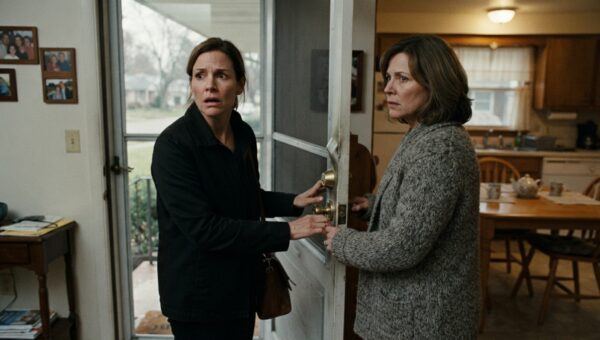
When I finally drove back to Elm Street, the house looked smaller than it had yesterday. The front screen door had that same little squeak on the third hinge that Mama had been meaning to oil since 1998. I unlocked the front door and stepped into the hallway where the coat rack still held her old wool cardigan smelling faintly of mothballs and peppermint.
For the first time in four years, the air in the hallway didn’t feel like a hospital room. It felt like my own house.
I went into the kitchen, pulled my old wooden paint box out from under the bottom shelf of the pantry where I had tucked it away after she fell the first time, and set it right on the kitchen table. The brass latches were slightly tarnished, but when I popped them open, the tubes of oil paint were still sitting there in their rows just like I left them.
Tomorrow is Friday. Renee is going to keep that chair open at nine o’clock, I suppose, because that’s just how Renee is. But I am not going to call to cancel. I am going to walk down there at ten, after she’s done with her first client, and tell her I want to book the nine o’clock spot for myself. Not for my mother’s hair, but to sit down and figure out where I’m going to set up my easel.
I stood by the front window of the living room watching the morning sun hit the porch railing where Mama used to sit with her cup of instant coffee. On my wrist, I was wearing her old silver charm bracelet that she left in the willow box on her dresser. It was heavy and loose, sliding down toward my thumb every time I moved my hand.