“No, Gamma, you haven’t sent anything for a long time.”
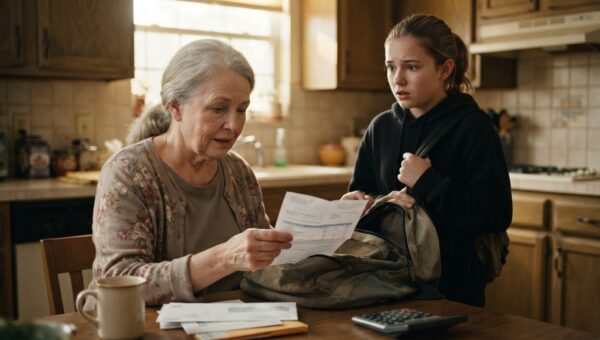
Ten words. That was all it took to tear apart two years of careful, quiet budgeting and soft-spoken trust. The kitchen in my small colonial house smelled faintly of roasted coffee beans and the lemon oil I use on the pine cabinets every Tuesday. Leo sat right there at my laminate kitchen table, his ten-year-old legs swinging back and forth because his sneakers didn’t quite reach the floor, holding a small plastic toy helicopter he had been eyeing in the catalog for three weeks.
He didn’t sound mad. He just sounded confused, like a kid trying to figure out why a simple math problem wasn’t adding up.
I had just asked him if he didn’t have any pocket money left from the three hundred dollars I dropped in the mail at the start of the month. Three hundred dollars. Not a fortune, but enough to build a real foundation for a boy growing up too fast in a world where things only get more expensive by the day. Every single month, right around the first, I slid the crisp bills into a heavy cream envelope, licked the flap, and walked it down to the corner box myself. I never put my return address in a fancy way. I just wanted it to feel like a letter from an old woman who loved him, without making him feel beholden to me or putting any weight on his small shoulders.
And every single month, Mindy was the one who checked the box.
Mindy is my daughter-in-law. David, my son, works sixty hours a week down at the county water authority, leaving early before the sun even clears the ridge and coming home smelling like chlorine and damp earth, too tired to look closely at anything except his supper and the evening news. Mindy stays home. Or at least, she stays in that house David bought with a VA loan ten years ago, a house where I have quietly paid the annual property taxes and the homeowners insurance out of my own retirement savings ever since David got laid off during that bad winter of 2018. It was our special arrangement. A quiet way to keep them afloat while they got their footing, structured so David wouldn’t have to swallow his pride and accept a handout from his mother.
I thought Mindy appreciated it. I really did. I thought we had an understanding, two women looking out for the same boys.
When Leo told me he hadn’t seen a dime, my chest went tight in a way that had nothing to do with my heart pills and everything to do with pure, cold rage. I didn’t scream at him. You don’t take your anger out on a ten-year-old who is just telling the plain truth. I simply smiled, told him we would figure out his toy, and sent him out to the back porch to check if the mint was coming up in the old half-barrel. Then I sat down at that table and let the silence settle in.
The bank records were right where I left them in my little gray metal lockbox. I spent Tuesday evening going through every single carbon slip, tracking the cash withdrawals that matched the first of every month for twenty-four straight months. Two hundred and four weeks. Twenty-four envelopes. Seven thousand two hundred dollars in crisp twenties and fifties, intended for a boy’s future college fund or a first car, quietly swallowed up by a woman who poured herself a second glass of Chardonnay every afternoon and drove a leased crossover she had no business financing.
And the house insurance. The twenty-four hundred due every six months for the county taxes. The twelve hundred for the roof and walls.
I didn’t call David. If I called David, it would turn into a shouting match that would split that family right down the middle, and David’s heart isn’t strong enough for a war between his wife and his mother. David loves Mindy, God help him, and he believes in the picture of the happy home they built together. Tearing that down with an accusation of mail theft would break my son long before it touched Mindy’s conscience.
So I decided to handle it myself.
Wednesday morning, I drove down to the First National Bank on Main Street. The teller, a nice girl named Brenda whose mother I used to teach Sunday school with, looked up from her screen when I asked to speak to the branch manager about setting up a youth trust account.
“For Leo?” Brenda asked, her fingers hovering over the keyboard. “You’ve been buying those savings bonds for him forever, Eleanor.”
“Not bonds this time, Brenda,” I said, keeping my voice very level. “A custodial trust. Direct deposit only. And I want the debit card and statements sent directly to a private P.O. box I’m opening today, or better yet, straight to his school.”
Brenda gave me a sharp look, the kind women who have lived in this county for fifty years give when they know something underneath the surface is shifting. But she didn’t ask questions. People in our town know better than to push when my jaw sets like that. We got the paperwork drawn up, funded the first deposit with a certified cashier’s check, and locked it down so tight not even a court order from a local judge could touch it until Leo turned eighteen.
From there, I drove three blocks over to the elementary school. Principal Higgins has known me since my own children were small, back when the gymnasium roof leaked and we had to bake three hundred cookies for the fall bazaar. He met me in his office with a cup of lukewarm coffee and a pile of permission slips.
“Eleanor, what brings you out in this damp?” he asked, adjusting his wire-rimmed glasses.
“I need a favor, Tom,” I said, setting a plain white envelope on his blotter. It had Leo’s full name written in my neat, old-fashioned cursive. “This is for my grandson. I want it handed directly to him by you, personally, at the end of the school day. Not in his backpack. In his hand. And I don’t want it mentioned to his mother or father. Can you do that for an old friend?”
Tom looked at the envelope, then up at my face. He saw whatever he needed to see in my eyes because he just nodded slowly, picked it up, and slid it into his top desk drawer. “Done, Eleanor. It stays between you and the boy.”
That took care of Leo. That left Mindy.
The formal termination notice didn’t need to be long or loud. A lawyer friend of mine down in Kingston, a man who owes me a favor from an estate settlement back in the nineties, drafted the simple declaration on official letterhead. It stated clearly that all voluntary, third-party financial subsidies regarding the real estate parcel located at 414 Maple Street, specifically property tax remittances and structural insurance coverages paid by external parties, were permanently withdrawn, effective immediately, with no further renewals or extensions to be offered.
I mailed it certified, return receipt requested, timed so it would land in their rural curbside box on Friday morning, right alongside the weekly circulars and the electric bill.
Friday afternoon at two o’clock, I drove my old Buick up the gravel drive at David and Mindy’s house. I brought a loaf of fresh zucchini bread wrapped in foil, just like I do every week. The red crossover was parked crooked in the driveway, half on the grass, which meant Mindy was home and rattled about something.
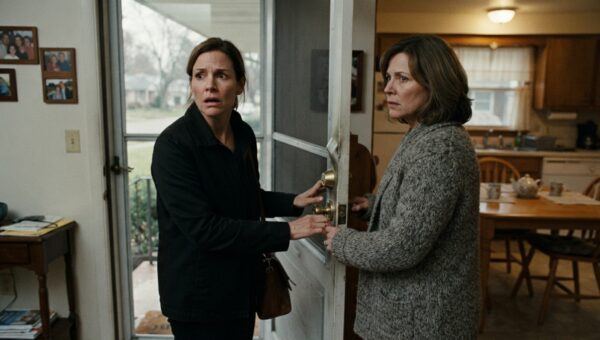
The front door opened before I even reached the second step. Mindy stood there in her gray velour lounge pants, holding a piece of heavy cream-colored paper in a hand that was shaking just enough to make the corner flutter against her thumb. Her face wasn’t pale; it was flushed bright red, right up into the roots of her highlighted hair.
“Eleanor,” she said, and her voice sounded tight, like a guitar string pulled one turn too far. “What is this?”
I stepped past her into the hallway, the smell of vinegar cleaning spray hitting the back of my throat. I didn’t take off my coat. I just set the loaf of zucchini bread on the narrow oak console table right next to the brass bowl where they drop their keys.
“It’s just a letter, Mindy,” I said softly, smoothing the front of my cardigan. “You can read, can’t you?”
“The tax office called about ten minutes ago,” she said, her voice dropping to a harsh whisper so she wouldn’t carry into the kitchen where David’s old hunting boots sat by the back door. “They said the escrow payment didn’t clear. They said your account was closed out. That’s nearly twenty-four hundred dollars due by the first of next month, Eleanor. You’ve been paying that since David and I got married.”
“And it was very kind of me to do so,” I replied, meeting her eyes without blinking. I let the silence stretch out between us, heavy and thick as wet wool. “All things must come to an end eventually, dear. Budgets change. Priorities shift. People find out where their money has been going.”
Mindy swallowed hard. Her throat worked visibly beneath her gold necklace. She looked down at the letter in her hand, then back up at me, and I could see the exact moment the trap closed around her. She couldn’t call David into the room. She couldn’t shout about how unfair it was that her free ride had vanished into thin air. Because the very second David asked why his mother stopped paying the taxes, Mindy would have to explain why the monthly cash envelopes stopped arriving at the box. She would have to explain the two years of stolen birthdays, the pocketed grocery money, the cash meant for a ten-year-old boy that went toward her salon visits and her car payment.
She was trapped by her own greed. Every single dollar she had taken from those envelopes was about to be eaten up by the tax collector, and she couldn’t utter a single word of complaint without blowing her entire life apart.
“We can’t afford twenty-four hundred dollars right now,” she whispered, her voice cracking just a little bit at the edges. “David thinks the mortgage is all we have to worry about. If he finds out…”
“If David finds out what, Mindy?” I asked, my voice as sweet and flat as skim milk.
She didn’t answer. She just stood there in the narrow hallway, clutching that piece of heavy paper against her chest like a shield against a firing squad.
I turned around, opened the front door, and stepped back out onto the porch into the crisp autumn air. I didn’t slam the door behind me. There was no need for dramatics. Slamming doors is for people who aren’t entirely sure they’ve won.
By five o’clock that evening, Leo had ridden his bicycle over to my house, his face flushed and grinning from ear to ear, holding a small blue plastic passbook in his back pocket. He didn’t say much about how Principal Higgins handed it to him between seventh-period math and dismissal, but he told me he already had enough in his new account to buy that helicopter and still have half left over for college.
Now, sitting here at my own kitchen table with the afternoon light fading through the sheer curtains, I look over at the small framed photograph of Leo holding his new bank book up to the camera like a proud little soldier. Beside it sits my checkbook, closed clean and flat against the wood, right next to a paid-in-full receipt for my own small property taxes, paid clear through the next decade.
The house across town is going to be a very quiet place this weekend, and honestly, that feels like justice enough.