The Grace Baptist fellowship hall always smelled like floor wax and boiled ham on a potluck Sunday, that heavy, greasy steam that clung to the wool of your sweater long after you had driven home. I sat right beside Brynn in the third row, watching her little fingers line up three small objects on the worn wooden bench between us. There was her stuffed rabbit with one gray ear, a box of Crayola crayons missing the blue one, and the little wooden jewelry box her uncle had carved for her fifth birthday.
She was six, and she treated those three things like they were crown jewels.
Except she wasn’t playing with them. She kept smoothing her palms over the lid of the jewelry box, staring down at the scuffed grain with her bottom lip caught between her teeth. Then she stood up without a word, walked four benches down toward the Deacon family, and dropped the crayon box into little Tommy Deacon’s lap. She came back, picked up the stuffed rabbit, and handed it to Mrs. Gable before the woman even had time to take her hymnbook out of the rack.
“Brynn, honey, what are you doing with your things?” I asked, leaning down and pulling her back toward my side of the pew.
She wouldn’t look up at me. Her small shoulders were stiff under her yellow cardigan, locked tight against the backrest.
“I won’t need them anymore,” she told me, her voice dropping down to that flat, obedient whisper she had picked up over the last few months.
I asked her why not, thinking maybe she had outgrown them or Claire had bought her something new for the upcoming week.
The air in the sanctuary felt suddenly thick, heavy with the drone of the air conditioner and the low murmur of the preacher shuffling his notes up front. Brynn kept her eyes fixed straight ahead on the oak floorboards.
“Mr. Reece says bad girls sleep in the basement, and there’s no toys down there,” she whispered.
My daughter Claire had married Marcus Reece eight months ago in a ceremony under the old sycamore trees behind the VFW hall. I had paid fourteen thousand dollars for every bit of it, from the caterer who served dry brisket to the photographer who didn’t catch a single natural smile. Claire had looked radiant, or at least I had convinced myself she did, smiling through the polite applause of people who knew Marcus only as the quiet man who worked down at the grain elevator. He had seemed polite enough back then, always holding doors and calling me ma’am with a smooth, practiced ease that never quite reached the corners of his pale gray eyes.
I knelt right there on the thin carpet of the church aisle, ignoring the way my knees popped and the stares from the choir loft behind us. I reached out and took Brynn’s cold little wrist, my thumb brushing the edge of her yellow sleeve.
“When was you down in the basement, sweetheart?” I asked, keeping my voice as steady as I could manage while my pulse kicked hard against my ribs.
She didn’t answer right away, but her breath hitched, that little catch in the chest that kids get right before they cry but are trying desperately not to. She pulled her sleeve up slow, dragging the yellow wool past her elbow like she was peeling off a bandage she knew was going to tear skin. Four small bruises sat in a row right there on the soft meat of her upper arm, just about the size of a man’s fingertips, dark purple fading into an ugly yellow at the edges.
I gripped the edge of the varnished pew so hard my knuckles turned the color of lard. “When I’m too slow getting dressed,” she said, her voice dropping so low I had to lean my ear right against her mouth to catch the words. “He counts. If he reaches ten, he…”
She didn’t finish the sentence. She didn’t have to. The rest of her arm told the whole story, clean and brutal, sitting right there under the fluorescent lights of a church where people were singing about grace.
I didn’t make a scene in the middle of the doxology. I didn’t march down the aisle and start shouting names, though every drop of blood in my head was screaming to do just that. Instead, I stood up, took Brynn’s small hand in mine, and walked straight out the side exit into the bright Sunday morning glare before the final hymn even started.
“We’re going to get some ice cream, Brynn,” I said, my voice shaking only a little as I opened the passenger door of my Buick. “And then we’re going to go see a doctor who checks scraped knees.”
She climbed inside without a word, clutching her little wooden jewelry box that Mrs. Gable had tried to hand back before we left. I took it from her and laid it on the dashboard, staring at the split in the wood where the latch didn’t quite meet right.
We bypassed the diner on Main Street and drove straight twenty miles over to the county urgent care clinic on the edge of Okmulgee. The waiting room smelled of rubbing alcohol and old linoleum, a clean, sharp smell that felt a hundred miles away from the damp earth of a basement. I didn’t wait for the receptionist to finish her phone call; I just walked right up to the glass partition and laid Brynn’s arm out on the counter like a legal document.
“We need a pediatrician on duty right now, and I want every single one of these marks measured and photographed for the county file,” I told the young woman behind the glass. My voice had that flat, granite tone my grandfather used to use when a stray bull broke through the fence line.
Within twenty minutes, a quiet, gray-haired nurse named Evelyn led us back to exam room four. Evelyn had known my family since the Reagan administration, and she didn’t ask foolish questions when she saw the bruise pattern. She worked with a calm, practiced efficiency, taking three separate digital photographs with the clinic’s camera while Brynn sat on the paper-covered table swinging her legs back and forth.
“The pressure marks are consistent with an adult male hand gripping a child’s upper arm with considerable force,” Evelyn said quietly, keeping her back to Brynn as she wrote down the measurements on the intake sheet. “These didn’t happen from a fall on the playground, Martha. You know that.”
“I know,” I said. “And I have a witness from the church who heard her give her toys away and repeat what he told her.”
While Evelyn finished the paperwork, I stepped out into the hallway and called Sarah Gable from the church nursery. Sarah picked up on the third ring, sounding flustered and apologetic about us leaving early. I cut right through her apologies with the plain edge of a butcher’s knife.
“Sarah, I need you to write down exactly what Brynn told you in the pew this morning about the basement and the toys,” I said, leaning my shoulder against the cool cinder-block wall of the clinic. “And I need you to sign and date it, because the sheriff is going to want it before the sun goes down.”
“Oh, Martha,” Sarah breathed, the color dropping right out of her voice. “Is it… is that what those marks were?”
“Just write it down, Sarah. I’ll be by your porch at two o’clock to pick it up.”
By noon, I had the urgent care pediatric report printed out in a crisp manila folder, complete with the standardized photographic evidence and the official assessment from the attending physician. The total cost of the visit was eighty-four dollars, which I paid in cash from the envelope I kept in my glove compartment for emergencies. Fourteen thousand dollars for a wedding dress and a sit-down dinner for people who only wanted to eat our beef and gossip about our family, and it had bought my granddaughter eight months of quiet terror while Claire was working the night shift down at the regional clinic.
I drove back to Claire and Marcus’s house just off Elm Street at 3:15 in the afternoon. Their house was a neat brick rancher with white shutters that Marcus had spent three weekends painting last spring, making it look respectable from the street while the rot sat right down in the dark under the floor joists. Claire’s sedan was parked in the driveway, meaning she was home resting before her Sunday night shift started at eleven.
I didn’t knock. I used the spare key Claire had given me back when they moved in, the one labeled with a little piece of masking tape in her own neat handwriting.
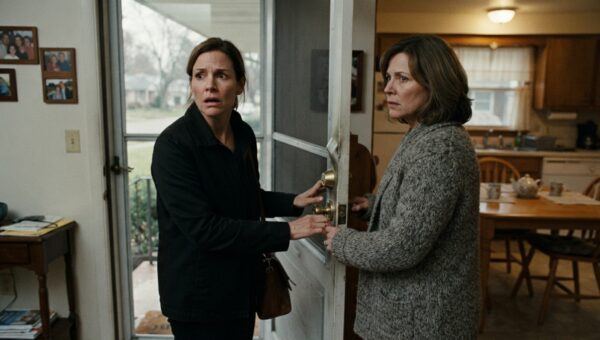
The house was quiet, smelling faintly of bleach and lemon Pledge. Claire was sitting at the kitchen island with a cup of black coffee, looking over her shift schedule with dark circles under her eyes that told me she hadn’t slept right since the wedding. She looked up as the door clicked shut, her expression tightening into that thin, defensive mask she had worn ever since she decided Marcus was her second chance at a proper family.
“Mom? What are you doing back? I thought you and Brynn were going to your sister’s after church,” Claire said, setting her mug down so hard the coffee sloshed over the rim.
I didn’t answer right away. I walked across the linoleum, laid the manila folder right on top of her shift schedule, and pulled the two glossy photographs out first. I didn’t say a word as I dropped them beside her coffee cup.
Claire looked down. Her breath caught in her throat, a sharp, ragged sound that ended in a dry swallow. She didn’t touch the pictures; she just stared at the four dark smudges on her daughter’s skin like she couldn’t make her eyes focus on what was right in front of her face.
“What is this?” she whispered, her voice dropping into that small, frightened register she used when she was six years old and had broken something expensive. “Where did she get those?”
“From her stepfather,” I said, keeping my voice lower than hers, steady and heavy as an iron skillet. “Ask her yourself, Claire. She’s sitting out in the car with her little wooden box because she didn’t think she’d need it where he puts her.”
“Marcus wouldn’t… he loves her, Mom. He helped her with her homework just last Tuesday,” Claire stammered, her hands flying up to push her hair back from her face in a frantic, jerky motion. “She bruises easily. You know how clumsy she is, she’s always running into the coffee table, “
“Don’t you dare,” I snapped, leaning over the counter until my face was only a foot from hers. The word-habit of my own mother rose up in my throat like bile. “Don’t you dare sit there and make excuses for a man I bought you with fourteen thousand dollars of my own retirement savings. He counts to ten, Claire. When he gets to the end of that number, he drags her down into the unlit cellar and leaves her there in the dark because she didn’t get her shoes on fast enough.”
Claire pushed her chair back so hard it scraped across the tile with a sound like tearing metal. “You’re lying,” she breathed, though her face had gone the color of skim milk. “You’ve never liked him. From the day we set the date, you’ve been looking for something to, “
“Look at the doctor’s report, Claire,” I said, tapping my finger right over the official seal of the Okmulgee County Health Network. “And then call Sarah Gable and ask her why your six-year-old daughter was giving away her stuffed rabbit in the third row because bad girls don’t get to keep toys in the basement.”
The kitchen went dead silent except for the low hum of the refrigerator in the corner. Claire stood there trembling, her eyes darting from the photographs to the medical seal and back again, the last eight months of her carefully constructed illusion crumbling right down to the floorboards. She reached out with one shaking hand, picked up the second photograph, and traced the line of those four fingertip bruises with the tip of her fingernail.
“He… he said he was just teaching her discipline,” Claire whispered, the words coming out broken and ragged like old cloth tearing on a barbed-wire fence. “He said I was too soft on her since the divorce.”
“Well,” I said, straightening up and reaching for my car keys. “He won’t have to worry about your softness anymore. Because the sheriff is already running the paperwork, and Marcus is going to find out what it feels like to have somebody count down to zero on him.”
We didn’t wait for Marcus to come home from his afternoon errand at the hardware store. By five o’clock, two county cruisers were parked two houses down behind the hedge, their lights off, waiting in the long shadows of the late afternoon sun. Deputy Vance, who used to play Legion baseball with my younger brother, came up the front walk alone with a sheaf of papers tucked under his arm and a face set like a granite tombstone.
Claire sat on the living room sofa with Brynn tucked right against her side, both of them staring out the front window as the sun began to drop behind the water tower down on Fourth Street. The house was too quiet, the kind of quiet that comes right before a storm breaks over the prairie and flattens everything in its path.
At 5:48 PM, Marcus’s red pickup turned into the driveway, the tires crunching loud on the loose gravel. He killed the engine, climbed out with a sack of drywall anchors in his hand, and walked up the front steps whistling some tune that didn’t have any rhythm to it.
He pushed the front door open without knocking, his boots tracking a little bit of red clay onto the welcome mat I had bought them for Christmas. He stopped dead in the hallway when he saw Deputy Vance standing by the coat rack and me sitting in the armchair by the television with my hands folded in my lap.
Marcus let the bag of drywall anchors drop to the floor. The plastic split open, and a dozen grey metal screws rolled out across the hardwood, scattering in every direction like loose teeth.
“What is this?” Marcus asked, his voice dropping into that low, flat rumble he usually kept reserved for when he thought nobody was listening. He looked at Claire, his eyes narrowing into two small slits of gray steel. “Claire. What did you let your mother do?”
Deputy Vance didn’t raise his voice, but he stepped forward and let the heavy click of the handcuffs echo off the high ceiling. “Marcus Reece, step away from the door and put your hands behind your back. You’ve got an emergency protective order waiting, and a warrant out of the county magistrate’s office for child abuse and unlawful restraint.”
Marcus didn’t move for three seconds. He looked at me, then at Claire, and for a second his mouth opened like he was going to argue his way out of it with that smooth, customer-service voice he used at the grain elevator. But then he saw the look on Claire’s face, grey and cold as winter river ice, and he knew the game was over. He turned his hands around slow, letting the steel snap shut around his wrists with a dry, metallic click that sounded better than any church bell I had ever heard.
They took him out through the front door without a siren, just the quiet slide of tires on gravel as the cruiser backed down the drive and headed toward the county line. Claire didn’t get up from the sofa. She just sat there with her arm around Brynn, crying silent, heavy tears that soaked right through the collar of the yellow cardigan.
By nine o’clock, the house was empty of everyone except the three of us. The county officers had gone, the reports were filed, and the emergency protective order was taped securely to the refrigerator right beside the grocery list. Claire went down to the basement once, staying down there for twenty minutes with a flashlight and a bottle of bleach before she came back upstairs with her eyes red and her jaw set hard, locking the cellar door behind her with a brass key she dropped into her apron pocket.
Upstairs in Brynn’s small bedroom, the glow from the streetlamp outside threw long, pale bars across the fresh white sheets. I stood in the doorway for a long time, watching the steady rise and fall of her small shoulder under the pink quilt.
The little wooden jewelry box her uncle had carved sat right where it belonged, placed carefully back onto the center of her nightstand alongside the stuffed gray rabbit with the one torn ear. Brynn was breathing deep and regular now, her face turned toward the wall, completely safe in a room where nobody was ever going to count to ten again.