Seven hundred and twenty hours. That was roughly how long it had been since my sister Clare stopped speaking to me over a petty argument about our mother’s old china cabinet, right up until the exact moment her name flashed across my phone screen while the lavender soap suds were still floating in Maya’s little plastic tub. I was giving my four-year-old daughter a bath when my sister called.
The bathroom air was thick with warm steam and the scent of chamomile. Maya was splashing water across the tiles, laughing at a plastic whale that kept tipping over, when my phone buzzed against the ceramic floor.
I didn’t want to answer it. My fingers were pruned from the warm water, and my back ached from kneeling on the hard bathmat. But family is family, or at least that is what I used to tell myself before I learned how easily a person can trade blood for an alibi. I picked up the phone, expecting another complaint about our cousin’s wedding or some imagined slight from the holidays. Instead, the voice on the other end didn’t even sound like Clare. It was high, brittle, and rattling like loose bolts in a tin can.
“I’m sorry,” she said, and the line hissed with static. “I had to do what’s best for the kids. CPS will be there in the morning.”
Then she hung up. No goodbye, no explanation, just the hollow electronic tone of a disconnected call. I stayed kneeling on the bathroom floor for a long, frozen second while the water dripped from my hair. Maya reached out and patted my cheek with a soapy hand.
“Mommy, whale is broken,” she whispered, her big blue eyes completely innocent of whatever machinery had just started grinding into motion.
I didn’t sleep that night. I sat at the kitchen table with all the lights off, watching the porch light cast long, yellow angles across the linoleum. My mind raced through a dozen different possibilities, none of them good. Clare had always been unstable, prone to dramatic exits and sudden financial crises, but this felt different. This felt calculated. I checked Maya’s room every twenty minutes just to watch the slow, rhythmic rise and fall of her small blanket.
By five in the morning, the house was dead silent, save for the hum of the refrigerator. I was drinking my third cup of lukewarm coffee when the first car pulled into our gravel driveway.
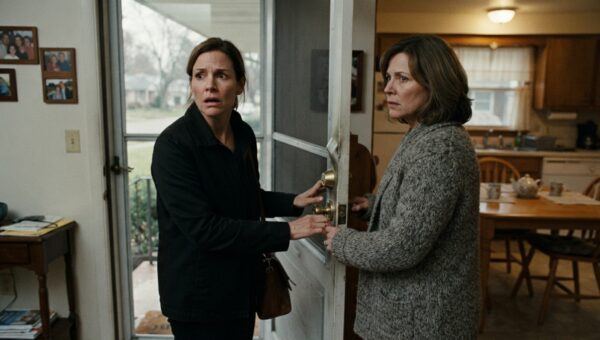
At 7:00 A.M. sharp, the authoritative pounding came. It wasn’t a normal knock. It was the heavy, rhythmic thud of official knuckles against solid oak, backed up by the heavy tread of heavy-soled boots on the porch steps. My reality fractured the second I turned the deadbolt. Investigator Miller stood in the doorway holding a leather folio, flanked by two municipal police officers whose uniforms looked entirely too crisp for that early hour.
“State child protective services,” Miller said, his voice flat and practiced. “We have an emergency temporary custody and removal order signed by Judge Vance. We need to inspect the premises and take the child into protective custody immediately.”
The words didn’t make sense at first. They bounced off my ears like foreign speech.
My home was spotless. I worked forty hours a week at the community college, kept the pantry stocked with fresh groceries, and had never so much as received a speeding ticket. Maya was still in her pajamas down the hall, clutching her favorite rabbit stuffed animal and wondering why men in uniforms were standing in our living room.
“There has to be some kind of mistake,” I said, my voice shaking so badly I could barely form the syllables. “Look around. Look at this house.”
“Ma’am, step aside,” one of the officers said, his hand resting instinctively near his belt. “We have a court order based on sworn affidavit and photographic evidence of severe domestic endangerment and hazardous living conditions on these premises.”
That was the word that stopped my heart. Hazardous. They weren’t talking about my house. They were talking about a ruin.
They let me dress Maya and pack a single small canvas bag with her clothes, but Miller shadowed my every move like a hawk. When they led her out to the unmarked sedan, Maya looked back at me with tears pooling in her eyes, asking why the nice police officers were taking her away. I promised her, with a voice that felt like broken glass in my throat, that I would see her in a few hours. The moment their taillights turned the corner of our street, I picked up my phone and called Dan Vance. Dan was the best family law attorney in the county, a man who charged three hundred dollars an hour and didn’t suffer fools or lazy caseworkers.
“Get to my office with the paperwork by nine,” Dan said, his voice deep and raspy over the speaker. “Do not argue with anyone else. Just bring me the copy Miller left on your kitchen counter.”
By 9:00 A.M., I was sitting across from Dan in his cramped, book-lined office downtown, watching him flip through the emergency removal petition with a pair of half-moon reading glasses perched on his nose. He didn’t say a word for what felt like hours. He just turned the thick stack of papers over, studying the exhibits attached to the back with intense concentration.
“Well,” Dan finally muttered, taking off his glasses and rubbing the bridge of his nose. “They certainly made it look convincing on paper. Sworn statement alleging black mold, exposed electrical wiring, and unheated living quarters in the primary basement suite where the minor child allegedly sleeps.”
“My basement is a finished playroom,” I said, my hands clenched so tight my fingernails dug into my palms. “We put down maple flooring two years ago. There is no mold. There is no exposed wiring.”
“I know,” Dan said quietly, tapping the corner of the papers against the dark wood of his desk. “Because these photographs attached to the affidavit do not match your house at all. Look at this exposed brick pillar by the boiler. And look at that water heater model. That’s a forty-year-old gas unit with rust running down the side. That’s not your utility room.”
I leaned across the desk, staring down at the grainy color prints stapled to the court filing. The cold dread in my stomach suddenly curdled into something much hotter and sharper. I knew those bricks. I knew that rusted water heater with the dented copper fitting near the top. I had stared at it three months ago when I went to help Clare clear out the damp basement of her rental house on Elm Street after her pipes froze during the winter storm.
“It’s Clare’s house,” I whispered. “That’s my sister’s rental on Elm Street.”
Dan didn’t waste a second. He picked up his desk phone, dialed a direct line to the county courthouse, and spoke in a sharp, authoritative tone that brooked no argument. Within an hour, he had secured an emergency judicial review and an immediate physical walkthrough order, dragging Investigator Miller back to my property along with a court-appointed bailiff to witness the truth.
By noon, Miller was standing in the middle of my actual basement, looking entirely uncomfortable as he stared down at the clean maple floors, the bright recessed lighting, and the modern electric HVAC system humming quietly in the corner. He looked at his tablet, then at the photographs attached to his sworn affidavit, and finally at me.
“The structural layout matches the address listed in the initial anonymous tip,” Miller mumbled, trying to salvage some shred of professional dignity. “The tip came from a verified relative claiming to be a concerned observer.”
“A concerned relative who happens to be fighting her ex-husband for custody of her own three children,” Dan said, stepping out from the stairwell with his arms crossed over his chest. “And who needed to deflect a surprise CPS inspection at her own neglected address this morning by framing her sister. Investigator Miller, did you verify the property ownership before executing an emergency removal order on a clean home?”
Miller’s face went tight. “We acted on exigent circumstances and photographic evidence submitted through the emergency portal.”
“Photographic evidence that was taken five blocks away at 421 Elm Street,” Dan replied, dropping a printed lease agreement and utility bill for Clare’s rental onto the folding table by the laundry sink. “We pulled the property records an hour ago. That basement belongs to Clare Higgins. Not my client.”
The pieces clicked together with the terrifying speed of a trap springing shut. Clare was facing a court-ordered home inspection for her own custody battle at eight o’clock that morning. Knowing her house was full of code violations, drug paraphernalia, and uncollected trash from her ongoing relapse, she had taken photos of her own basement, uploaded them under a false digital signature, and deliberately redirected the state’s attention straight to my front door. She had sacrificed my daughter just to buy herself twenty-four hours of breathing room in her own legal war.
By 3:00 P.M., we were sitting in Judge Vance’s third-floor courtroom. The air in the room was stale and smelled of old leather and floor wax. Clare was sitting on the wooden bench near the back, looking pale and disheveled in a stained denim jacket, her eyes darting toward the exit like a trapped animal. She hadn’t expected Dan to move this fast. She certainly hadn’t expected Investigator Miller to realize he had been played so easily by a desperate addict.
When Dan presented the side-by-side architectural comparisons, the utility records, and a same-day pediatric wellness exam proving Maya was in perfect physical health with zero signs of neglect, Judge Vance didn’t even bother listening to Clare’s court-appointed counsel. The judge’s expression was like carved granite as he looked down from the high oak bench.
“This court does not appreciate being used as a weapon in private family disputes,” Judge Vance said, his voice ringing off the high plaster ceiling. “The emergency removal order is hereby vacated with prejudice. The child is to be returned to her mother immediately. Furthermore, this court is filing an immediate referral for criminal charges regarding the submission of fraudulent evidence and filing a false emergency report.”
He looked directly past the lawyers toward the back of the room.
“Bailiff,” the judge said calmly. “Please ensure that Ms. Higgins remains in the building for questioning by the district attorney’s office regarding child endangerment and perjury.”
I didn’t look back at Clare as the deputies stepped toward her bench. I didn’t want to see her face, and I didn’t want to hear whatever frantic, half-baked excuse she was about to spill onto the courtroom floor. The only thing that mattered was the ticking clock in my head, reminding me that Maya had been sitting in a county holding facility for eight hours too long.
By 7:00 P.M., exactly twelve hours after the heavy pounding had shattered our quiet morning, the front door of my house clicked shut behind us for good. The living room was quiet again, bathed in the warm amber glow of the table lamps. Maya was sitting up in her own bed, wearing her favorite flannel pajamas, clutching the yellow rubber duck she had left beside her tub that morning as if she had never been anywhere else.
I sat down on the edge of her mattress, watching her eyelids grow heavy as the exhaustion of the day finally claimed her. On the oak nightstand beside her lamp, right next to a glass of water and her favorite storybook, sat the certified court document bearing the judge’s signature, officially vacating the petition and clearing our name of every single lie Clare had tried to write into our lives.
Maya drifted off to sleep with her thumb tucked softly against her cheek, breathing slow and deep in the safety of her own room. Downstairs, the deadbolt clicked into place with a dry, final sound, sealing the perimeter of our home against anyone who might ever try to break it again.