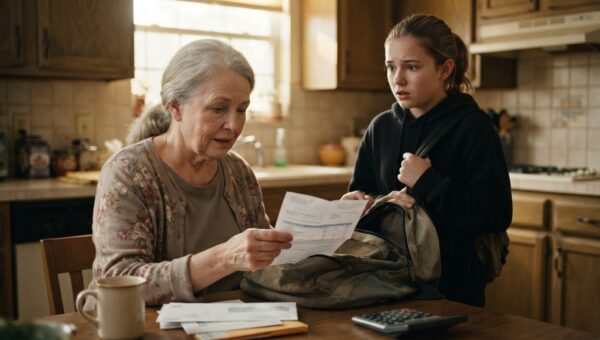
Brenda was sitting at the oak kitchen table with her reading glasses pushed up on her forehead when the mail carrier dropped the square envelope into the metal box by the driveway. I remember the exact weight of it when I picked it up off the counter an hour later. It wasn’t flimsy like junk mail or slick like a bill.
It was heavy card stock, cream-colored, the kind people pay extra for when they want something kept on a mantelpiece.
My name was written across the front in a sharp, slightly backward slant that I would have known anywhere.
I stood there in the quiet kitchen with the screen door clicking against its frame in the May breeze. Brenda didn’t look up right away from her crossword puzzle. She just reached for her mug of lukewarm decaf and took a slow sip, waiting for me to open whatever county notice or church fundraiser had arrived.
“Who’s that from?” she asked.
“Mark,” I said. My voice sounded thin, like dry paper tearing.
Brenda lowered her mug. The glasses slipped down the bridge of her nose, and she peered over the top of them at the envelope in my hands. Thirty years of habit had made us experts at reading the margins of each other’s silences.
She knew as well as I did that our son hadn’t written anything to this house since the Clinton administration. Not a postcard, not a hurried note inside a Father’s Day card signed by someone else, not even a wrong number on a late-night landline.
“Well,” Brenda said, and her voice had that careful, guarded edge she always used whenever his name floated into the room like an unwanted draft. “Open it then. Let’s see what they want.”
I slid my thumb under the flap. It tore with a dry, sharp sound that made the dog lift his head from the braided rug by the stove. Inside was a crisp invitation to a high school graduation in a town forty miles south, dated for the twenty-second of May, honoring a boy named Tyler. My grandson. I didn’t even know what grade he was in until that second, let alone that he was old enough to wear a cap and gown.
Tucked behind the formal invitation was a small white index card. The same slanted handwriting covered one side. Just four words.
I stared at them until the ink seemed to blur together into a dark smear against the white paper.
Brenda watched my face tighten. “Arthur? What does it say?”
“Come alone. I’m ready.”
The kitchen went dead quiet except for the hum of the refrigerator. Brenda let out a short, dry breath that wasn’t quite a laugh. “Well, that’s typical. After all this time, still making demands. Does he think I’m going to pack myself into a suitcase? We go together or we don’t go at all, Arthur. You know how those people are.”
Those people. That was her phrase for them. Her phrase for Mark’s maternal grandparents who took him in when he was fourteen, who fed him and patched his scraped knees and bought him his first truck and paid for his dental work while I sent checks through the mail like a silent business partner paying off an old debt.
I looked down at the index card again. The ink was slightly smeared where his thumb had pressed against it before the ballpoint dried.
In 1995, the house on Elm Street had felt smaller than it actually was. Mark was fourteen, all elbows and defiance, walking around with a scowl that never quite left his face after his mother died and Brenda moved in with her two girls. Every evening felt like waiting for a fuse to blow. Brenda wanted order and quiet hours and polite manners at the dinner table. Mark wanted to slam doors and play his music loud enough to rattle the windowpanes and throw his dirty boots right in the middle of the hallway where anyone could trip over them.
They went at each other like cats trapped in a sack. Every single night, it was something. She told him he was disrespectful. He told her she didn’t belong in his house. And I stood in the middle of the kitchen with my hands in my pockets, wishing the floor would open up and swallow me whole.
I chose the quiet house.
I remember packing his duffel bag on a Tuesday afternoon while he was out behind the garage. I didn’t even have the courage to look him in the eye and tell him what I was doing. I just loaded his clothes into the trunk of the Buick, drove him down the state highway forty miles south to his grandmother’s porch, and left him there with a handshake and a fifty-dollar bill folded into his palm.
I told myself it was for his own good. I said it to Brenda on the drive back. I said it to my sister on the phone. I said it to myself in the bathroom mirror every morning while I shaved. He needs a steady hand, I told myself. He needs a place where he can breathe without stepping on eggshells.
I said it enough times that I half believed it.
The other half of me knew the truth, and it sat like a heavy stone in my gut for three decades. I was a coward. I couldn’t handle the friction, so I handed my boy off to someone else and bought myself thirty years of peaceful evenings in front of the television.
“Arthur, did you hear me?” Brenda was standing by the counter now, wiping down the laminate with a damp sponge in sharp, circular motions. “If we’re going down there, we need to leave by noon so we can beat the construction on the bypass. And I’m not sitting in the back row either. After everything we did for him, “
“You didn’t do anything for him, Brenda,” I said.
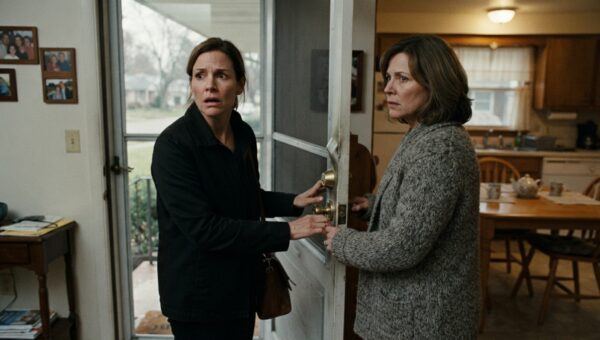
The sponge stopped moving. She didn’t turn around right away. Her shoulders stiffened under her floral blouse, and the silence stretched out between us until it felt heavy enough to crack the ceiling plaster.
“Excuse me?” she said, her voice dropping down into that cold, level register she used when she was genuinely offended.
“I said you didn’t do anything for him,” I repeated. My heart was hammering against my ribs, hard and fast, the way it used to back when Mark was still small enough to pick up. “And I didn’t either. Not really. We let him go because it was easier for us.”
Brenda turned around slowly, her face tight and pale. “After everything I put up with? After the way that boy spoke to me? In my own kitchen? You’re going to stand there and blame me because you couldn’t control your own son?”
“I’m not blaming you,” I said, and for the first time in thirty years, I meant it. “I’m blaming me.”
She stared at me for a long second, her eyes narrow and unbelieving. Then she tossed the sponge into the sink with a wet slap, untied her apron, and walked down the hall toward the bedroom without another word. The door didn’t slam, but the click of the latch was final enough.
I stayed at the kitchen table with the graduation invitation in my hand. The four words stared back up at me from the white card stock.
Come alone. I’m ready.
He didn’t want Brenda there. He didn’t want thirty years of polite, guarded small talk over Christmas ham where we exchanged weather reports and avoided looking too closely at each other’s lives. He wanted the man who dropped him off on a porch in 1995 to show up and own it. Face to face. No buffers. No excuses.
May twenty-second came in with a gray, misty drizzle that coated the windshield of my old pickup truck before I even backed out of the driveway. Brenda stayed in bed when I left. I heard her moving around behind the closed door around six in the morning, but she didn’t come out to say goodbye, and I didn’t ask her to.
The drive down the state highway took forty-one minutes. I kept my hands at ten and two on the steering wheel, watching the mile markers tick backward one by one as the familiar stretch of blacktop rolled beneath my tires. Every billboard, every rusted barn, every cluster of pine trees by the creek brought back the memory of that afternoon thirty years ago when I drove my son away so I could have some peace and quiet.
The high school auditorium was packed tight with parents and grandparents holding video cameras and bouquets of cellophane-wrapped flowers. I found a seat near the back on the aisle, sliding onto the hard folding chair among strangers who were laughing and shouting names across the rows.
When the graduates filed in wearing their blue robes, I didn’t need the program to pick him out. Mark was sitting three rows down from the front, broad-shouldered and graying at the temples, clapping as his son’s name was called over the loudspeaker.
Halfway through the ceremony, Mark turned his head slightly and looked back toward the rear of the gymnasium. His eyes swept over the crowd until they locked onto mine in the twelfth row.
He didn’t wave. He just gave one slow, deliberate nod.
After the tassel turning and the flurry of white caps tossed into the air, the crowd spilled out onto the front lawn into the damp afternoon air. I hung back, letting the families with their balloons and cameras drift toward the parking lot while I walked slowly around the brick building toward the residential street behind the football field.
Mark was standing by the side door of a detached two-car garage, leaning against the jamb with his hands shoved deep into the pockets of his jacket. He looked older, of course, with lines around his eyes that weren’t there when he was fourteen, but the way he held his chin was the exact same stubborn tilt I used to see every time I told him to clean his room.
I stopped about ten feet away on the gravel drive. The stones crunched under my boots.
“You made good time,” Mark said. His voice was deeper than I remembered, steady and flat, without any of the old heat.
“Traffic wasn’t bad,” I said. “Highway’s smoother than it used to be.”
He pushed off from the doorframe and took a few steps toward me, stopping just short of the grass. He looked at me for a long time, taking in my gray hair and the slight stoop in my shoulders that hadn’t been there the last time we stood across from each other.
“Brenda stay home?” he asked.
“She stayed home,” I said.
Mark nodded once, looking down at his boots for a second before he raised his eyes back to mine. “Good.”
We stood there in the mist for a minute, neither of us moving, the thirty-year gap hanging between us like a physical weight. I wanted to say something about the weather, or congratulate him on Tyler, or talk about the drive down, but the words caught in my throat. None of it mattered. None of it was what we were both standing there for.
“I’m sorry, Mark,” I said. The words came out rough and clumsy, the way they should have thirty years ago. “I shouldn’t have left you on that porch. I wasn’t looking out for you. I was looking out for myself.”
Mark let out a long breath, and the tension in his shoulders seemed to drop an inch. He didn’t smile, but the hard line of his mouth softened just enough.
“I know,” he said quietly. “Took you long enough to admit it.”
He turned and gestured toward the open door of the garage behind him. “Come on. Let me show you something before the rest of the family gets back from the restaurant.”
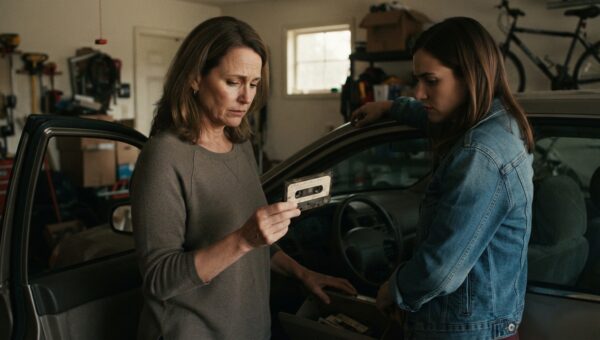
I followed him inside out of the drizzle. The garage smelled of motor oil, cut pine, and old iron. Against the back wall stood a heavy wooden workbench with a vice bolted to the corner and a pegboard lined with hand tools, chisels, hammers, and saws that looked like they had been wiped down and cared for over decades.
Right in the middle of the bench sat an old oak toolbox with brass latches that I recognized instantly. It was my father’s box. The one I left behind in the basement of the Elm Street house when we moved, thinking it was just junk taking up space.
“Found it in the back of my grandfather’s shed five years after I moved in with them,” Mark said, running his hand over the worn lid. “He said you told him to bring my things down piece by piece, but you forgot this one.”
I stepped up beside him, the smell of sawdust and grease filling my lungs. I looked down at the old box, and then at my own hand resting right next to his on the scarred edge of the wooden bench.
“I didn’t forget it,” I said softly, the lie tasting bitter on my tongue. “I just didn’t know how to ask for it back.”
Mark didn’t say anything to that. He just reached out, unlatched the brass clasp of the toolbox, and lifted the lid.