Maya was three years old, and every single morning she stood by the front window with her little yellow plastic watering can, talking to the ferns on the porch while I tried to figure out how to stretch our grocery money through Thursday. I had a yellow legal pad on the kitchen table with columns drawn out in blue ink, cutting out our gym membership, dropping our landline, and canceling the newspaper subscription just to save forty-two dollars a month.
We needed three hundred and eighty dollars a week for the Montessori preschool down on Elm Street, and Greg kept shaking his head over his coffee cup every time I brought it up.
“We just don’t have it,” he told me that Tuesday, not even looking up from his tablet. His fingers tapped a steady, impatient rhythm against the glass screen. “You are acting like money grows on trees out here.”
“We could if we prioritized it,” I said, my voice shaking a little because I hated asking twice. “I’m already picking up those extra transcription jobs at night, Greg. Maya learns her letters so fast. She needs that environment.”
He slammed the tablet down so hard the coffee sloshed over the rim of his mug and pooled across the laminate. “No. End of discussion.”
I let it drop right there because fighting with Greg always left me with a tight, sour knot in my chest that took hours to untangle.
I cleared the breakfast plates and started wiping down the counters with a damp sponge, watching the gray dishwater swirl down the drain. I figured that was just how our life was going to be, tight and pinched and always waiting for the other shoe to drop, until I went looking for a rubber band in the kitchen junk drawer later that afternoon.
Buried under a pile of expired coupons, a broken pair of sunglasses, and three dead remote controls was a square window envelope from a property management company downtown. The blue ink through the glass window caught my eye because it wasn’t a bill for our mortgage or our electric. It was a receipt for Unit 504B, addressed straight to Gregory Vance, with a total amount of three thousand four hundred dollars.
My fingers went cold right there over the junk drawer. Three thousand four hundred dollars a month for an apartment we didn’t live in, while I was scrubbing toilets and selling my old college textbooks online to pay for three-year-old Maya’s winter boots.
I stood there in the quiet kitchen for a long minute, watching the dust motes drift in the sunbeam above the stove, while my brain tried to shove the numbers into some kind of shape that made sense.
I didn’t sleep that night. Greg came home late from his office downtown, smelling faintly of Scotch and cedarwood, and kissed the top of my head while I sat staring at the blank television screen. I didn’t say a word about the envelope tucked safely inside the pocket of my canvas cleaning apron hanging on the back of the pantry door. Every time he shifted in his sleep beside me, turning away with a heavy sigh, my mind raced through every dark possibility a wife can conjure in the small hours. Who lives in that unit? Is Greg cheating? Why is he paying someone’s rent?
By seven in the morning, before the sun had even burned the fog off the top of the maple trees across the street, I had Maya dressed and buckled into her car seat with a box of graham crackers and her favorite stuffed rabbit.
I didn’t leave a note for Greg. I just turned the key in the ignition of our station wagon and drove straight downtown toward the brick high-rise on Grand Avenue where the property management logo on the envelope said Unit 504B was located.
The lobby smelled of fresh floor wax and expensive citrus air freshener. A young man in a gray uniform stood behind a marble reception desk, looking very official behind a bank of computer monitors. My heart was hammering so hard against my ribs I thought it might bruise the bone.
“Can I help you, ma’am?” he asked politely, looking down at Maya, who was clutching her rabbit and staring at the tall brass elevator doors.
“I’m looking for Unit 504B,” I said, my voice sounding smaller than I wanted it to. “My husband… Gregory Vance pays the account for that unit.”
The doorman tapped a few keys on his keyboard, gave me a quick, professional sideways glance, and nodded. “Floor five. Take a right off the elevator. Door’s right at the end of the hall.”
The elevator ride lasted about three seconds, but it felt like descending into an ice cave. My palms were slick against the canvas strap of my diaper bag. When the brass doors slid open with a soft chime, the hallway was silent and dim, carpeted in thick gray wool that swallowed the sound of my sneakers. I walked down to the end, past silver door numbers, until I found the brass digits 504B.
I didn’t give myself time to chicken out. I just raised my hand and knocked twice on the dark wood.
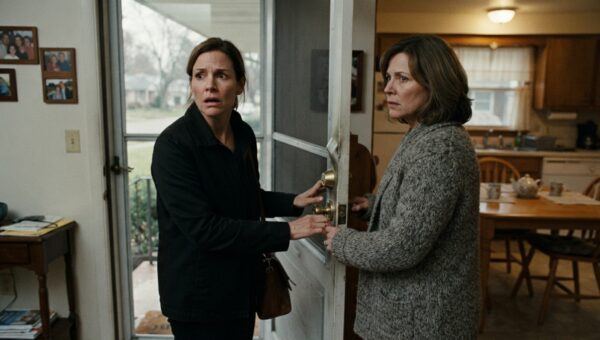
From inside, I heard the slow shuffle of slippers against a hard floor, followed by the dry click of a deadbolt turning over. The door swung open about six inches, held by a brass security chain, and an older woman with sharp gray hair pulled back into a loose bun peered out at me through the gap. She was wearing a faded floral house dress and holding a porcelain teacup in her hand.
“Yes?” she asked, her voice raspy and tired.
I opened my mouth to ask for the tenant, to ask why Greg’s name was on the check, but the words died in my throat the second I looked into her eyes. The shape of her jaw, the slight crook in her left knuckle, the pale blue of her iris, it was like looking at a photograph of Greg twenty years into the future.
“Helen?” I whispered, the name slipping out before I even knew I was saying it.
The old woman’s face went completely slack. The teacup rattled against the saucer in her hand, a thin, sharp clink that made Maya flinch behind my skirt. “Who are you?” she breathed, her fingers tightening around the edge of the door. “How do you know that name?”
“I’m Clara,” I said, and my voice cracked right down the middle. “Greg’s wife.”
Helen stared at me for a long, terrible second, her breath hitching in her throat. Then her hand dropped from the chain, the latch swung free, and the door pushed all the way open into a sunlit living room filled with expensive floral furniture and framed photographs of Greg as a teenager standing beside a high school track trophy.
“He told you I was dead, didn’t he?” she asked softly, stepping back to let me into the apartment. “The day before you two walked down the aisle, he told you my heart gave out in Florida.”
I walked into the room like I was wading through wet cement, Maya clinging tightly to my jeans. Every surface was neat, dusted, and maintained with a level of comfort that made my stomach turn. There was a basket of fresh fruit on the glass coffee table and a stack of glossy gardening magazines beside a leather armchair.
“Four years ago,” I said, my hands shaking so hard I had to tuck them under my arms. “He said you passed away before we even met. He said there was nobody left on his side of the family to invite.”
Helen let out a dry, humorless laugh that sounded more like a cough. She walked over to the window overlooking the brick street below, her slippers making a soft scuffing sound against the hardwood. “He was always good at erasing things that didn’t fit his picture. My gambling debts back in Syracuse nearly cost him his scholarship twenty years ago. When I wouldn’t stop calling him for help after I lost the house, he decided it was easier to bury me than to pay my bills in public.”
She turned back around, her expression a mix of bitter pride and deep, heavy resignation. “Then I got sick two years ago. I needed hip surgery, and my landlord was about to throw me out on the curb. He showed up here with a checkbook and a set of rules. Three thousand four hundred a month, paid direct to the office, as long as I never pick up the phone, never send a letter, and pretend I don’t exist. He said he had a new life now. A proper wife. A little girl.”
She looked down at Maya, who was hiding behind my legs, peeking out with wide, curious eyes. A tear cut a clean path through the dust on Helen’s cheek, but she didn’t bother to wipe it away. “He pays for everything out of some separate stash he manages to squirrel away. He visits about once a month on a Tuesday afternoon, stays for twenty minutes, checks the mail, and leaves without a word.”
I stood there in that sunlit room, surrounded by Greg’s mother and the photographic proof of his four-year lie, and the cold knot in my chest finally cracked open into something hot and sharp. Every sacrifice I had made over the last three years, every skipped meal, every canceled appointment, every time I sat at the kitchen table counting pennies while Greg lectured me on household frugality, wasn’t because we were poor. We weren’t poor at all. We were just financing Greg’s guilt and his polished suburban illusion, one luxury apartment rent check at a time.
“Thank you,” I said to Helen, my voice steadier now than it had been all morning. I didn’t yell at her. I didn’t have any anger left for her. She was just another casualty of Greg’s neat little bookkeeping system.
“What are you going to do, child?” she asked, her voice dropping to a whisper as I turned back toward the hallway.
“I’m going home to look at our bank statements,” I said.
The drive back to the house took twenty minutes, and every mile felt like a gear clicking into place. When I walked through the kitchen door, I didn’t put Maya’s coat away. I sat her down at the kitchen table with a box of crackers and her coloring book, walked straight to Greg’s home office, and pulled our filing box out from the bottom shelf of the walnut bookcase.
I spent the next two hours tearing through two years of joint checking account records, tracking the automated transfers that Greg had routed through a secondary online business account he claimed was just for minor client reimbursements. Three thousand four hundred dollars every single month, like clockwork, drawn out of our household earnings before I ever saw a dime of it. Over twenty-four months, that was more than eighty-one thousand dollars diverted away from our mortgage, our savings, and our daughter’s future to keep a dead woman alive in a high-rise downtown.
At six o’clock that evening, the deadbolt on the front door clicked back with that familiar, hollow sound I had lived with for six years. Greg stepped into the hallway, tossed his leather briefcase onto the credenza, and loosened his silk tie with a tired groan.
“Clara?” he called out, walking toward the kitchen. “Smells like we’re having takeout again. Did you get those forms typed up for my cousin’s company?”
I was sitting at the oak kitchen table with the yellow legal pad in front of me and two thick stacks of printed bank statements spread out on either side of my coffee mug. The house was dead quiet except for the hum of the refrigerator in the corner.
Greg stopped in the doorway, his tie hanging loose around his collar, his eyes dropping to the papers on the table. The color didn’t drain from his face like it does in the movies; instead, his jaw just tightened into a hard, rigid line, and his shoulders dropped an inch.
“What is all this?” he asked, his voice flat and careful.
I didn’t stand up. I just looked at him across the table, sliding the property management receipt right into the center of the wood grain between us.
“Unit 504B, Greg,” I said softly. “Helen sends her regards. She told me all about her hip surgery and the twenty-minute visits on Tuesday afternoons.”
He didn’t move. He stood there in the doorway for three long seconds, looking at the receipt, then down at the bank statements, and finally back at me. All the smooth, confident posture he used in his office downtown seemed to slide right off him, leaving just a tired, cornered man who had spent so many years lying he forgot how the truth worked.
“Clara, let me explain,” he started, taking half a step forward with his hand raised in that familiar, placating gesture. “You don’t understand the pressure, “
“No, Greg, I do understand,” I said, cutting him off before he could take another breath. “You told me your mother was dead so you wouldn’t have to deal with her past, and then you stole eighty-one thousand dollars out of our family account to keep her comfortable in a luxury high-rise while you told me we couldn’t afford three hundred dollars a month for Maya’s preschool.”
“She’s my mother,” he snapped, his voice finally rising with a flash of real anger. “What was I supposed to do? Let her starve on the street?”
“You could have told me the truth on our wedding day,” I said, my voice not shaking at all now. “You could have treated me like a partner instead of an employee in your little managed corporation. But you didn’t. And you’re not going to do it anymore.”
I reached into the file folder and pulled out two printed documents I had printed out earlier that afternoon at the library down the street, formal separation of bank account paperwork and a completed enrollment form for the Elm Street Montessori preschool, complete with a check routing number drawn from the secondary account I had just frozen online.
“All our joint accounts are already severed,” I told him, watching his eyes widen as the words landed. “I moved half of what was left into a new account in my name alone this afternoon. As of right now, you can pay Helen’s rent out of your own personal discretionary salary, because not one more cent of household money is going toward your secrets.”
“Clara, you can’t just, “
“And Maya starts school on Monday morning,” I said, standing up from the table and smoothing down the front of my shirt. “The tuition check has already cleared. If you have a problem with any of it, you can sleep in the guest room tonight and talk to a lawyer in the morning.”
I walked past him down the hallway without looking back, leaving him standing alone in the kitchen with his briefcase still clutched in his hand and the bank statements scattered across the wood table.
Two weeks later, the morning air was crisp and smelled of woodsmoke and wet leaves as I walked down the sidewalk holding Maya’s small, warm hand in mine. She was wearing her new red jacket with the fleece lining that I bought with the money we recovered from those hidden transfers, and her little yellow backpack bounced against her shoulders with every skip.
We stopped at the bright green front doors of the Montessori school on Elm Street, right where the painted wooden sign hung above the bell. Maya looked up at me with her big blue eyes, her fingers tightening around mine for just a second before she gave me a bright, gap-toothed grin.
“Can I go play with the blocks now, Mama?” she asked.
“Go on,” I said, watching her push the heavy door open and step inside into the warm, bright classroom filled with the sound of children laughing and wooden toys clacking together.
I stood on the sidewalk for a long moment after the door clicked shut, watching her through the low window as she hung her yellow backpack on her assigned hook and ran straight for the corner shelf. My chest felt light and completely clear, for the first time in six years, knowing that whatever came next, I was standing on solid ground of my own making.