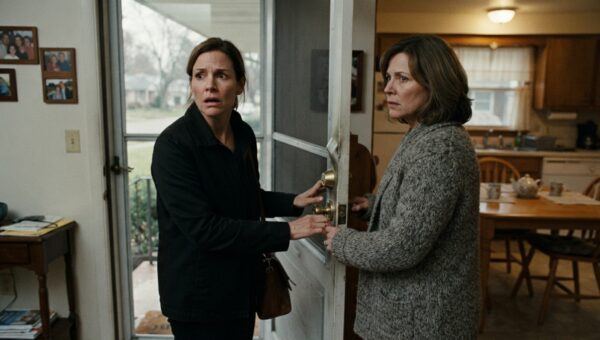
The house had this dead, hollow feel to it when I came downstairs to put the coffee on at six in the morning, and the silence was the first thing that tripped the hair on my arms. Arthur’s leather wallet was sitting right there on the Formica counter, square next to the tin of instant coffee. His heavy brass key ring was tossed beside it, and his phone was face down on the nightstand upstairs with the screen dark and dead.
His truck was still parked out in the gravel driveway, right where he always left it under the old sugar maple. I figured he had stepped out to check the oil drum or walked down to the mailbox in his slippers, though his boots were lined up neat by the back door. But ten minutes passed, and then twenty, and the coffee pot finished gurgling its black stream without a sound from the porch.
I walked out onto the gravel in my bare feet, the sharp little stones biting into my soles, and looked across the empty yard toward the treeline. The woods behind our property were thick with elderberry and sumac, and the fog was just starting to lift off the grass like steam off a kettle. I called his name once, just loud enough to carry past the clothesline, but nobody answered.
By noon I was on the telephone with his younger brother Dale, whose voice sounded scratchy and thick with sleep when he picked up three counties away.
Dale hadn’t seen him, didn’t know a blessed thing about why Arthur would walk off without so much as a tube of chapstick or a spare nickel. By that evening, the local sheriff’s deputy was sitting at our kitchen table writing down particulars in a little spiral pad with a chewed-up yellow pencil.
Three days of absolute hell followed in that quiet house, with the phone ringing every hour and the coffee getting cold in the pot because I couldn’t swallow a drop. I drove myself half crazy imagining every ditch and culvert between here and the county seat, picturing him hurt or lost or wandering around in a daze. The deputies brought a pair of tracking hounds on the second afternoon, but the dogs lost the scent right by the mailbox where the asphalt met the state road.
Then, on the fourth morning just as the sky was turning that pale, bruised color before dawn, the back screen door let out its familiar squeak.
I was sitting at the table with my wool sweater pulled tight around my shoulders, staring at the exact spot where his wallet had been sitting for ninety-six hours. Arthur walked right on into the kitchen, and he looked like a ghost that had spent three days baking in the desert sun.
He was wearing a faded canvas work shirt that was three sizes too big for him, smelling faintly of salt water and cheap laundry soap, and his face was burned a raw, angry red across the bridge of his nose. He didn’t look at the wallet, and he didn’t look at the phone sitting dead on the counter. He just stopped by the sink, ran his palm over the cold porcelain, and said two words.
“I’m sorry,” he whispered.
I stood up so fast my knees cracked, the chair scraping loud against the linoleum. “Where were you, Arthur?
The police have been tearing this county apart. Your brother’s been out of his mind.”
He didn’t answer me. He didn’t even turn around to look me in the eye, which wasn’t like him at all, because Arthur was always a man who met you square when things got hard. He just shook his head once, a slow, heavy movement, and walked right past me toward the stairs.
“Arthur, you talk to me right now,” I said, my voice shaking so hard the words tumbled over each other. “Where have you been?”
“I can’t,” he muttered, his boots heavy on the wooden steps. “Just let me be, Clara. Please.”
He went upstairs, took a long shower that rattled the pipes in the walls, and went straight to bed without eating a bite. When he woke up the next day, he went back to his job at the lumberyard as if nothing had happened, moving through the rooms with that same heavy, quiet tread he had carried since the day we married.
Years went by like that, quietly sliding past while that three-day ghost sat between us at the supper table like an uninvited guest we had learned to step around. People in town whispered for a while, of course, because small towns have long memories and nothing better to do than chew on a mystery. But when nobody got arrested and Arthur didn’t run off a second time, the talk died down into polite little nods at the grocery store.
I stopped asking after the first year, because every time I brought up those seventy-two hours, Arthur’s face would go tight and gray, and he would retreat into a silence so deep you could practically hear the floorboards aching under the strain. I loved him too much to keep twisting the knife, but it left a dull, throbbing ache right behind my ribs that never quite went away. I learned to live with the half-life of a man who was sitting right across from me while some part of him stayed trapped out on a road I wasn’t allowed to see.
The only hint he ever left around the place was a framed black-and-white photograph of his older brother David, who had died when Arthur was just a boy before I ever came to these parts. Arthur had tucked a handful of gray, salt-stained ocean pebbles behind the glass in the back of the frame, right up against the cardboard backing, where I found them one afternoon while dusting the sideboard.
Last year, the call came from the county hospital on a rainy Tuesday afternoon when the wind was rattling the loose tin on the machine shed roof. Evelyn, my mother-in-law, had taken a sharp turn for the worse after months of fighting a failing heart that finally grew too tired to keep rhythm. She was eighty-four years old, and she had spent most of her life looking at the world through a pair of wire-rimmed glasses and a wall of frozen pride that never quite thawed.
I drove out through the gray drizzle, my windshield wipers slapping a steady, dreary beat against the glass, wondering why she had asked for me instead of Arthur. When I walked into that sterile little hospital room, the air smelled of floor wax and rubbing alcohol, and Evelyn looked smaller than I had ever seen her. Her skin had that thin, papery look of old paper left out in the sun, and her breathing sounded like dry leaves scraping across a porch.
“Shut the door, Clara,” she said, her voice barely louder than the hum of the IV pump beside the metal bed.
I pulled the heavy wood door clicked shut and sat down in the plastic chair by the mattress, folding my hands in my lap. She reached out with a hand that looked like bird bones wrapped in parchment and caught hold of my sleeve.
“You’re wondering about that week three years ago when Arthur disappeared,” she whispered, her eyes watery behind those thick lenses. “I see it on your face every time you look at him. You think he had a woman somewhere down the line. You think he lost his mind.”
“I stopped wondering after a while, Evelyn,” I said, though my heart gave a hard thump against my ribs.
“He didn’t have nobody,” she spat out, a flash of that old stubborn fire briefly lighting up her faded eyes. “He went to Point Shelter. That stretch of jagged rock up by the northern headlands where the tide comes in like a freight train.”
I frowned, trying to place the name. “Point Shelter? That’s four hundred miles north of here. How on earth did he get all the way up there without his truck or his wallet?”
“He walked half of it,” she said, her chest heaving as a dry cough rattled through her bones. “And he caught a Greyhound bus with forty-two dollars he had stuffed inside an old coffee tin in the garage. He left his truck and his phone behind because he didn’t want nobody tracking him down. He wanted to go down into that water empty-handed, just like David did.”
The name hung in the cold air of the hospital room like a stone dropped into a quiet well. David. The brother who had drowned thirty years before Arthur and I ever met, the ghost whose photograph sat on our sideboard with those little gray pebbles tucked behind the glass.
“Tell me,” I said, and my voice came out lower and harder than I intended.
“Arthur was nine years old when it happened,” Evelyn whispered, her grip on my sleeve tightening until her knuckles turned white. “They were out on the shelf rocks when a rogue wave came up over the weed line and sucked David right off his feet. Arthur reached out and grabbed his brother’s jacket, but he was just a little scrap of a boy, and the undertow was too strong. David pushed Arthur back up onto the dry ledge with his last breath before the foam took him under.”
She closed her eyes for a long moment, her breath coming in shallow, ragged hitches, and I could hear the rain tapping softly against the hospital windowpane.
“I blamed him,” she said, and the confession seemed to cost her every ounce of strength she had left in her tired body. “For thirty years, I looked at Arthur and I saw the boy who lived while my firstborn died in the dark water. I never told him I forgave him. I let him carry that blame every single day of his life, until he nearly broke under the weight of it.”
I just sat there in the silence, listening to the steady beep of the monitor, feeling the cold truth of it settle over my shoulders like a wet wool coat.
“On the thirtieth anniversary of the day David went under,” Evelyn continued, her voice dropping to a harsh rattle, “Arthur found David’s old waterproof silver watch tucked away in the bottom of my cedar chest while he was helping me clear out some old boxes. The shock of it broke something inside him. He didn’t tell me where he was going when he showed up at my front porch four days later, looking like he’d been put through a meat grinder. He just handed me that old silver watch and said he had left it on the ledge where David fell.”
She opened her eyes and looked right at me, her gaze piercing and heavy with regret. “He didn’t tell you because he didn’t want you carrying that kind of darkness. He thought if you knew the whole truth about what happened on those rocks, you wouldn’t be able to look at him the same way either.”
Evelyn passed away quietly two nights later, before Arthur ever got the chance to make peace with her in the way a son ought to, but she left her burden behind in that room for me to carry back home.
I didn’t say a word to Arthur about what his mother had told me for nearly a month, letting him move through the house with his usual quiet steps while I turned the whole story over in my mind like a smooth stone in my pocket. I watched him sit at the kitchen table in the evenings, staring out at the sugar maple while the light faded from the yard, carrying a grief that was old enough to vote.
Then, on a clear Saturday morning last October when the air was crisp enough to bite your cheeks, I tossed two heavy wool blankets and a thermos of black coffee into the back of the truck, walked over to Arthur while he was sharpening an ax in the shed, and told him to get his jacket.
“Where are we going, Clara?” he asked, wiping the oily rag across his palms, his eyes narrowing with a cautious, guarded look I knew too well.
“We’re going north,” I said simply, opening the driver’s side door and tossing my keys onto the seat. “To Point Shelter. It’s about time I saw the view.”
Arthur went completely still for a long second, the sharpening stone dropping from his hand onto the dirt floor with a dull thud. His jaw worked once, twice, as if he were trying to find words he hadn’t spoken in three decades, and then the color seemed to drain right out of his cheeks before he let out a long, ragged breath that sounded like a shutter banging in the wind.
He didn’t ask how I knew, and he didn’t try to make up a lie to cover his tracks. He just walked around the front of the truck, climbed into the passenger seat with heavy, slow movements, and stared straight ahead through the windshield as I put the truck in gear and turned us toward the highway.
We drove four hundred miles through the rolling hills and pine forests until the trees thinned out and the smell of salt water started drifting in through the open windows. When we finally parked the truck at the edge of the state park gravel lot, the wind was howling off the gray Atlantic, kicking up whitecaps that crashed hard against the black stone cliffs below.
We walked down the steep, narrow footpath together in silence, our boots crunching over dry pine needles and shale until we reached the rocky overhang where the trail ended and the open sea began. The wind was so loud up there you had to lean in close just to hear yourself breathe, and the spray from the breakers rose up like cold smoke against our faces.
Arthur walked right out to the very edge of the ledge, looking down into the churning green water where the rocks jagged out like broken teeth. His shoulders were rounded under his jacket, and he stood there with his hands jammed deep into his pockets, shivering slightly not from the cold, but from the memory of a nine-year-old boy reaching out a small hand that wasn’t quite strong enough.
I didn’t stay back on the path. I walked right up beside him, reached out, and took his cold, rough hand out of his pocket, lacing my fingers through his until he had no choice but to look down at me.
“Your mother told me everything before she went, Artie,” I said, shouting just enough to carry over the roar of the surf. “She told me about the watch. She told me about the water.”
Arthur closed his eyes tight, and I saw a single tear cut a clean path right through the salt and wind-burn on his cheek. “I couldn’t save him, Clara,” he choked out, the words tearing loose from somewhere deep inside his chest after thirty years of silence. “He pushed me up. He gave me his last breath, and I just let him go because I was too little to pull him back.”
“You were nine years old,” I said, and my own voice broke right there in the salt air, but I squeezed his hand until my fingers ached. “You were just a child, and he loved you enough to make sure you made it back to shore. You don’t have to carry this stone anymore. I’m right here.”
He stood there on the edge of that windy cliff for a long time, staring down at the churning foam where the waves broke against the rocks below, his chest heaving as the last of that heavy, bitter armor finally cracked and fell away into the sea. Slowly, deliberately, he reached into his coat pocket, pulled out a smooth gray ocean pebble he had carried all the way from home, and tossed it out over the drop.
We watched it fall together through the spray until it vanished into the white water below, and for the first time in all our years of marriage, the air between us felt entirely clear.