My daughter told me I had two choices: serve her husband or leave her home. So I smiled, packed my suitcase, and walked out without raising my voice.
When my daughter said I could either wait on her husband or get out, I did not shout. I did not argue. I did not slam anything against the counter. And I did not remind her, at least not then, of every bill I had paid in silence, every bag of groceries I had carried into that house, and every piece of my retirement I had sacrificed because I thought that was what a father did.
I just nodded, walked up the carpeted stairs to the guest room I had stayed in for three years, and picked up the canvas duffel bag my late wife gave me back in ninety-four. It was heavy in my hands, weighted down with three pairs of slacks, seven cotton shirts, and a framed photograph of Elena when she was six years old, standing by the old tire swing in our backyard in Knoxville.
Marcus was leaning against the kitchen island when I came back down, holding a cup of black coffee and wearing that small, crooked grin he always wore when he thought he had won something important. He looked at the duffel bag and then at me, shaking his head like I was a slow-witted dog that finally needed putting out in the yard.
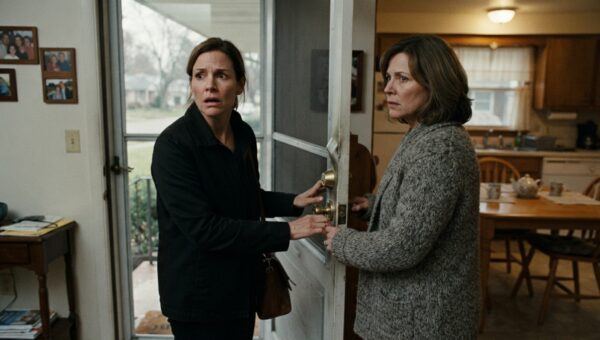
“Don’t let the screen door slam on your way out, Arthur,” Marcus said, taking a slow sip of his coffee. “We need our privacy back anyway.”
I didn’t look at him. I looked at Elena instead. She was standing by the refrigerator, her arms crossed tight over her chest, staring down at the linoleum like she was trying very hard not to see me at all.
She had her mother’s jaw, stubborn and set, but she had let Marcus do the talking for the last twelve months until her own voice sounded less like hers and more like an echo of his complaints.
“Goodbye, Elena,” I said quietly, the screen door clicking shut behind me with a dry, familiar rattle.
I walked three blocks down Maple Street to my old Buick LeSabre, the one with the dented rear quarter panel from where I backed into a mailbox back in two thousand and twelve. The engine turned over on the first try, steady and low. I didn’t drive far. I drove straight to the Pine Crest Extended Stay on the east side of town, paid for two weeks with my debit card, and carried my single bag up the metal stairs to room 114.
The room smelled faintly of stale carpet cleaner and pine disinfectant. The bedspread was a dull brown pattern that looked like it had survived three decades of traveling salesmen.
I sat down on the edge of the mattress and set Elena’s picture on the small nightstand beside a Gideon Bible.
The silence in the room was heavier than I thought it would be. For three years, my life had been the background noise of their household. The sound of Marcus stomping down the stairs at eight in the morning, complaining about his back or the coffee maker or the state of the economy. The sound of Elena running the dishwasher while trying to keep her voice down so she wouldn’t wake up her husband. I had spent seven hundred and thirty days filling the quiet spaces between them with my own savings, paying off the gaps they pretended didn’t exist.
Nobody told me how quiet freedom would feel once you finally closed the door on a place where you weren’t wanted.
On the second day, I sat at the small laminate desk by the window and pulled out my small leather checkbook register.
I didn’t feel angry. That surprised me. I just felt this strange, hollow sort of clarity, the kind you get when you finally put down a heavy box you have been carrying up a long hill for too long.
I called my bank at 9:15 in the morning.
“I need to stop all automatic monthly transfers from my primary checking account,” I told the teller, a young woman whose voice sounded entirely too cheerful for a Tuesday.
“Certainly, Mr. Vance,” she said, her keyboard clacking softly in the background. “Which accounts are we unlinking?”
“All of them,” I said. “The mortgage payment for the property on Oak Ridge Lane. The electric, the water, the gas, and the grocery delivery service. Cancel every single one effective immediately.”
She paused for a second. “That’s five separate recurring payments, sir. Are you sure you want to cancel the mortgage draft? That’s usually tied to a primary home loan.”
“I am entirely sure,” I said. “Turn them off.”
After I hung up the phone, I went down to the small kitchenette and made myself a cup of instant coffee using the little plastic machine on the counter. I watched a gray-haired man in a faded blue windbreaker wash his pickup truck in the gravel parking lot outside. I didn’t think about Marcus or Elena for a solid hour. I just watched the soapy water slide down the side of that old Ford and disappear into the drainage grate by the curb.
For the next four days, I stayed in room 114, walked down to the small diner on the corner for eggs and toast, and listened to the local radio station talk about the weather coming in from the mountains. I didn’t check my phone. I didn’t want to know what Marcus was saying to Elena about my absence, or how quickly they realized the house was suddenly short on groceries.
I knew how the math worked. Marcus had lost his main consulting contract back when the regional paper mill shut down, though he told Elena he left on principle because the management was incompetent. He hadn’t earned a steady dime in eighteen months. All he had done was shift his small freelance checks into his personal savings account for his weekend golf trips while my monthly retirement distribution quietly kept the roof over their heads, the lights burning, and the pantry full of expensive coffee and organic produce.
Marcus had convinced my daughter that I was just an aging dependent living off their charity, a third wheel who needed to earn his keep by fetching his son-in-law’s slippers and fixing the leaky garbage disposal without complaint. He wanted her to believe I was a burden so he could feel like the lord of a house he couldn’t even afford to insure.
On the morning of the seventh day, the sun came up hard and bright over the gravel parking lot, casting long shadows against the motel siding. I was sitting in the vinyl armchair by the window, reading the local paper, when my cell phone let out a short, sharp buzz on the nightstand.
Then it buzzed again. And again.
By the time I reached over to pick it up, the screen was lit up with notifications stacking on top of each other like a pile of dry kindling.
Twenty-two missed calls. All of them from Elena.
My thumb hovered over the screen for a second, feeling the cold glass. My heart didn’t race. It just settled into a slow, steady rhythm, the way it did when I used to wait out a hard frost in the orchard back home.
Beneath the list of missed calls was a single text message, sent forty seconds earlier.
Dad, please answer. I found the accounts. I had no idea you were paying for everything. Marcus lied to me. I need you.
I stared at those words for a long time. The motel room was dead quiet except for the low hum of the refrigerator in the corner. I didn’t feel the triumph I thought I might feel when the truth finally broke their door down. I just felt a deep, heavy sort of sorrow for my daughter, who had spent three years believing she was building a life with a man who was actually standing on top of my savings account just to keep his head above water.
My phone rang right then, vibrating against the nightstand with a sharp, insistent rattle.
I picked it up, watched Elena’s name flash across the screen, and pressed the green button.
“Dad?” her voice came through the speaker, thin and shaking so hard she could barely get the syllable out. “Dad, where are you?”
“I’m at the Pine Crest, honey,” I said, my voice steady. “Room 114.”
“You have to come back,” she cried, and I could hear the background noise of their kitchen, the frantic, high-pitched paper-rustling sound of someone tearing through a metal filing cabinet. “The bank sent an automated notice this morning. The mortgage hasn’t been paid for this month, and the electric company is threatening shut-off, and… and I opened the bottom drawer of the desk where Marcus keeps his files, Dad. I found the statements. You’ve been paying the mortgage. Every single month. For three years.”
“I told you I was helping out,” I said quietly.
“You weren’t helping out, you were carrying us!” Her voice broke completely, turning into a rough, jagged sob. “Marcus told me you were just chipping in for groceries. He told me he was paying the main bills. But the statements have your name on every wire transfer. All of them.”
“Where is Marcus?” I asked.
There was a long silence on the other end of the line, broken only by the ragged sound of her breathing. When she spoke again, all the softness was gone from her voice, replaced by something cold and hard and absolute.
“I packed his bags,” Elena said, her voice dropping to a harsh whisper. “I found his bank app on his iPad while he was still sleeping. He has twelve thousand dollars sitting in a private account while our electric bill was sitting in the past-due pile. I threw his golf clubs out on the front lawn ten minutes ago. I told him if he didn’t get off the property before the sheriff got here, I’d show the police his side of the text messages where he bragged about bleeding you dry.”
I didn’t say anything for a moment. I looked out the motel window at the gray Buick parked by the fence.
“Do you want me to come over, El?” I asked.
“I want you to have lunch with me,” she whispered, her voice cracking. “At that little diner on Fourth Street. The one Mom liked. If you’re willing to talk to me. I know I was awful to you, Dad. I let him treat you like a servant in your own home. I am so sorry. I didn’t know.”
“I’ll be there at twelve,” I said.
We hung up without another word.
I sat there on the edge of the brown motel bed for a long time, looking down at Elena’s picture on the nightstand. The glass was clean, catching the morning light from the window.
At twelve o’clock sharp, I walked into the diner on Fourth Street. The smell of frying onions and stale coffee hit me the second I pushed open the heavy glass door. Elena was sitting in the corner booth, the red vinyl one right beneath the framed picture of downtown Knoxville in the nineteen-seventies.
She looked smaller than she had a week ago. Her hair was pulled back into a loose clip, and her eyes were red around the edges, like she hadn’t slept since the bank notices arrived in their mailbox. On the seat beside her sat a thick manila folder bulging with white paper and yellow bank slips.
When she saw me walking toward the table, she started to stand up, then sank back down into the booth, her hands clenched tight in her lap.
I slid into the opposite seat, took off my jacket, and laid it on the empty space beside me.
“You look tired, El,” I said gently.
“I haven’t slept,” she said, her voice trembling as she reached across the table and pushed the manila folder toward me. “I read every single one of them, Dad. From the month you moved in until last Tuesday. You paid the insurance. You paid the property tax. You even paid for the oil changes on his car while he sat in the living room and told me you were a leech.”
“I wanted you to have a secure place to live,” I said plainly. “That’s all.”
“He called me stupid this morning,” she whispered, a single tear spilling over her lower lid and running down her cheek. “When I told him to get out, he laughed in my face and told me I couldn’t survive a month without his management. He said I was too blind to see how the world works.”
“People who are empty inside usually make the most noise when they’re leaving,” I said, reaching across the table to cover her trembling hand with my own.
She looked down at our hands, her shoulders shaking as she let out a long, shuddering breath. “Will you come back home, Dad? The house is yours. I talked to the mortgage company; we can transfer the primary deed into your name if you want. You never have to leave that room again.”
I pulled my hand back slowly and picked up the paper menu resting against the metal napkin holder.
“No, El,” I said softly, looking her straight in the eye. “I’m not moving back into that house.”
She flinched like I had struck her across the face. “Dad… please. I’m sorry. I’ll make it right.”
“You will make it right, but you’ll do it on your own terms, in your own house,” I said, setting the menu down on the table. “I love you more than anything in this world. I’d do it all over again if I had to, because you are my daughter. But I am not going back to live under a roof where my dignity is up for debate. I have my own place now. It’s clean, it’s quiet, and nobody tells me where to sit.”
Elena stared at me for a long time, her lips parting slightly. Then, slowly, the tension in her shoulders seemed to ease, replaced by a heavy, hard-won understanding. She nodded once, wiped her cheek with the back of her hand, and reached for the silver coffee pot the waitress was bringing over to our table.
Two days later, I signed the lease on a small, bright two-room apartment on the north side of town, right across from the public library where the maple trees are tall enough to shade the whole second-floor balcony.
The kitchen is small, just enough room for a round oak table and two wooden chairs. On the counter by the coffee maker, I set the framed picture of Elena standing by the old tire swing when she was six years old, her hair blowing in the wind, smiling up at a camera that didn’t know a single thing about what was coming down the road.
Every morning at seven o’clock, I fill my white ceramic mug, step out onto the metal-railed balcony, and watch the sun come up over the rooftops. The air smells like pine and damp cedar, clean and sharp in the early morning light.
My retirement funds are secure in my own name, my phone only rings when people who care to talk to me are on the other end, and for the first time in three years, the silence in my house doesn’t feel like something I have to pay for.