Seven hundred and thirty days had come and gone since I last heard my daughter say my name, and by March I had grown very good at pretending the silence did not hurt at all. You learn to live around an empty bedroom the way you live around a crooked step on your front porch. You just step over it without looking down.
My husband Don had been quiet about it too, mostly because there was nothing left to say after the argument we had on a rainy Tuesday back when the world still made sense. Jenna had packed her duffel bag in the front hallway, her jaw set in that stubborn way she inherited entirely from me, and she walked out the front door without turning back. I told myself pride was a spine. I told myself a mother has to hold her ground or the kids will walk all over her. But a spine gets stiff after three winters of looking at a phone that only rings with wrong numbers and church bulletins.
Then March rolled in with a raw, gray drizzle that soaked right through my boots whenever I walked down to the mailbox at the end of the gravel drive. That was when the Thursday pattern started, quiet as a mouse running behind the baseboards.
Don never used to care much about cologne, preferring the smell of fresh cedar shavings from his woodworking shed or just plain soap. But on three successive Thursdays, I caught the sharp, clean scent of sandalwood and citrus floating down the hallway while I was folding laundry in the back bedroom. He told me he was helping out an old buddy from his union days with some inventory work over at the supply warehouse in Creston, two towns over. I didn’t think much of it at first because Don was always fixing things for people. He was the kind of man who would drive forty miles in a snowstorm to help a stranger change a flat tire.
The trouble started on a Tuesday morning when I went to hang his winter coat in the hall closet before the weather warmed up for good. His canvas field jacket felt heavy on the left side, like he had a handful of loose change or a heavy pocket knife in the lining.
I reached in to clear it out, and my fingers brushed against a piece of smooth plastic instead of metal. I pulled it out into the dim light of the hallway, and my thumb immediately registered the slick, magnetic weight of a Creston Motor Inn keycard. It was tucked right behind a cream-colored piece of cardstock that read Save the Date in elegant script. I pulled that card out too, my heart doing a strange, heavy drop against my ribs. There was a date penciled in for June, and fourteen hundred dollars had quietly left our joint savings account in two separate withdrawals over the last six weeks. I didn’t scream or throw things because I was past the age of theatrical tantrums. I just walked straight down the hall to the spare room where I kept my laptop, pulled up the legal forms I had been researching for a month, and printed out the divorce papers with a steady hand.
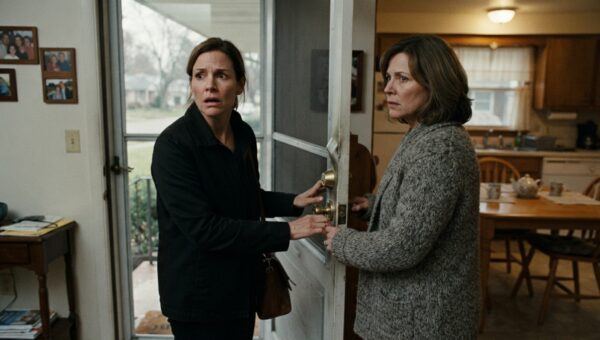
By Thursday evening, the house smelled of pot roast and boiled potatoes, normal and domestic, which felt entirely wrong given what I was carrying around in my apron pocket. Don walked through the back door at 6:15 PM, hanging his jacket on the peg by the door just like he always did, smelling faintly of that expensive citrus cologne. I didn’t wait for him to sit down at the table. I walked out of the kitchen with the hotel keycard, the Save the Date card, and the crisp white stack of divorce papers held out in front of me like a shield. I laid them down on the wood grain right between the salt shaker and the butter dish, the legal headings staring right back up at him in bold black type. Nobody said anything for a second and honestly that felt worse than shouting. The kitchen clock on the wall gave a loud, dry tick that seemed to echo off the cabinets.
“Who is she, Don?” I asked. My voice sounded thin and papery, like dry leaves scraping across a driveway. “Three months of Thursdays. Creston Motor Inn. Fourteen hundred dollars missing from the rainy-day fund. I want to know her name.”
I watched his face closely, waiting for the red flush of shame or the tight, defensive squint of a man caught in a lie. But Don didn’t get angry at all. He didn’t even blink. He just let out a long, slow breath that seemed to deflate his shoulders by an inch, and he reached slowly into the inside pocket of his shirt. He pulled out his old flip phone, tapped the screen twice with his thumb, and hit the speaker button before setting it down beside the divorce papers. The phone crackled with a burst of static, and then a young woman’s clear, bright voice filled our quiet kitchen, speaking words that hit me harder than a physical blow.
“Tell Mom I’ll save her a seat,” the voice said.
My hands went entirely still in my lap, the blood rushing in my ears so loud I could barely catch my breath. I knew that voice better than I knew my own reflection in the mirror. It was Jenna. It was the voice I hadn’t heard in seven hundred and thirty days, sounding older, clearer, and somehow lighter than it had the day she walked out our front door.
Don sat down slowly across from me, his calloused hands resting flat on the table, not touching the papers or the keycard. “It’s Jenna,” he said softly, his eyes fixed on the grain of the wood. “She called me back in March, right out of the blue. She’s marrying a good boy named Marcus in June, and she wants you there more than anything in the world. But she knew how stubborn you both were, and she was terrified you’d slam the door in her face if she called you directly.”
The kitchen seemed to tilt on its axis for a moment, the ordinary appliances and the half-eaten dinner dissolving into a blur of impossible light. I just sat there because my brain kind of stopped working for a second, trying to reconcile the vision of the other woman I had built in my head with the reality of my own flesh and blood. Don didn’t gloat or tell me I was a fool for jumping to conclusions. He just reached into his coat again, pulling out a handful of glossy photographs and a folded paper receipt from a bridal shop in Creston. He slid them across the table toward my fingertips one by one.
“I’ve been driving out there every Thursday to help her pick out a venue and get things sorted,” Don said quietly, his voice heavy with all the miles he had been keeping track of alone. “That fourteen hundred dollars didn’t go to any hotel room for a stranger. It went down as the deposit on her wedding dress so she wouldn’t have to start her marriage under a mountain of debt. She was too proud to ask you for help directly, and you were too proud to offer. So I became the go-between. Every Thursday I’d drive over, meet them after work, and we’d sit in a diner booth going over napkin colors and guest lists.”
He pointed a thick, steady finger at the receipt sitting beside the divorce papers, the ink stamped clear and neat by a clerk in Creston. “The motel keycard was just because we stayed late working on the seating chart last week and it got too late to drive back safely through the mountain pass in the dark. I didn’t tell you because every time I brought up Jenna’s name over the last three years, you’d walk out of the room or change the subject. I was trying to protect you from your own stubborn heart.”
I picked up the photographs with trembling fingers, my thumb brushing over the image of Jenna standing in front of a white lace dress hanging from a fitting room hook, smiling wider than I had seen her smile since she was sixteen years old. Tucked behind the pictures was a small, folded note written in her familiar, hurried handwriting, addressed to her father but clearly meant for me to see eventually. The words blurred behind the sudden, hot rush of tears I hadn’t invited, breaking through the dry dam I had built around myself for three long years. I looked down at the crisp white divorce papers I had printed out just an hour earlier, at the neat legal paragraphs detailing the division of a life we had spent decades building together.
Without saying another word, I picked up the stack of legal forms in both hands and tore them right down the middle with a sharp, tearing sound that filled the quiet room. I folded the halves over again and dropped the ragged pieces into the metal wastebasket beside the sink, watching them settle among the vegetable peelings and the junk mail. Don didn’t move or say I told you so. He just watched me with those tired, steady eyes, waiting to see what was left of me underneath all that armor I had been wearing for so long.
“Give me the phone, Don,” I whispered, wiping the back of my hand across my cheek. “Give me the phone right now.”
He slid the old flip phone across the laminate surface toward me without a word. My thumb shook so badly against the plastic buttons that I had to dial the ten digits twice before I got the number right, the little screen glowing in the darkening kitchen. It rang four times, long and hollow, and then a familiar voice answered on the other end of the line, breathless and hesitant.
“Hello?” Jenna said.
The kitchen was so quiet I could hear the faint hum of the refrigerator in the corner and the distant sound of a truck shifting gears out on the highway. I took a deep breath, fighting the lump in my throat that felt as hard as a stone.
“Jenna,” I managed to get out, my voice cracking right down the middle. “Your dad tells me you’re saving me a seat.”
There was a sharp intake of breath on the other end of the line, a sudden, ragged sound that told me she was crying too. “Mom?” she whispered, her voice trembling. “Are you really there?”
“I’m here,” I said, looking across the table at Don, who finally let out a long, shaky breath and reached across to cover my hand with his own. “I’m right here, honey. Tell me what time I need to be fitted for my dress.”