Simon didn’t give gifts. Not for birthdays, not for anniversaries, not even for Christmas unless my mother sent something and forced him to sign his name to the card before handing it over. For twenty years, I lived as his unpaid housekeeper, cooking his meals, ironing his shirts, keeping the house quiet so he could rest after his office job.
I told myself it was just how men from his side of the county were built. They didn’t do sentiment. They just worked and expected a hot supper when they came through the back door at six o’clock.
That Christmas Eve started like every other holiday in that house, with me scrubbing the grease off the back burner while the ham baked in the oven. Simon had left at three o’clock to pick up some last-minute file from his downtown office, claiming the regional director needed a signature before the holiday shutdown. By eight o’clock, the ham was cooling on the counter and the gravy had skinned over in the pan. I sat by the window watching the sleet turn the cedar branches heavy and gray.
When the clock on the mantel ticked past nine, I finally dialed his cell phone. It rang four times before he picked up, the background noise sounding like the muffled hum of a crowded restaurant bar rather than an empty office floor.
“I’m busy! CAN’T YOU JUST LEAVE ME ALONE ALREADY?!” he shouted before the line went dead with a sharp click.
I sat down hard on the braided rug by the hearth, the tears coming fast and hot because I realized I wasn’t even worth a polite lie anymore. Nobody said anything for a minute, and the quiet in that room felt heavier than lead. I pulled myself up off the floor, wiping my face with the sleeve of my cardigan, and walked across the living room to pull the heavy velvet drapes shut against the sleet.
That was when I saw it tucked behind the lower boughs of the fir tree.
It was a flat square box wrapped in heavy silver paper with a satin bow that looked like it came straight from a high-end department store counter. I hadn’t wrapped it. I wrapped every single gift in this house using the cheap red-and-green rolls from the dollar store down by the hardware yard.
My fingers felt clumsy and cold as I tugged the ribbon free and pulled the lid off the heavy cardboard.
Inside sat a velvet jewelry case and a manila folder with my address typed across the tab in neat black letters. I popped the jewelry case open first, catching the dull gleam of a heavy gold tennis bracelet set with diamonds that blinked back the light from the tree bulbs. Tucked under the hinge was a small cream card written in Simon’s familiar, hurried cursive.
To Clara, my real future. Merry Christmas, gorgeous. We are almost free.
The room seemed to tilt sideways for a second. I pulled the manila folder open with shaking fingers, letting the papers fan out across my lap. They weren’t office memos. They were draft divorce filings, drawn up by an attorney in Portland three weeks prior, assigning our house, our savings accounts, and even the equity in my father’s old woodlot to a corporate shell company named Meridian Holdings.
Everything I had worked for, every year I spent scrubbing his floors and washing his socks, was being signed away without my signature.
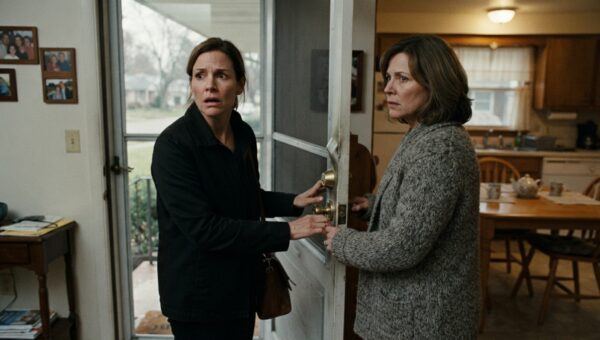
I didn’t scream. I didn’t throw anything. I just stood up, left the front door wide open to the cold draft, and ran down the gravel drive in my slippers all the way to Brenda’s porch three houses down.
Brenda took one look at my face when she opened her door in her flannel bathrobe and pulled me inside without asking a single question.
“Get in here out of the wind, honey,” she said, her voice dropping an octave as she steered me toward her kitchen table and poured me a cup of black coffee that smelled like chicory.
I didn’t answer right away because my teeth were chattering too hard to form words. I just pulled the creased card and the legal papers out of my coat pocket and laid them flat on her oilcloth table next to the sugar bowl. Brenda read the card twice, her lips pressing together into a thin white line that I knew meant she was fixing to get mad. She wasn’t a woman who raised her voice, but when she set her mug down on the wood, it didn’t make a sound.
“That son of a bitch,” Brenda whispered, her eyes fixed on the signature at the bottom of the property transfer. “Simon has been running around behind your back with someone from the regional office, hasn’t he?”
Three weeks later, the snow had melted into gray slush along the edges of the macadam, and I was sitting across a folding table from a family law attorney named Marcus Vance whose office smelled of old law reporters and peppermint tea. Brenda had driven me there in her pickup truck, waiting in the parking lot with the heater running while I laid every single document from that Christmas box out between us. Mr. Vance didn’t look shocked or surprised. He just adjusted his wire-rimmed glasses, jotted down the file numbers from the corporate shell company, and told me we had enough financial paper trails to freeze Simon’s personal accounts before the court date.
“He made a mistake leaving these in the house,” Mr. Vance said, tapping his yellow legal pad with a blue ballpoint pen. “He thought he could blindside you after the first of the year. We are going to move first.”
By the time Christmas Day rolled around twenty-four hours after my discovery, Simon still hadn’t come home. He had sent a brief text message at midnight claiming his car battery had died in the office garage and he was sleeping on the cot in the breakroom. I packed two suitcases with my mother’s cedar chest linens, my winter coats, and the small porcelain butter churn that belonged to my grandmother, loading them into the trunk of my old Subaru while the neighborhood was still quiet.
I left the Christmas tree lights plugged in. I left the silver-wrapped box right where I found it, open on the coffee table with the diamond bracelet and the Clara card resting neatly on top of the draft divorce papers. Then I drove over to Brenda’s spare bedroom and slept for ten hours straight without waking up once.
Simon came home late on Christmas afternoon, expecting his usual plate of warmed-over ham and a wife who would apologize for locking him out of the conversation.
According to Brenda, whose kitchen window faced the side of our drive, he sat in his idling sedan for nearly ten minutes before he finally got out and walked up the front steps without his briefcase. He didn’t find me in the kitchen. He didn’t find his dinner in the oven.
When I went back to the house two days later with the sheriff’s deputy standing by the front porch to keep the peace, Simon looked ten years older, his collar unbuttoned and his hair standing up in gray tufts where he’d been pulling at it. He tried to block the doorway with his shoulder, his voice dropping into that low, wheedling tone he used whenever he needed me to lie to his sister about why we couldn’t visit for Thanksgiving.
“Look, let’s just sit down and talk about this like adults,” he said, reaching out a hand toward my arm as if he could still steer me wherever he wanted. “The firm has been stressful lately. That card was a joke between some of the guys from the warehouse. It doesn’t mean anything.”
I didn’t step inside the foyer. I stayed out on the concrete porch where the cold air felt clean and sharp against my skin.
“Don’t lie to me,” I said, my voice sounding steadier than I felt inside. “My lawyer has the copies of the property transfers and the bank statements from the credit union. The house is already tied up in the injunction, Simon. You can call Clara and tell her the future is on hold.”
He stared at me then, really looked at me, as if he were seeing a stranger standing on his welcome mat instead of the woman who had ironed his shirts every Sunday night since we were twenty-two years old.
“You can’t do this,” he muttered, his face turning that blotchy, grayish red that always meant he was losing control of the room. “We’ve got twenty years invested here. Where are you even going to go?”
I turned around and walked down the steps toward Brenda’s truck without looking back to see if he followed me.
Now, three months down the road, I am sitting in the corner booth of the diner off Route 4 watching the morning sun come through the plate glass window. The coffee in my mug is hot and strong, and I didn’t have to boil it on a stove I cleaned myself. My name is the only one on the lease for the two-bedroom apartment above the hardware store, and the ring finger on my left hand feels light, cool, and entirely empty.