The green ceramic mug was still sitting on the laminate counter when Julian stood up from the kitchen table. It was three weeks after our first anniversary, fourteen months since we stood under the maple trees in my cousin’s backyard and said our vows, and the silence in our little house on River Road had a heavy, metallic edge to it.
Julian had been doing it for eight months. Every single night at precisely 3:05 AM, the floorboards outside our bedroom would creak under his bare feet, and he would drift down the dark hallway like a ghost with his eyes half-glazed and his mouth moving in silent, rhythmic murmurs. I had spent months worrying myself sick over him, calling neurology clinics in Albany, researching REM sleep behavior disorders on my phone until my eyes burned, and tiptoeing behind him in the dark to make sure he didn’t turn on the stove or walk out the front door into the upstate chill.
Back then, everything still felt tender and new, or at least I kept telling myself it did. We were still living in the shadow of my father’s sudden passing from a massive heart stroke just two months before the wedding, a loss that had left me untethered and clinging to Julian like he was the only solid thing left in the world.
Daddy had been a towering figure in our corner of the Hudson Valley, a man who built half the municipal bridges and school additions in the county and whose word was treated like scripture down at the town hall. When Julian offered to go through Daddy’s forgotten storage unit down by the river to help me clear out the old filing cabinets and boxes of paperwork, I thought it was the kindest, most selfless thing a new husband could do. I remember watching him carry those heavy cardboard banker boxes out of the damp concrete room, his sleeves rolled up, his forehead dotted with honest sweat, telling me gently, “Let me handle the messy stuff, honey, you’ve carried enough this year.”
I don’t even know why I remember the exact weight of those boxes now, but my mind keeps drifting back to them. I was so grateful I could barely see straight.
Julian took over the spare room in the back of the house, turning it into his makeshift archive, spending hours behind a locked door sorting through old tax receipts and blueprinted municipal contracts from the seventies and eighties. He told me it was comforting to learn how my father had built his legacy from the ground up, brick by honest brick, before handing the reins over to the partners who bought out the firm after his retirement. I would bring him a turkey sandwich at noon, and he would look up with those tired, sympathetic eyes, thanking me with a soft kiss on the cheek.
The sleepwalking started three months after that cleanout began. At first it was just shuffling. Then came the mumbling in the dark kitchen. I would find him standing motionless in front of the empty refrigerator, staring into the dark with his jaw slack, muttering phrases that never quite made sense when I tried to shake him awake. “The load is shifting,” he whispered one Tuesday night in November, his fingers twitching against the handle of the vegetable crisper. “We have to adjust the line before the audit hits.” When I called out his name, he would blink slowly, look around with a dazed, confused expression, and rub his temples as if he had just woken from a terrible dream. “I’m sorry, babe,” he would murmur, wrapping his arms around me with a shudder. “Must be the stress from the new accounts at the firm.
I’ll make an appointment with Dr. Hayes next week.” He never made the appointment, of course, and after a while, I stopped asking him to.
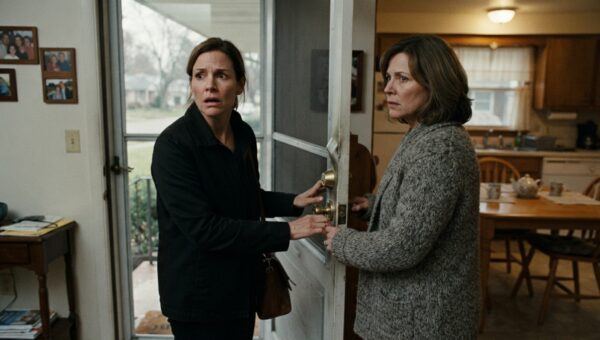
The night it all broke open started like any other, except the air had that sharp, biting dampness that comes right before an early spring frost. I woke up at 2:58 AM to an empty mattress on my right side. The digital clock on the nightstand glared red in the dark: 2:59. I lay there for a minute listening to the hum of the refrigerator downstairs, feeling that familiar knot of anxiety twist in my stomach. I got up, pulled my flannel robe tight around my shoulders, and stepped out into the hallway. The hardwood was freezing under my bare feet. I didn’t turn on the overhead lights; I just navigated by the faint amber glow of the streetlamp outside the front window. When I reached the top of the stairs, I heard the low, steady murmur of a voice coming from the den. It wasn’t the broken, rambling mutter of a sleepwalker. It was crisp, deliberate, and entirely awake.
I crept down the remaining steps, holding my breath, my hand trailing along the cold wooden banister. The door to the den was cracked open about two inches, and a narrow wedge of blue light spilled out onto the hallway rug. I froze with my shoulder pressed against the drywalled corner, my heart hammering so hard against my ribs I was terrified he would hear it through the walls. Julian was sitting at his mahogany desk, leaning forward into the glow of his laptop screen, holding our old landline phone to his ear with his shoulder. His voice wasn’t slurred or distant. It was sharp, cold, and entirely unfamiliar. “She doesn’t suspect anything,” he said into the receiver, and every drop of warmth drained out of my body. “The paperwork is ready. I moved $90,000 yesterday through the shell in Delaware, and the rest clears out once the title transfer goes through on Friday.”
I stood there in the dark hallway for a long time, my brain refusing to stitch the pieces together. Eighty thousand dollars of our joint savings, gone. Eight months of midnight theater, gone. I didn’t cry. I didn’t scream. I walked quietly back to our bedroom, picked up my phone from the nightstand, and sat on the edge of the bed with my knees pulled up to my chest. I opened our bank app with trembling fingers, tapped on the joint savings account we had funded with our wedding gifts and my small inheritance, and stared at the available balance. The number mocking me from the screen was $8,420. The rest had been siphoned off in four separate wire transfers over the past three weeks, each one routed through an intermediary account I had never seen before.
I didn’t wake him up. I didn’t confront him while the rage was still hot and stupid in my throat. I waited until the house went completely silent again at 3:34 AM, and then I took the landline phone off the receiver in the kitchen, sat down at the heavy oak table, and dialed the number glowing in the recent-call log on Julian’s desk phone. It rang three times before a woman’s calm, professional voice answered on the other end, sounding as awake as if it were the middle of the afternoon. “This is Vanessa,” she said smoothly, without a trace of sleep in her tone. “If this is about the Cayman routing, the signatures need to be notarized by noon tomorrow or the escrow closes.”
My voice came out lower and steadier than I expected it to. “Who is this?” There was a sharp intake of breath on the other end of the line, followed by the sound of rustling paper. Then Vanessa let out a short, dry laugh that made the hair on my arms stand up. “Oh,” she said, her tone shifting from businesslike to something almost pitying. “You must be Julian’s wife. Look, if he hasn’t told you yet, I’m sorry, but you need to know what you’re sitting on. He’s not leaving you for me. He’s running. From what he found in your father’s old storage unit down on 4th Street. Documents that prove your entire family’s fortune came from a pension-embezzlement ring that cheated hundreds of local union workers for thirty years.”
The kitchen seemed to tilt sideways for a second, the yellow paint on the walls blurring into gray. “You’re lying,” I whispered into the mouthpiece. “My father built municipal bridges. He was an honest man.” Vanessa didn’t sound angry or defensive; she just sounded tired of cleaning up other people’s messes. “Check the third filing cabinet in that unit, honey,” she said softly. “The locked one under the tarp. Look for the black ledger labeled ‘Special Reserves.’ Julian found it back in October, and instead of telling you, he figured out how to drain your accounts and secure a second passport before the federal subpoenas land on your doorstep. He’s leaving you to take the fall for an estate that was built on stolen bread. Have a good night.” The line went dead with a sharp click.
Dawn didn’t bring any relief, just a hard, pale light that made everything in the kitchen look gray and cheap. I didn’t wait for Julian to wake up. At 7:00 AM, I grabbed the heavy brass key ring from the hook by the pantry, walked out to my Subaru, and drove the three miles down to the 4th Street self-storage facility before the office even opened. The morning air was biting, smelling of damp asphalt and old river silt as I walked down the narrow, gravel-paved aisle to Unit 114. My hands were shaking so badly I dropped the key twice before it finally caught in the heavy padlock. I pulled the corrugated metal door upward with a sharp rattle that echoed off the concrete walls, and there it was: the dusty cardboard boxes Julian had supposedly sorted through months ago, still stacked against the back wall under a grease-stained canvas tarp.
I climbed over a broken crate and knelt down in the dust, ripping open the lid of the third metal filing box marked with my father’s old handwriting. Inside were rows of thick, leather-bound ledgers with yellowed pages covered in neat, meticulous columns of figures. I flipped open the one marked 1988. It wasn’t construction costs or steel orders. It was a dual-entry payroll record detailing how millions of dollars in municipal pension funds had been systematically diverted through shell companies registered in Delaware and Panama, skimming three percent off every public contract while real working men lost their medical benefits and pensions. Clipped to the back page of the ledger was a pink carbon copy of a federal grand jury subpoena addressed directly to my father’s estate trust, dated three weeks before he passed away. Julian hadn’t just found old family papers. He had found a ticking bomb, and instead of talking to me about it, he had calculated exactly how much cash he could steal before the fuse burned down to the wire.
I didn’t cry in that storage unit. I felt a strange, cold clarity settle over my bones, replacing the panic with something much harder and sharper. I closed the metal box, pulled the padlock back through the latch, and drove straight to the offices of Miller and Vance, a white-collar criminal defense firm located in an old brick building near the county courthouse. By 9:30 AM, I was sitting across a mahogany desk from a gray-haired attorney named Arthur Vance, laying out the bank statements, the phone records, and the exact location of the storage unit files while my hands finally stopped shaking. Arthur listened without interrupting, his eyes narrowing as he flipped through the printouts of the wire transfers to Delaware. “He’s trying to liquidate and jump the border before the estate auditors realize the accounts are tied to the original fraud indictments,” Arthur said quietly, tapping a silver pen against his chin. “If we move right now, we can freeze every penny of that offshore transfer through federal banking compliance before the final escrow clears. And as for you, my dear, we’re going to file for an emergency asset freeze and turn these ledgers over to the U.S. Attorney’s office under a complete cooperation agreement before Julian’s name is anywhere near the warrant.”
The rest of the morning moved in a blur of stamped documents, digital signatures, and whispered phone calls to federal investigators who had been tracking the old municipal embezzlement ring for over a year. By 4:00 PM, the emergency injunctions had been signed by a federal judge, and the offshore account in Delaware was officially locked down by banking compliance officers. I drove back home with a manila folder resting on the passenger seat, my heart beating in a steady, rhythmic thud against my ribs. The Subaru’s tires crunched on the gravel driveway as I pulled up to the house. Julian’s sedan was parked in the spot by the side door, its trunk wide open to the gray evening sky.
When I pushed the front door open, the smell of cedar and dry cleaning hit me immediately. Julian was standing in the middle of our bedroom with his navy travel duffel open on the bed, frantically stuffing shirts and folded sweaters into the canvas compartments. His face went gray when he saw me standing in the doorway with my coat still buttoned up to my chin. He stopped with a blue dress shirt clutched in his fist, his mouth opening and closing a couple of times before he managed to squeeze out a choked, desperate sound. “Honey,” he stammered, taking a half-step toward me with his eyes wide and pleading. “Thank God you’re here. You won’t believe what I just found out. The federal investigators, they’re looking into your father’s old accounts, everything is compromised, I was just packing up some files to take to the lawyer’s office to protect us, “
I didn’t move. I didn’t raise my voice. I reached into my coat pocket, pulled out the manila folder, and tossed it across the bed so it landed squarely on top of his half-packed clothes. “You don’t need to pack the files, Julian,” I said, my voice sounding like it belonged to a total stranger standing somewhere outside my own body. “I went down to the storage unit this morning. And I spoke to Vanessa at the offshore brokerage firm. The only thing you’re protecting is your own skin.” Julian froze, the blue shirt slipping from his fingers and landing softly on the duvet. He stared at me for three long seconds, all the rehearsed panic draining out of his face until nothing was left except a cold, calculating hardness. “You’re a fool,” he hissed, his voice dropping an octave as he stepped toward the edge of the bed. “If I didn’t move that money, the government would have seized every single cent we had to pay off your father’s victims. I was saving us.”
“You were saving yourself,” I said quietly, taking a step back toward the hallway. “And you forgot one little detail. The $90,000 you wired yesterday? Federal banking compliance froze it four hours ago. Vanessa cooperated as soon as she realized the funds were tied to an active grand jury subpoena.” Before he could lunge forward or find another lie to stitch together, heavy footsteps echoed on the front porch, followed by two sharp raps on our front door. Through the open bedroom window, I could see two men in dark windbreakers standing on the porch step, their federal badges catching the last amber rays of the April sun. Julian turned back toward the window, his shoulders slumping all at once as the weight of what he had built came crashing down around him. I turned my back on him, walked down the hallway without looking back, and pulled the front door shut behind me, leaving the house to the silence it had always deserved.