The red notification light on my old cell phone blinked three times against the nightstand before I finally reached over and picked it up. It was 6:59 on a Tuesday evening when the caller ID flashed a number I hadn’t seen on a screen in nearly six years. My hand was shaking against the plastic case because I already knew whose voice was going to come through the speaker before I even pressed accept.
Back in 2018, the world I knew shrank down to the size of a two-bedroom apartment that smelled entirely of spoiled milk and wet diapers. My sister Brenda had left her three kids alone for two whole weeks to go on what she called a trip, which the police report later classified as a motel-room bender three counties over. The oldest, Leo, was only nine then, old enough to remember the sound of the front door clicking shut and old enough to try to feed his four-year-old sister and three-month-old baby sister dry cereal out of the bottom of the pantry until the boxes ran completely empty. When child services finally called me to come down to the precinct, Leo was holding his baby sister so tight his knuckles were white as chalk, and he wouldn’t let go of my coat even after we got into my little sedan.
We had to move them out of that district immediately, switch their schools, find new daycares, and learn how to function without looking over our shoulders every time a car door slammed outside.
Over the next five years, my life became carpools, parent-teacher conferences, bedtime stories, and the quiet, heavy work of convincing three traumatized kids that nobody was packing bags in the middle of the night anymore. I gave up my apartment in Pittsburgh, moved back into our old family house with the peeling white trim, and built a predictable, safe rhythm where meals happened at six and nobody ever yelled unless the Steelers were playing.
Brenda spent those years moving through the state system, first county jail, then a stint upstate, while I became Mom in every way that actually mattered. The kids grew up calling me by my first name sometimes and mama other times, and I stopped trying to correct them because it all meant the same thing under our roof. The little girls, Maya and Lily, only knew Brenda from faded photographs tucked inside a gray photo album in the back of my closet, and they asked about her about as often as they asked about the weather last Tuesday.
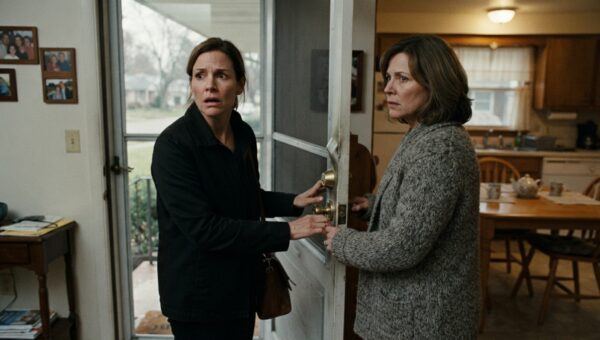
Then the phone rang that Tuesday evening, and Brenda’s voice came through the line clear, sharp, and entirely unchanged by six years behind wire fences. She didn’t ask how I was doing, and she didn’t waste any time with pleasantries before she dropped the sentence that made my stomach turn cold.
“I’m out now, so you can just pack up their things and give them back,” Brenda said, her tone brisk like she was talking about picking up dry cleaning.
I stood there in the quiet hallway of my house, staring at the small gray smudge on the wall where Lily liked to lean her shoulder, and my tongue felt too heavy for my mouth. I tried to tell her that things weren’t that simple, that kids aren’t spare keys you leave under a mat, but she just talked right over me. She told me her probation officer had signed off on her housing, that she had a job folding napkins at a diner off Route 22, and that a mother has rights that the state can’t just throw away because of a few mistakes.
“I’m coming over on Saturday to pick them up, so be ready,” she said right before the line went dead with a sharp click.
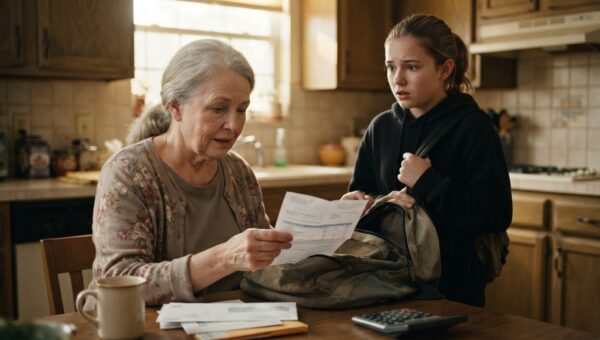
I didn’t sleep at all that night, pacing the hallway between the children’s rooms while the refrigerator hummed in the kitchen below. Leo, who is fifteen now and broad-shouldered like our grandfather, caught me sitting at the kitchen table at 4:52 in the morning with a cup of cold chicory between my hands. He didn’t ask why I looked like I’d been crying, because he already knew the look on my face from the nights when he used to wake up screaming about empty cereal boxes.
“She called, didn’t she?” Leo asked, leaning his shoulder against the doorframe with his arms crossed over his chest.
I looked up at him and nodded because I never believed in lying to him about the things that affected his life. We sat down together at the laminate table, just the two of us while the rest of the house was still asleep, and I asked him the hardest question an aunt should ever have to ask her nephew.
“Brenda wants to see you guys,” I said, my voice cracking slightly around the edges. “She says she’s ready to be a mom again.”
Leo didn’t look down at his shoes or fidget the way he used to when he was little, and that stillness scared me more than any outburst could have. He just stared right through the window above the sink where the sky was turning the color of wet slate.
“I don’t want to see her,” Leo said, his voice dropping an octave into something frighteningly adult. “I don’t care that she’s out. I still hate her for leaving us alone in that dark apartment.”
He stood up, walked back down the hall toward his room, and closed his door with a soft click that echoed through the empty house. I sat there alone in the dark kitchen for a long time, wrestling with the heavy guilt that hummed behind my ribs like an electric wire. Part of me, the weak part that remembered sharing bedrooms with Brenda when we were girls, wondered if I was being too hard, if I was keeping them away just because I liked being the indispensable one. But then I remembered the way Leo’s ribs looked through his shirt back in 2018, and I knew I couldn’t trade his hard-earned peace for my sister’s guilty conscience.
By Friday afternoon, Brenda had called four more times, each message growing more frantic and angry until she threatened to call the sheriff and report me for kidnapping my own nieces and nephew. I didn’t answer her calls, but I texted her a single address for a neutral diner forty miles away from our town, telling her we would meet on Saturday morning without the children or we wouldn’t meet at all.
Saturday morning came with a heavy, gray mist hanging over the valley, the kind of damp weather that smells like old coal dust and wet gravel. The Heritage Diner at the south end of Route 1 was half-empty when I walked in, smelling of fried bacon and stale floor wax just like it always did on weekends. Brenda was already sitting in a red vinyl booth near the back, wearing a denim jacket that looked too tight across her shoulders and tapping a long, painted fingernail against the laminate tabletop.
She didn’t look like a monster, and that was always the hardest part of dealing with Brenda, because she just looked like an ordinary woman who had worn her life down to the nub. She looked up as I slid into the opposite side of the booth, her eyes sharp and scanning the empty space behind me like she expected three kids to pop out from under the table.
“Where are they?” Brenda asked before the waitress even had time to drop off our menus. “I told you to bring them so we could go home.”
I kept my hands flat on the table, right over the edge where the red vinyl was torn and patched with gray duct tape. I told her plainly that the kids weren’t coming, that Leo had said no, and that the legal custody papers we filed back in 2018 were still very much in effect.
Brenda’s face twisted up, and she leaned across the table so fast her coffee cup rattled in its saucer.
“You stole my kids while I was gone,” she hissed, her voice rising high enough that the waitress stopped wiping down the counter near the register. “You think you’re some kind of saint because you kept them fed for a few years? They’re my blood. Give them back.”
I didn’t yell back, and I didn’t let my hands shake, because I had spent six years becoming the person these kids needed me to be.
“You left a three-month-old baby on a mattress with a nine-year-old who didn’t know how to boil water, Brenda,” I said, my voice dropping down to a quiet hum that cut right through her anger. “Leo remembers every single day of those two weeks. He doesn’t want to see you, and I am not going to drag him into a room just to make you feel better about the years you missed.”
She stared at me for a long time, her mouth half-open like she was trying to find a word that was meaner than the truth, but nothing came out.
“You can’t keep them from me forever,” she whispered finally, though the fight had gone entirely out of her shoulders.
“I’m not keeping them from anyone,” I said, sliding a small business card for a family counselor across the table toward her coffee mug. “If you want to earn the right to be in their lives, you start through the courts, and you start by listening to what Leo needs instead of what you want. Until then, stay away from our house.”
I left a five-dollar bill on the table for the coffee I never ordered, stood up from the red vinyl booth, and walked out into the cool morning air without looking back once. The drive home took forty minutes through the winding mill roads, and by the time I pulled into the driveway, the mist had burned off into a pale, clean afternoon sun.
When I opened the front door, the smell of cinnamon and baked apples hit me right in the face from the kitchen where Lily was standing on a stepstool trying to stir batter with a wooden spoon. Leo was sitting at the kitchen table with his history book open, working through his homework under the warm circle of the desk lamp while Maya colored with crayons on the floor beside him. They all looked up when the door clicked shut, their eyes checking my face for trouble the way they always did whenever I came back from dealing with the outside world.
I hung my coat on the peg by the door, walked over to the table, and ruffled Leo’s hair as I passed by his chair. He didn’t pull away, just leaned his head into my hand for half a second before going back to his dates and battles. I sat down at the edge of the table to help Maya find her yellow crayon, listening to the quiet, steady hum of the house we built together out of the wreckage of everything that came before.