Seven hundred and thirty days had come and gone since I last heard my seven-year-old son Toby laugh without that awful, shallow rattle in his chest, and by last month I had grown very good at pretending the silence did not frighten me.
I spent most of my mornings sitting at our old laminate kitchen table, watching the small digital clock on the microwave tick past 4:52, wondering how a person is supposed to keep breathing when they are waiting for a phone call that might never come.
Toby was upstairs sleeping under a heavy quilt, his skin the color of skim milk, his little body worn down to bone by end-stage renal failure. The doctors at the regional transplant center in Amarillo had told us plainly that our chances on the donor registry were sliding downward by the week. We needed a miracle. Or we needed money we didn’t have, or time we were rapidly running out of.
Then the phone on the counter vibrated twice against the Formica.
Dr. Aris didn’t waste breath on small talk when I picked up. He just told me to get Toby and our overnight bags down to the emergency intake bay inside forty minutes because a matched organ had just arrived via courier from a regional center two counties over. He spoke fast, his voice clipped and breathless, telling me the donor was a non-directed altruistic match who wished to remain entirely anonymous. No names, no background, no interviews.
Three weeks after the successful transplant surgery, when Toby was finally strong enough to sip chicken broth from a yellow plastic bowl, I found a folded slip of heavy white stationery tucked underneath his hospital chart on the bedside tray. It wasn’t signed by a doctor or a nurse. It was written in a sharp, left-leaning script that I didn’t recognize, using a cheap black ballpoint pen.
The note was only six words long.
“I Had Two. He Had None. The Math Was Simple.”
For twelve solid months, those six words lived rent-free inside my head. I carried that slip of paper in my wallet until the ink started to blur along the creases. I asked every nurse on the pediatric floor if they knew who brought it, but the privacy protocols were ironclad. Whoever saved my son had paid all their own travel expenses, declined to be interviewed by the hospital public relations team, and vanished before Toby even opened his eyes in recovery.
“Mom, can we plant the tomatoes today?” Toby asked me last Tuesday afternoon, tugging on the hem of my apron while the kitchen windows rattled against a stiff spring wind.
He looked healthy. His cheeks had filled out with a normal, ruddy color, and his sneakers were scuffed at the toes from running across the school playground. Looking at him, it was hard to believe he had ever been tethered to a dialysis machine. But the debt of gratitude I owed the unknown donor was a heavy weight pressing against my chest every single day. I couldn’t thank anyone. I couldn’t send a card. I couldn’t even say a proper prayer because I didn’t know whose name to put on it.
The official letter from the transplant registry arrived in the mail on a rainy Thursday morning.
The mandatory one-year anonymization buffer period had officially expired. The donor liaison, a kind woman named Brenda whose voice I recognized from half a dozen previous phone calls, explained that the non-directed donor had finally signed the secondary consent form allowing mutual contact information to be released upon request.
“Are you sure?” I asked, gripping the landline receiver so hard my knuckles went white. “She actually wants to talk to me?”
“She checked the box consenting to direct contact, Mrs. Miller,” Brenda said softly through the static. “The forwarding address is on file here in our regional database. It’s about forty miles east of you, out past the county line.”
She read off a street name in a quiet, dead-end neighborhood in the next town over, and I wrote it down on the back of a grocery receipt with a shaking hand.
The drive took forty-four minutes.
The sky over the plains was the color of a wet slate roof, low and heavy with the threat of April hail. My station wagon hummed along the two-lane asphalt highway, the tires throwing up a steady hiss of spray against the wheel wells. Every mile I put behind me felt like driving deeper into a past I had spent the last eight years running away from.
The address Brenda gave me led to a small, single-story brick cottage sitting back from the road behind a thick hedge of overgrown boxwoods. A faded blue sedan was parked in the gravel drive, its front bumper scraped near the headlight. The front yard was neat enough, though the grass needed an early spring mowing, and a single rusted metal lawn chair sat near the front steps under a drooping hackberry tree.
I parked three houses down because my hands were shaking too hard to parallel park properly against the curb.
I sat in the idling car for five full minutes, staring through the windshield at the peeling white paint around the front door frame. The house looked quiet. Too quiet. A thin wisp of gray smoke was drifting lazily from the brick chimney, suggesting someone was inside tending a wood-burning stove against the damp chill.
I turned off the ignition, stepped out into the wet gravel, and walked slowly up the front path.
The crunch of my boots sounded loud against the dead winter grass. I didn’t know what I was going to say when the door opened. I had rehearsed a dozen different speeches during the long drive, ranging from formal expressions of medical gratitude to tearful breakdowns, but none of them felt right.
I reached out and knocked twice on the wooden screen door.
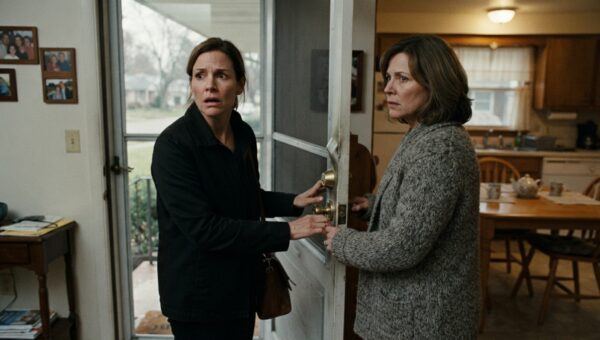
Inside, I heard the faint scuffle of soft-soled shoes against a hardwood floor, followed by the metallic click of an interior latch turning. The screen door pushed outward with a slight squeak, and the woman standing in the doorway looked right into my eyes.
The world kind of stopped working for a second.
The breath went out of my lungs in a sharp rush, and I had to reach out and grab the rough wooden porch pillar to keep from stumbling backward off the step.
It wasn’t a stranger.
It was Evelyn.
My older sister Evelyn stood there wearing an oversized flannel shirt with the sleeves rolled up to her elbows, her graying brown hair pulled back in a loose, messy clip. Her face was thinner than I remembered, lines carved deep around her mouth and eyes, but the sharp, steady gaze was unmistakable. She froze with her hand resting on the wooden frame, her lips slightly parted, staring at me as if she were looking at a ghost.
Nobody said anything for a second and honestly that felt worse than shouting.
“What are you doing here, Clara?” Evelyn finally asked. Her voice was remarkably steady, though I could hear the faint catch in the back of her throat.
“You,” was all I managed to get out. My throat felt dry as sandpaper. “It was you.”
Evelyn didn’t try to close the door. She didn’t look away. She just let her hand drop slowly to her side and looked down at the porch floorboards for a long moment before meeting my eyes again.
“Toby needed a match,” she said quietly, as if that explained eight years of complete silence, bitter estrangement, and a major organ transplant.
“You gave him your kidney,” I whispered, my voice cracking right down the middle. “You gave a piece of yourself to a kid you haven’t laid eyes on since he was a baby.”
“I had two. He had none,” Evelyn replied, repeating the exact words from the note she left at the hospital. “The math was simple.”
The weight of eight stubborn, angry years came crashing down on us right there on that damp wooden porch. I thought about how we stopped talking after our mother passed away, fighting over old debts and stubborn pride, letting a stupid family argument turn into a permanent wall of silence. I had spent years telling myself that Evelyn was cold, that she didn’t care about anyone outside her own quiet little life.
And all the while, she was the one who quietly walked into a clinic, endured months of grueling medical screenings behind my back, and gave half her vitality to save my son because she knew my stubborn pride would never let me ask her for help directly.
“You could have died,” I choked out, tears finally breaking over my lower lashes and running hot down my cheeks. “Why didn’t you tell me? Why didn’t you let me know it was you?”
Evelyn shook her head, her expression softening into something tired and profoundly gentle.
“If I told you it was me, your pride would have gotten in the way,” she said softly, stepping a little closer to the screen door. “You would have said no out of spite, or you would have felt like you owed me a debt you could never pay back. Toby didn’t need family drama attached to his second chance at life. He just needed a kidney that worked.”
I reached into my coat pocket with trembling fingers, pulled out the worn, folded slip of hospital stationery I had carried around for a full year, and held it out toward her.
“I kept this,” I whispered.
Evelyn looked down at the slip of paper in my hand, then looked back up at my face. A slow, tentative smile touched the corners of her mouth, the first real smile I had seen from her since before our mother’s funeral.
“I figured you might,” she said, and then she pushed the screen door all the way open, stepping out onto the porch to pull me into a tight, quiet hug that felt like coming in out of the cold after a very long winter.