The smell of wet wool and cedar always stays in your bones when you spend forty winters on the Oregon coast, but that Tuesday morning in April, the chill came from the inside out. I was emptying the pockets of Dale’s heavy wool coat before hanging it in the back of the hall closet, our routine for the change of seasons.
My fingers hit something small and metallic near the lining seam, catching on the rough tweed. It was a brass key, short-shanked and worn smooth at the teeth, the kind that belongs to an old padlock or a metal locker box.
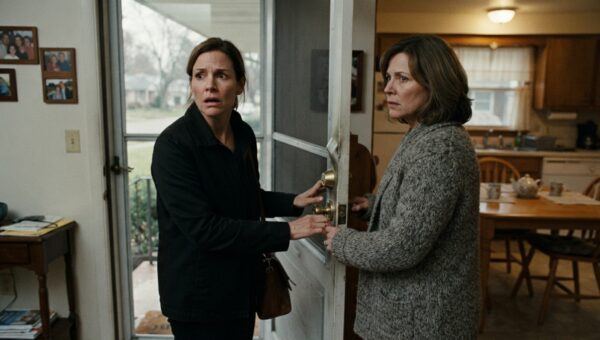
I brought it out into the kitchen light, turning it over between my thumb and forefinger while the kettle hummed on the burner. Dale was already down at the wharf checking the diesel filters on the harbor patrol boat, a job he had kept for twenty-two years without missing a single Monday. When he came home for lunch at twelve-thirty, I laid the brass key right beside his coffee mug on the laminate counter. He didn’t blink, but his jaw muscle twitched once, that tiny vertical jump I had learned to read over sixteen years of shared salt air and burnt toast.
“Found this in your coat pocket,” I said, keeping my voice level because I was already tired of the games.
Dale picked up his sandwich, took a slow bite, and wiped his mouth with a paper napkin before he even looked down at the metal. “Must be from that old locker down in Astoria,” he said, his tone entirely too casual. “Back when I had the boat engine parts stored down by the cannery.
Throw it in the junk drawer, Faye. I haven’t used it since before we married.”
That was the first lie, though I didn’t know the exact shape of it yet. Dale hadn’t kept a locker in Astoria since the winter of 2004, and the key looked too clean for twenty years at the bottom of a pocket. I watched him grab his jacket from the back of the chair and head back out the screen door, the spring slamming shut with its familiar tinny rattle. I stood there for a long time watching dust motes drift in the window glare, feeling that dull, heavy pressure behind my ribs that usually meant I was about to do something difficult.
I didn’t throw it in the junk drawer. I dropped it into my apron pocket, grabbed my car keys from the hook by the pantry, and got into the gray sedan with three hundred thousand miles on the odometer.
If Dale was lying about a brass key, I needed to know why, because sixteen years of marriage is a long time to spend building a house out of sand.
I spent the next three hours driving down every gravel shoulder and industrial park between here and Newport. There are nineteen self-storage facilities within a twenty-mile radius of our house, ranging from giant climate-controlled rows with electronic gates to rusty corrugated shacks behind the lumber yards. The third place I tried was South County Storage, a gravel lot wedged between a boat repair shop and a row of dead pines. The manager was a tired-looking man named Carl who had a radio tuned to a baseball game that wasn’t even playing yet.
He didn’t want to look at the key at first, but twenty dollars cash slipped across the counter changed his mind about company policy. He took the little piece of brass, slotted it into his heavy gauge reader, and tapped his keyboard with two thick fingers.
“Unit 38,” Carl said, squinting at the green phosphor monitor. “Row C, back by the timber line. Leased under the name Arthur Vance. Paid in cash every month like clockwork for the last eleven years.”
“Arthur Vance,” I said, tasting the name like a bad penny. “My husband’s middle name is Arthur.”
Carl just shrugged, pulled a yellow master padlock key off his pegboard, and told me I had ten minutes before he went on his cigarette break. The gravel crunched loud under my sneakers as I walked the long row of green metal doors, the salt air tasting sour in the back of my throat. Row C was dark, tucked in the shadow of the hill where the sea mist always lingered longest.
I found Unit 38 right between a row of old crab pots and a pile of discarded drywall. The padlock was a heavy brass Master Lock, but Carl’s key turned it on the first try with a heavy, oily click that made me jump. I pulled the corrugated door upward, and the rusted metal shrieked against the tracks, letting in a shaft of pale, gray Oregon light.
The smell hit me before I could see anything. It wasn’t the smell of mildew or old rope. It was lavender soap and stale wool, the exact scent of the cedar chest my grandmother had left me before she passed away in ninety-eight.
Inside, the unit was no bigger than a walk-in closet, but it had been finished out with plywood walls painted a pale, buttery yellow. Against the back wall stood a narrow twin bed with a quilted floral comforter in a pattern I had never seen before, though the folded pillowcases looked entirely too familiar. On the small bedside table sat a ceramic lamp with a cracked green shade and a stack of paperback books with their covers warped by dampness.
I stepped across the threshold, my boots leaving gray prints on the bare concrete floor. Pinned to the plywood walls on either side of the bed were dozens of photographs, held up by silver thumbtacks that caught the weak light from the open door. I walked closer, my hand coming up to cover my mouth because my brain simply refused to process what my eyes were telling me.
Every single picture was of me.
There were snapshots of me standing on the front porch in my faded denim apron, holding a mug of coffee while looking off toward the harbor. There were photos of me walking down Fourth Street with my grocery bags, shots taken from a high angle through some kind of telephoto lens, and pictures of me sitting at the kitchen table reading the local paper through the sheer curtains. My hair was shorter in some, longer in others, charting the passage of ten or eleven years like a museum exhibit of my own private life.
Next to the bed was a tall plastic laundry hamper filled to the brim with women’s clothing. I reached out a trembling hand and pulled a sleeve out of the pile. It was a cotton blouse with small blue cornflowers, the exact size I wore every single day. I remembered buying that blouse at the thrift shop in Waldport back in the summer of 2014, and I remembered wearing it once before it mysteriously disappeared from the laundry line while I was out at the pharmacy.
I looked down at the floor near the small bedside table and noticed a stack of carbon-copy receipts from the storage office, each one stamped with a monthly total of $175. Eleven years of monthly payments. Eleven years multiplied by twelve months, coming out to $23,100 in cash tucked into envelopes and handed over to Carl or his predecessor. My husband worked down at the patrol docks making an honest mechanic’s wage, and yet he had somehow funneled twenty-three thousand dollars into a tiny metal box to keep a room that looked like a shrine to a woman who didn’t even know she was being watched.
The name on the lease wasn’t Dale, and it wasn’t Arthur Vance either. Written in a cramped, left-slanted hand on the bottom signature line of the original 2013 contract was a name I knew better than my own, a name from the county records office that had been a local ghost story for over a decade.
The woman in those photos wasn’t just me. Or rather, she was someone who had lived in this town before I ever moved here from Coos Bay in twenty-fourteen.
I stood there in the center of that tiny plywood room for nine minutes by the clock on my dashboard, watching the dust motes dance in the gray light while the blood roared in my ears like surf against the jetty. The pieces didn’t fall into place like a neat puzzle; they dropped like heavy iron weights through the floorboards of everything I thought I knew. Dale hadn’t just married me because he loved me. He had found someone who looked enough like the ghost in his past to fill an empty space in a rented box by the trees.
I walked back out to the gray sedan, my legs feeling light and hollow, and sat behind the wheel with the engine off while the steering wheel felt cold against my palms. I didn’t cry because my chest was too tight for tears, the same way it felt when my father told us the boat was going under during the storm of ninety-six.
I pulled my cell phone from my purse and dialed three numbers with fingers that wouldn’t quite obey my commands.
“South County Sheriff’s Department,” a bored voice answered on the second ring. “Officer Miller speaking.”
“My name is Faye Vance,” I said, my voice sounding thin and dry like dry grass in November. “I’m calling from South County Storage off Route 101. Unit 38.”
“Ma’am? Is there a break-in?”
“No,” I said, looking out the windshield at the gray line of the tree ridge where the crows were gathering for the afternoon tide. “My husband keeps a unit here. There are photographs of me on the walls, hundreds of them, dating back eleven years. But the name on the rental agreement isn’t his. It’s registered to Clara Henderson.”
There was a long, heavy pause on the other end of the line, the kind of silence where you can hear the dispatcher’s pen stop moving against paper.
“Clara Henderson,” the officer repeated, his voice dropping an octave into something hard and flat. “Clara Henderson was reported missing out of Report County in the autumn of 2013. The last person who saw her alive before she vanished from her cottage was Dale Vance.”