My heart pills didn’t run out on time. I noticed it on a Tuesday morning, counting the little square compartments in my plastic organizer, and saw too many blue tablets left over, as if last month’s refill had simply refused to disappear.
I didn’t think much of it at first. You count things wrong when you get to sixty-four, or you skip a dose because your stomach feels sour, or you forget whether you took Sunday night with your tea.
But I keep a strict book. I write the date in pencil beside the kitchen calendar because the cardiologist told me consistency is what keeps the valve from fluttering.
So I called the mail-order pharmacy in Harrisburg, the one with the automated voice that always sounds like it is smiling through a headset.
The girl who finally came on the line had a flat, professional voice that made me feel like an interruption. She asked for my birth date and the policy number on our blue card, and then she clicked something on her keyboard that sounded loud over the wire.
“Your prescriptions moved into mail order back in January,” she said, her tone bright in that irritating way customer service people use when they are reading off a screen. “Spousal authorization on file. Your husband set it up. Such a thoughtful man.”
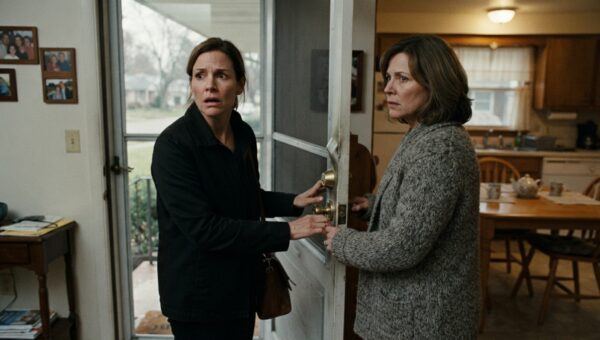
I looked out the kitchen window at the wet grass in the side yard where the dandelions were just starting to show their yellow heads. “My husband?” I asked.
“Gene,” she said, reading it right off the screen. “Gene Miller. Set it up for automatic shipment to Linden Street. Everything is paid through the secondary account.”
We do not live on Linden Street. We live on Maple, three blocks past the Methodist church where the roof has needed shingling since the big storm two winters ago. Linden Street is on the other side of the railroad tracks, down where the rental duplexes sit close together and the yards are mostly gravel and old tires.
“Are you sure?” I asked her, and my voice sounded thin even to me. “Linden Street?”
“That’s the address on the active account, ma’am,” she said. “Three-month supply delivered monthly since January. Next auto-renewal is scheduled for the tenth of next month.”
I thanked her and hung up the wall phone before she could ask if there was anything else she could help me with. My hand was shaking slightly against the cream-colored plastic of the receiver, and I set it back on the cradle with a small, dry click that seemed too loud in the empty kitchen.
Gene was out in the garage tinkering with the lawnmower deck. I could hear the rhythmic *clink-clank* of a wrench against metal, the same sound he had made every Tuesday afternoon for thirty years.
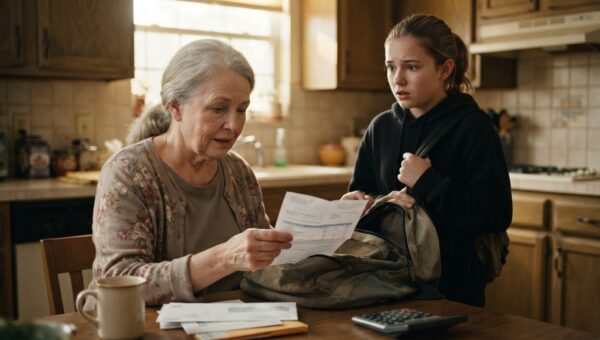
I went to the pantry and pulled down my spare ledger, the black composition book where I keep track of utilities and freezer beef shares. I turned back to January. On the fourteenth of that month, Gene had laid a stack of papers across the oilcloth kitchen table while I was stirring the gravy. He told me it was just the new Medicare supplemental paperwork, the kind the government sends out every winter like clockwork. He had pointed to the bottom line with the stub of a yellow pencil and told me where to write my name. I had signed it without reading the small print because my eyes were watering from the onions and because you do not spend forty years married to a man who works at the lumberyard without learning how to trust his hand on the household business.
That night, I set supper in front of Gene on the speckled laminate table. Pork chops fried until the edges were dark, mashed potatoes with a hollowed-out well for the butter, and green beans from the jars we canned back in August.
Gene sat down and pulled his chair in with that familiar scritching noise against the linoleum. He didn’t look up right away. He reached for his fork, wiped it with his paper napkin the way he always did, and then cut into the center of the chop.
I laid my notes beside his plate. The page from the composition book, the pharmacy’s customer service number jotted in margin ink, and the exact dates of every mail-order shipment that had gone across the tracks since the snow was on the ground.
We watched forty years of marriage hold its breath in the quiet space between the stove and the refrigerator. The refrigerator gave its usual low, rattling hum, and then the compressor kicked off, leaving the room so still I could hear the sound of Gene chewing his food. He swallowed once, hard, and his throat worked beneath the loose skin under his jaw.
Then he said one thing. Just the one thing.
“That’s Denny’s street.”
His own son. The boy we raised in the back bedroom, the one who took our old Ford truck when he turned twenty-one and never quite figured out how to keep a job that didn’t involve cash under the table or disappearing for three days at a stretch. Denny, who lived in a rented half-house with peeling blue paint and a rusted-out lawnmower rusting into the dirt by the back steps.
“I know whose street it is, Gene,” I said. My voice didn’t shake. That surprised me. When you are sixty-four and your heart has a little flutter in it like a trapped moth, you learn to keep your breathing steady so you don’t give anybody an excuse to fuss over you. “I asked you who authorized the change.”
Gene put his fork down. He didn’t drop it. He laid it across the rim of his plate with the careful, deliberate precision of a man who knows he is cornered but wants to make sure he doesn’t make a mess doing it.
“He was in a hole, Clara,” Gene whispered. He kept his eyes on the grease spot on his plate. “The boy was in a real hole.”
“With what?” I asked. “We gave him two thousand dollars out of the oil reserve fund last November. He said it was for the truck transmission.”
“It wasn’t for the truck,” Gene said, and his voice sounded thin, like dry paper tearing. “He had some men after him. Men from over in Scranton. Loan sharks, Clara. They told him they were going to break his hands if he didn’t come up with four thousand by the end of January. He came to the shop. He was shaking so bad he couldn’t hold a coffee cup.”
I stood there by the stove with my dish towel in my hand, wiping the same spot on the counter over and over again until the formica was dull. “And so you gave him my heart pills?”
“I didn’t give him your pills,” Gene said, and his voice went up a notch, defensive and small. “I wouldn’t do that. I know what those pills cost us, even with the secondary. I know how you feel when you miss a dose. I just… I let him use the mail-order account so he could get the shipments. The specialty ones. The ones the clinic in Wilkes-Barre prescribes for the rhythm.”
“They ship three months at a time, Gene,” I said, and the words felt heavy in my mouth. “Where were my pills? If Denny was getting the shipments on Linden Street, what was I taking out of my organizer every morning?”
Gene swallowed again. He reached up and rubbed his face with his hand, pushing his glasses up onto his forehead so the red marks from the wire frames showed white against his temples. “I bought samples,” he muttered. “From a fellow I know down at the freight dock. Old Dr. Henderson’s nephew works out of a warehouse in Dunmore. He gets the pharmaceutical reps’ overstock. I was buying them three at a time in little foil strips to keep your box full so you wouldn’t notice the boxes were going to Denny’s porch.”
“You were buying black-market samples off a loading dock,” I said, stating it back to him as if I were repeating an order to a grocery clerk. “For three months.”
“They were the same pills,” Gene said, his voice cracking slightly. “Exact same manufacturer. Little round white ones with the score mark down the middle. I checked every single strip.”
“Until when, Gene?” I asked. “When did the samples stop coming?”
He didn’t answer. He just looked down at his fork, his shoulders rounding under his blue work shirt until he looked twenty years older than he had when he walked in from the garage at five o’clock.
“Last month,” I said, answering my own question because I could see it in the way he wouldn’t meet my eyes. “The source dried up. That’s why my organizer had extra pills left over this week. Because for the last three weeks, I haven’t been taking your dock samples, and Denny hasn’t been taking the mail-orders either. He’s been selling them, hasn’t he?”
Gene didn’t say anything. The silence in the kitchen wasn’t dramatic. It was just heavy and gray, like the sky before an April sleet storm.
“He wasn’t taking them for panic disorder,” I said. “He was selling them to that crowd down by the bowling alley. High-value specialty cardiacs bring a lot of cash when you find the right buyer on the internet.”
“He said he was going to clear the debt,” Gene whispered. His chin dropped toward his chest. “He said once he paid off the first four thousand, he’d stop. He swore to God on his grandmother’s grave he’d stop after the March shipment.”
I laid the dish towel on the counter. I walked over to the hook by the back door where my wool cardigan hung, the gray one with the wooden buttons that my sister bought me in Binghamton. I slipped my arms into the sleeves. It felt a little tight across the back, but it was warm enough.
“Clara,” Gene said, looking up with his eyes wide and watery behind his glasses. “Where are you going?”
“Nowhere,” I said. “I’m going to bed. But tomorrow morning at nine o’clock, the two of us are going to get into that Buick, and we are going to drive down to Linden Street.”
“Clara, wait,” he started, but I walked past him up the stairs without looking back. The cedar floorboards in the upstairs hallway gave off that dry, familiar pop right by the linen closet, just like they did every night, and I went into our bedroom and closed the door.
***
The morning sun didn’t do much for Linden Street. It sat low behind the brick walls of the old silk mill across the tracks, throwing long, cold shadows across the gravel driveways and the patchy lawns where nobody had bothered to rake the dead leaves from November.
Our Buick pulled up right behind Denny’s rusted-out Ford pickup with a crunch of loose shale under the tires. The engine clicked twice as I turned the key off, and then there was only the sound of a dog barking somewhere three houses down and the steady dripping of a frozen gutter over the front porch.
Gene didn’t turn off his side of the truck. He left the motor idling, the old V-8 engine thrumming through the floorboards with a low, nervous vibration. He sat with both hands locked onto the top of the steering wheel, his knuckles white under the skin where the sun had browned them over forty summers of roofing and building.
“Gene,” I said.
“Clara, let me go up first,” he murmured, staring straight ahead through the windshield at the peeling blue paint of Denny’s front door. “Let me talk to him. He might not even be awake yet. You know how he stays up late with those computer games.”
“He’s awake,” I said, opening my door before he could reach across to stop me. “The kitchen light is on behind that greasy curtain.”
The porch boards were soft under my shoes, rotting around the edges where the rain came off the roof without a gutter to catch it. I didn’t wait for Gene. I reached out and knocked twice against the hollow wood of the door, using the flat of my knuckles the way my mother taught me when we went door-to-door for the church bazaar.
We waited maybe ten seconds. Inside, something heavy scraped across a linoleum floor, and then the deadbolt turned with a dry, metallic *thunk*.
The door swung inward about six inches. Denny stood in the gap, wearing a gray gym sweatshirt with the sleeves pushed up to his elbows and his brown hair sticking up on one side where he’d been sleeping on it. He smelled stale, like cigarette smoke and old coffee grounds that had sat in the basket since yesterday.
“Mom?” he said, and his eyes went wide for a second before he caught himself and tried to force that familiar, lazy grin he’s used since he was twelve years old to get out of mowing the lawn. “What are you guys doing out this early? Is everything okay at the house?”
He didn’t look at Gene. He looked at me, and I could see the little pulse jumping in the hollow of his throat just under his jawline.
“Step aside, Denny,” I said.
“Mom, I’m kind of in the middle of, “
I didn’t wait for him to finish. I put my hand flat against the center of his chest and pushed. He wasn’t expecting it, he weighed forty pounds more than me and stood six feet tall, but the surprise of it made him stumble back half a step into the narrow hallway.
I walked past him into the house.
The front room smelled like grease and wet carpet. On the little chipped laminate table by the front window sat two cardboard pharmacy mailing cartons, the white shipping labels torn halfway off to hide the bar codes. Next to them was a small digital kitchen scale, the kind people use for measuring baking powder or small packages, and a plastic Ziploc bag containing three strips of my white mail-order heart tablets, still in their foil packaging with the blue lettering crisp and clear.
Gene came in behind us, closing the front door softly behind him as if he were afraid of breaking something. He looked at the table, then at Denny, and his mouth stayed open just a little bit, like he had more to say but couldn’t find the air for it.
“You were selling them online,” I said. I didn’t raise my voice. I spoke in the same flat tone I used when I told the clerk at the hardware store that the three-quarter-inch screws were short by two in the box.
Denny wiped his hand across his mouth, his eyes darting toward the kitchen door where a sink full of dirty dishes sat piled three inches high. “Mom, look, it’s not what you think. The guy in Scranton, he said he had a buyer who was willing to pay top dollar because the local pharmacies are backordered on these specific ones. It was just to cover the truck payment. If I missed the payment this month, they were going to repossess it before I could get the engine rebuilt.”
“You took three months of my medication,” I said, walking over to the table and picking up the Ziploc bag. The plastic felt cold against my fingers. “You took the medicine that keeps my heart from racing out of my chest while you sat here playing with scales.”
“Dad said it was okay!” Denny shouted then, his voice cracking with that old, ugly whine he used to use when we caught him lying about his report card in the eighth grade. He pointed a finger straight at Gene, his face turning red right up to his hairline. “Tell her, Dad! You told me you could get the samples! You said the old man down at the docks would keep you supplied until I got the debt cleared!”
I turned and looked at Gene.
Gene was standing by the coat rack with his hat still in his hand, his shoulders down and his mouth pulled into a straight, hard line that looked like a scar. He didn’t look at Denny. He looked at me, and there was something so miserable and small in his face that for half a second I almost felt sorry for him. Almost.
“You lied to me,” I said to Gene. “You sat at my kitchen table for forty years, and when the boy got himself into a corner because he couldn’t keep a job, you didn’t help him fix it. You just helped him steal from me.”
“I was trying to keep him from getting his legs broken, Clara,” Gene whispered, and the sound of it was so pathetic it made the room feel smaller. “What was I supposed to do? He’s our boy.”
“He’s thirty-eight years old, Gene,” I said. “And I am sixty-four, and I have a heart valve that doesn’t care whose boy he is.”
I picked up the two unopened cardboard cartons from the table, tucked them firmly under my arm, and dropped the Ziploc bag of loose strips right into the deep pocket of my gray wool coat.
Denny took a step forward, his hand coming up toward my arm as if he were going to stop me. “Mom, wait. Those are, those are mine. We had an arrangement, “
Gene moved faster than I’d seen him move in five years. He didn’t yell. He just stepped right between Denny and me, putting his heavy palm flat against Denny’s chest the exact same way I had two minutes before.
“Don’t you touch her,” Gene said, and his voice wasn’t thin anymore. It was low and hard, the way it used to sound when he was foreman at the lumberyard and some kid on the forklift tried to pull a fast one with the inventory logs. “Don’t you ever touch her.”
Denny stopped, his hands dropping to his sides, staring at his father as if he had never seen him before in his life.
Gene didn’t look back at him. He turned around, pushed the front door open, and held it for me while I walked out onto the wooden porch with the boxes under my arm.
***
We didn’t talk on the drive back to Maple Street.
Gene kept both hands on the wheel at ten and two, exactly the way they taught him in driver’s education back in nineteen-seventy-two, and he drove twenty-five miles an hour the whole way through town, even when the milk truck was riding our bumper with its blinker flashing.
When we pulled into the gravel drive, I didn’t wait for him to come around to my side. I got out, carried the two boxes up the back steps, and walked straight through the kitchen to the hall telephone.
I called the mail-order pharmacy first. I told the girl on the other end, a different one this time, with a softer voice that sounded like she might actually live in Pennsylvania, that I wanted every single spousal authorization on my file canceled effective immediately. I told her that if any box of pills ever went to any address other than Maple Street again, I would personally drive down to Harrisburg and sit in the lobby until the manager came out to explain himself.
Then I called Dr. Henderson’s office at the clinic. I told the nurse practitioner that my husband had been interfering with my prescriptions, and I wanted my chart locked with a verbal password that only I could give over the phone.
Gene sat at the kitchen table while I made the calls. He didn’t take off his coat. He just sat there with his cap in his lap, turning it round and round by the brim until the wool was dark where his fingers held it.
When I hung up the phone for the second time, the kitchen was completely quiet except for the refrigerator humming its old, familiar song in the corner.
I went to the back room and brought out the new plastic box I bought last year at the pharmacy in town, the one with the little brass lock on the side that Denny had given me for Christmas three years ago before he started needing money for his truck.
I sat down at the laminate table, right across from Gene, and set the little box between us.
I opened the cardboard cartons with my kitchen shears, pulled out the three clean bottles of white tablets, and began sorting them one by one into the little Sunday-through-Saturday squares. One for Monday morning. One for Monday night. One for Tuesday.
Gene watched my fingers. He didn’t say a word. He just sat there in his blue work shirt with his cap in his lap, watching every pill drop into its little plastic compartment until the whole week was full and accounted for.
When I finished, I snapped the lid down until it clicked into place. Then I took the small brass key off my key ring, slid it into the side of the organizer, and turned it twice until the lock caught with a tiny, distinct sound that filled the whole kitchen.