The house had smelled like damp cedar and peppermint tea for as long as I could remember, even after Mama passed away in her sleep at eighty-nine.
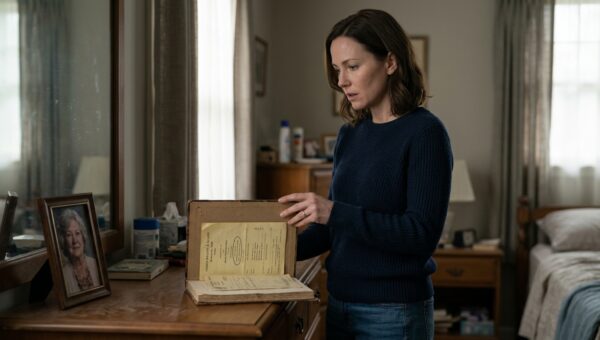
I was three weeks into clearing out the spare bedroom, the one where the radiator always knocked like someone trying to get in from the cold.
My knees were aching from the pine flooring, and I was using a dull putty knife to scrape away the second layer of floral wallpaper near the baseboard because the edges had peeled back into gray curls.
The plaster underneath was old and crumbly, the kind they used back when the town still had three shingle mills running down by the bay.
Mama had lived in this house since nineteen-fifty-four, and she never changed a thing except for putting down new linoleum in the kitchen back when the grand-kids were small.
I found the envelope tucked right into a gap where the lath had warped away from the stud, held fast by forty years of dust and dried paste.
It didn’t look like much, just heavy blue linen paper with my name written in Mama’s careful, sloping cursive that always looked like rows of wheat bending in the wind.
The seal was brittle yellow wax that cracked right off the flap when I nudged it with the corner of the putty knife.
“If you’re reading this, I’m gone,” she wrote in that same steady hand, and my thumb left a gray smudge across the ink where my hand wouldn’t stop shaking.
“When you were six weeks old, a woman came to our door. Crying. She begged me to take you. Your father was dangerous.”
I sat down hard on the bare floorboards, the cold wood biting right through my jeans, and stared at the lines until the words started running together.
“She visits every birthday. Sits in a car across the street.”
My birthday had been three days ago, right on a Tuesday, when the wind off the Pacific was howling enough to rattle the storm windows out in the porch alcove.
I didn’t even take off my work coat before I walked straight to the small desk in the corner and opened up the tablet for the Ring camera app.
It took me twenty minutes to figure out how to filter the cloud storage back to Tuesday morning at seven o’clock, right when the gray mist was still hanging low over the hemlocks across the road.
There it was.
A faded blue Honda Civic with a dented rear fender parked right under the big maple tree where the municipal sign blocks the line of sight from the kitchen window.
It sat there for two hours with the engine off, the driver’s side window rolled up an inch against the drizzle, just facing our porch.
I went back further in the app, tapping through the calendar months until the dates turned yellow and old.
Every single year on October fourteenth, that same blue Honda showed up at 7:15 in the morning and stayed until nine.
Last year there wasn’t just a car, though, and I remembered the heavy box sitting on the cedar mat when I came out to grab the milk at noon.
It was a small red leather case holding a $180 gold bracelet with a safety clasp shaped like a tiny dolphin, and there hadn’t been a single line of writing on the paper tag inside.
I had walked right out to the gravel edge of the road that morning, shading my eyes against the salt glare, wondering which one of Mama’s old church friends had left such an expensive piece of junk on our steps.
The Honda had been sitting right there with the hazard lights off, and the woman inside had looked up through the windshield just as my boots hit the gravel.
She had my eyes.
Not just the hazel color, but the way the corners crinkled when the sun hit them, that exact little hitch in the bone right above the tear duct.
I had stood on the shoulder with the wind blowing my hair across my face, and she had stared right back at me through the dirty glass before putting the car into gear without a single wave.
“I didn’t know what to do with her,” Mama had written down on the third page of the letter, the ink starting to get a little shaky near the bottom margin where she must have been pressing too hard with the fountain pen.
“She stayed in that car until the sun came up over the ridge, and every year she looks older, Clara.
She looks just like you looked when you were twenty, sitting on the porch steps with your boots untied.”
I folded the blue paper back up along the original creases, my fingers stiff and cold despite the little space heater humming by the door.
The house was so quiet I could hear the old refrigerator in the kitchen clicking its relay switch on and off every few minutes like a metronome.
I walked out to the hallway mirror, the one with the foxed silver backing where my reflection looked like it was swimming underwater, and pulled my hair back behind my ears.
There was that same little notch in my left earlobe that Mama always said came from my uncle George, though George had been dead since the Carter administration and didn’t look like anyone in our family album.
The doorbell rang once, sharp and short, cutting through the hum of the heater and the rattle of the pipes in the cellar.
I didn’t drop anything.
I didn’t freeze.
I just walked down the narrow hall past the framed photographs of Mama’s high school graduation and the blurry polaroids of the fishing boat Earl used to run before his lungs gave out in ninety-six.
When I pulled the heavy oak door open, the salt air hit me all at once, cold and wet with that particular smell of rotting kelp and pine needles that you only get down here where the highway ends at the water.
The blue Honda was parked right by the mailbox, idling with a low, steady thrum that sounded like an old sewing machine running in an empty room.
The driver’s door creaked open against the wind, and a woman in a gray wool cardigan stepped out onto the gravel, her boots crunching on the small white stones we’d laid down back when Earl was still hauling gravel for the county.
She looked smaller than she had on the camera, her graying hair tucked under a yellow rain hat, carrying a canvas tote bag that looked like it had been mended with blue thread along the bottom seam.
She stopped about six feet from the bottom step, right where the hydrangea bushes were dying back for the winter into brown paper balls.
Her hands were stuffed deep into her coat pockets, but I could see the knuckles were red from the damp air coming off the salt marshes down the hill.
“I thought about coming up last year,” she said.
Her voice wasn’t anything like Mama’s voice, which had always been sharp and dry like corn husks, but it had that same flat coastal rhythm where every sentence ended like she was waiting for a ferry that might not show up.
“I saw the letter was still behind the wall,” I said, leaning my shoulder against the door frame so the cold wind wouldn’t push it all the way open. “Mama kept it there a long time.”
“She was a hard woman,” the woman said, looking past my shoulder into the dark hallway where the peppermint tea smell was still drifting out toward the porch. “She didn’t want any trouble from him.
He was still living down in Coos Bay back then, and he had a way of finding people who didn’t want to be found.”
“He’s been gone twenty years,” I told her, and the words sounded strange in my own mouth, like I was reading them off a tombstone in the Methodist yard. “He died in the trailer park behind the cannery. Nobody went to the service except the county coroner.”
She nodded once, slow and heavy, like she was checking off an item on a grocery list she’d carried around in her coat pocket for half a century.
“I know,” she said. “I went down there to check the register.”
We stood there for a minute while a blue heron lifted off from the salt grass across the road, its long legs trailing behind it until it cleared the telephone wires by ten feet.
“You left the bracelet,” I said, looking down at her wrists where the cuffs of her sweater were frayed gray.
“It was your grandmother’s,” she said, and her chin gave that same little twitch that I saw every time I looked in the mirror after washing my face at night. “She gave it to me the night I left the hospital.
She said if I ever got back on my feet, I was supposed to bring it back to the house on the hill.”
“You took forty-one years,” I said, and there wasn’t any heat in it, just the flat weight of the numbers sitting between us on the gravel.
“I didn’t have anywhere to be that was better than here,” she said.
She reached out and laid the canvas tote bag right on the bottom step, right where Mama used to leave the milk bottles when the winter frost was too hard for the delivery truck to make the grade.
“Are you staying for coffee?” I asked her, and my hand finally let go of the door frame.
“Only if it’s the cheap kind,” she said, looking up at the gray sky where the first drops of the afternoon rain were starting to pit the dust on the hood of her car. “Mama never could abide that chicory stuff you buy down at the mercantile.”