The sanctuary was dead quiet except for the steady hum of the radiator in the corner and the heavy ticking of the bronze wall clock over the vestry door. I was standing near the coffee urn after the second service, holding a styrofoam cup that had gone cold in my hand, when I noticed Brynn sitting by herself on the third pew.
She had her little blue cardigan buttoned crooked, the second button stuck in the third hole, which was unlike her because my daughter Laura always made sure she looked like a picture out of a catalog.
Brynn wasn’t drawing in her little coloring book or lining up her plastic horses the way she usually did during fellowship time. She was handing things out. She gave her purple crayon to Deacon Miller’s grandson. Then she unzipped her small canvas backpack and pulled out the plush rabbit with the torn ear, passing it across the aisle to a woman I barely knew.
I walked over down the red carpet, my heels clicking too loud against the linoleum, and knelt right beside the wooden pew so I was eye-level with her. Her small fingers were working nervously at the hem of her sleeve, twisting the yellow cotton until the fabric was white.
“Honey, what are you doing with your rabbit?” I asked, keeping my voice low so I wouldn’t startle her. “You love that thing. You take it everywhere.”
She wouldn’t look up at me. She just kept her chin pressed hard against her chest, staring down at the scuffed toe of her Mary Jane shoes.
“I won’t need them anymore,” she told me. She’s six, and her voice sounded too small for the room, flat and dry like she was reciting something she had practiced in the dark.
I reached out to touch her hand, but she flinched back so fast she nearly knocked over the hymnal rack. I asked her again, my chest tightening up with a cold prickle that had nothing to do with the draft from the vestry door.
“Mr. Reece says bad girls sleep in the basement, and there’s no toys down there,” she whispered.
Julian Reece. My daughter Laura had married him eight months ago in a ceremony down at the country club that I had paid for down to the last dollar, fourteen thousand clean out of my retirement CD because Laura swore he was a good man who treated her girl like a princess.
I gripped the edge of the polished oak pew so hard my knuckles turned the color of lard.
“When were you down in the basement, Brynn?” I asked, and my voice didn’t sound like my own anymore. It sounded raspy, like someone tearing dry burlap.
She slowly pulled her left sleeve up, inch by inch, until the skin caught the gray morning light coming through the stained glass. Four small bruises in a row, exactly the size of a grown man’s fingertips, purple and yellow around the edges like old plums.
“When I’m too slow getting dressed,” she said, and her lower lip gave a tiny, helpless twitch. “He counts. If he reaches ten, he…”
She didn’t finish the sentence because she didn’t have to. I already knew what happened when he reached ten.
Eight months ago, Laura had walked down that aisle in her ivory silk gown while the string quartet played Bach, and I had stood in the third row smiling until my cheeks ached.
Julian had stood up there tall and handsome in his charcoal suit, shaking my hand afterward and telling me I didn’t need to worry about a single thing, that he would take care of my girls like they were cut glass. But within two months, the phone calls from Laura had started changing. She stopped coming over for Sunday pot roast. She started saying Brynn was getting moody, that the child was acting out and throwing tantrums over nothing, and that Julian was just trying to instill some backbone into a kid who needed discipline.
Julian had spent eight months wrapping wire around the house, convincing Laura that her own daughter was a chronic liar who invented stories for attention, while he played the patient stepfather who had to lock her in the dark just to keep the peace.
I didn’t take Brynn back to her mother’s house after church that morning. When Laura texted me at noon asking why we hadn’t come home for Sunday chicken, I told her we stopped by the pharmacy and were grabbing lunch at the diner. I loaded Brynn into the passenger seat of my old Buick, buckled her in twice, and drove straight past the turnoff for their subdivision.
We didn’t go to a diner. I drove twenty miles over to the urgent care clinic off Route 4 where I knew Dr. Vance was on duty, a sensible woman who had stitched up my knee when I took a spill off the back porch ladder three summers ago.
The clinic waiting room smelled like antiseptic and wet carpet. I kept Brynn’s hand locked tight in mine the entire twenty minutes we sat under the flickering fluorescent lights, watching the second hand on the wall clock tick in jerky little jumps.
When the nurse finally called our names, I walked us back to the exam room and sat right on the edge of the paper-lined table with Brynn’s small shoulders pressed against my chest. Dr. Vance walked in with her clipboard, gave me one look, and closed the door behind her without a word.
“Let’s take a look at your arm, sweetheart,” Dr. Vance said, her voice dropping into that quiet, steady register that doctors use when they are looking at something they already know they have to report.
She didn’t ask leading questions. She just measured the span of those four dark marks with a clear plastic ruler while I held my breath, and then she took three clinical photographs with the office camera.
“These match adult finger pressure,” Dr. Vance said, looking right into my eyes over the top of her wire-rim glasses. “And the shoulder tissue shows rotational torque. Who did this, Brynn?”
“Mr. Reece,” Brynn whispered against my sweater. “He counts to ten when I drop my shoes.”
Dr. Vance laid the ruler down on the tray with a sharp little clatter. She didn’t have to tell me what came next because the state of Ohio has very strict laws about pediatric contusions that look like hands, and within five minutes she was on the secure line with both county child protective services and the township police.
We stayed in that little exam room for two hours while a social worker named Brenda arrived with a thick black binder and recorded every single word Brynn could manage to say about the dark room under the stairs, the cold concrete floor, and the way Julian would stand outside the door waiting for his timer to ring.
By four o’clock, two cruisers and an unmarked sedan were parked out along the curb of Laura’s subdivision, their blue lights turned off but the engines still ticking in the damp spring air. I sat in the front seat of my Buick with Brynn asleep in the back, her thumb tucked halfway into her mouth, while Officer Higgins walked back from the front door of the house and motioned for me to get out.
Laura opened the front door herself before the officers even had to knock a second time. She was wearing her gray lounge pants and an old sweatshirt with the sleeves pushed up to her elbows, her hair pulled back in a loose clip that looked like she had done it in a hurry.
“Mom? What is going on?” Laura asked, her voice sharp and defensive the moment she saw me walking up the brick walkway behind two uniformed men. “Why are you bringing police to my house? Julian is inside taking a nap.”
“Tell Julian to come out here, Laura,” I said, and my voice didn’t shake once.
Julian appeared behind her in the hallway a second later, wearing a polo shirt and no shoes, his face dropping that easy-neighbor smile the second he saw my badge-carrying escort.
“Is there a problem, officer?” Julian asked, stepping up beside Laura and putting a heavy, proprietary hand right on the small of her back. “My wife and I were just having a quiet afternoon.”
“Julian Reece?” Officer Higgins asked, pulling a folded legal document from his breast pocket. “Step outside on the porch, please. We have an emergency protective order issued out of juvenile court, along with a warrant for temporary custody.”
“This is ridiculous,” Julian said, his voice rising an octave as his chest puffed out. “Laura, tell them. Tell them her kid is disturbed. She makes up stories for attention all the time. Ask your mother, she knows how dramatic the girl is.”
Laura looked from Julian to the police officer, and then her eyes landed on me standing by the porch rail. She looked like someone had just dropped a bucket of ice water down the back of her shirt.
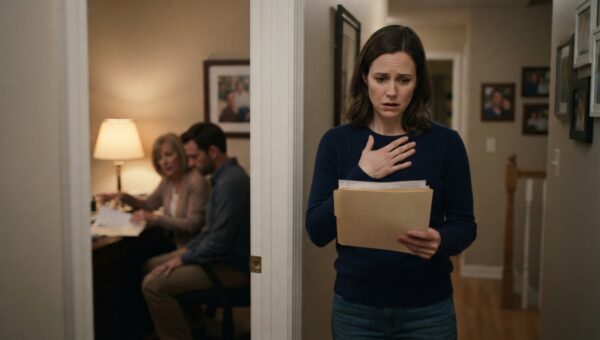
“Mom, what did you do?” Laura whispered, her hand going to her throat. “What is he talking about?”
I didn’t answer with words. I reached into my canvas tote bag, pulled out the certified medical packet from Dr. Vance with the color photographs of Brynn’s arm clipped right to the front, and handed the whole thing directly to my daughter.
“Look at page two, Laura,” I said, pointing my finger at the exact measurements of those four fingertip bruises. “Read what your husband does when she takes too long getting her shoes on.”
Laura opened the folder with trembling fingers. She stared down at the photographs for five long seconds, her lips parting as the color drained completely out of her face until she looked almost translucent in the fading daylight.
“No,” Laura whispered, shaking her head so hard her hair clip fell out and hit the welcome mat. “No, this… she fell off the porch step last Tuesday. Julian said she tripped over the garden hose.”
“He counts to ten, Laura,” I said, and I stepped close enough to smell the cheap laundry detergent on her collar. “And then he drags her down into the dark basement and locks the door. He’s been doing it for months while you were at the grocery store.”
Julian made a sudden move backward toward the heavy oak door, his hand reaching behind his back toward the hallway table, but Officer Higgins was already moving.
“Don’t do it, pal,” Higgins said, grabbing Julian’s forearm in a iron grip and spinning him against the brick wall of the porch before the man could even grunt. “Hands behind your back. You’re under arrest for domestic endangerment and child battery.”
The metal click of the handcuffs sounded too loud in the quiet suburban street, sharp and final like a gate slamming shut in an empty field. Julian didn’t look like a master of the house anymore; he looked small and greasy, his mouth working silently as they shoved him down the steps toward the cruiser.
Laura dropped the medical folder right on the welcome mat, the pages scattering across the concrete like autumn leaves, and slid down the doorframe until she was sitting on the porch floor with her face buried in her hands.
“I didn’t know,” she sobbed, her shoulders heaving up and down under the gray sweatshirt. “Mom, I swear to God I didn’t know.”
“I know you didn’t,” I said softly, and for the first time all day, my own knees felt a little weak.
We didn’t stay there to argue with the neighbors who were peeking out from behind their lace curtains down the block. We packed up Laura and Brynn that very night, loading three suitcases into the back of my car and leaving fourteen thousand dollars worth of wedding memories behind in a house that was already turning cold.
Two days later, the divorce papers were filed, and Julian was sitting in a holding cell waiting for a judge who didn’t take kindly to men who terrorized six-year-olds in cellars.
By Friday evening, the house on Elm Street smelled like yeast rolls and floor wax again, just the way it used to before any of them ever heard the name Julian Reece.
I sat right beside Brynn on her twin bed under the patchwork quilt her great-aunt Millie had stitched back in ninety-four. She had her small canvas backpack open beside her pillow, and she was watching me with those wide, clear eyes that didn’t look scared anymore.
From the top drawer of her nightstand, I lifted out the little painted wooden jewelry box with the brass clasp that she thought she was never going to see again.
I set it down carefully on the coverlet between us. Brynn reached out with both hands, picked up the tiny metal key hanging from the ribbon, and turned it twice in the brass slot until the spring clicked.
She lifted the lid. The little ballerina inside began to spin in circles on her tiny mirrored floor, twirling round and round to the tinny, sweet notes of an old music box tune that filled the bedroom with steady, quiet life.