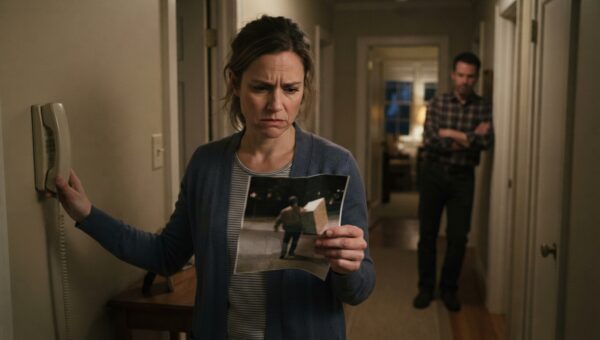
A certified letter came for my husband while he was at work. I signed for it because the mail carrier, young Toby with the orange cap, always whistled twice when he had a delivery requiring a signature. Thirty-one years married, and I’d never opened his mail. We had an unwritten rule in our kitchen on Maple Street that mail addressed to Ray stayed on the end of the counter by his coffee mug until he came home from the yard at five.
But this one had a stark red box at the top that said FINAL NOTICE in capital letters.
My hands were still damp from scrubbing the cast-iron skillet when I slid my butter knife under the flap. I steamed it open right there over the kettle spout because the glue was stubborn. It wasn’t a tax form or an equipment recall from Ray’s contracting supply company. It was a collections demand from a bank downtown, showing a balance of $61,000 owed on a second mortgage against our house. Our house. The same house where we hosted our daughter’s graduation party, the same house we burned the final mortgage slip for back in the autumn of 2019 when Ray popped a bottle of sparkling cider on the back deck and kissed my forehead until I laughed.
I read the figures four times over because my eyes kept blurring at the zeros.
At the very bottom of the second page, beneath a block of dense legal fine print, sat my own signature. My looping cursive, right there next to Ray’s messy scrawl. I stared at it until the ink seemed to swim. I remembered that night eighteen months ago when Ray had slid a clipboard across this exact laminate table while I was stirring the Sunday pot roast, telling me it was just administrative paperwork to lower our homeowners insurance rate after the county reassessment. He told me to sign by the red tabs so we could save thirty bucks a month. I trusted him without looking because thirty-one years of sharing a pillow teaches you how to stop checking the math behind a man who smells like cedar sawdust and laundry soap.
When his green Ford pickup crunched into the gravel drive at 5:12, I didn’t hide the paper. I set the white envelope right in the center of the table with the red balance facing up.
Ray walked through the back door carrying his faded canvas lunch cooler, whistling that tuneless little tune he always used when he had a good day pouring concrete. He stopped dead the second he saw the envelope. The whistling died in his throat like a snuffed candle. His weather-lined face went from ruddy to the color of wet newsprint in three seconds flat.
“Where did sixty-one thousand dollars go?” I asked. My voice didn’t shake. That scared me more than anything else.
He wouldn’t lift his eyes from the page. He kept his calloused hands flat on the edge of the counter, his knuckles shining white under the overhead fluorescent light. Then he looked at the floor and said, “It’s Perry. I couldn’t watch our boy lose the…” He left the sentence dangling right there in the air between us, broken and unfinished.
“Lose what, Ray?” I asked, stepping closer. “His truck? His tools? Or his freedom?”
“The supply yard threatened to take him to court,” Ray mumbled, finally looking up with that miserable, whipped-dog expression he always used when he knew he’d crossed a line he couldn’t walk back across. “He bought too much commercial grade lumber and missed three jobs in a row over in West Wichita. The liens were piling up. If they sued him, his contracting license would’ve been revoked before the month was out. He would’ve lost everything he built.”
“And so you decided to trade our retirement for his bad habits?” I said. I felt cold all over, the kind of chill that doesn’t come from an open window. “You put a lien on the roof over our heads without telling me so our twenty-eight-year-old son could keep playing businessman?”
Ray tried to reach out and touch my arm, but I stepped back before his fingers could brush my sleeve. “I thought I could pay it off before you ever noticed,” he said, his voice dropping to a low, pleading hum. “I took on extra side jobs pouring foundations on Saturdays. I was making the interest payments every month until the winter slowdown hit us. Then the rates adjusted. I tried to refinance again, but the bank said no. I’m sorry, Colleen. I just couldn’t watch him go under.”
The next morning, I didn’t wait for Ray to leave for the yard. I sat at the kitchen table with my phone and called the number listed on the collection notice. A polite young woman named Brenda with a sharp voice answered on the third ring. I didn’t ask for explanations. I asked for the payoff quote, the default timeline, and the exact date the foreclosure warning would convert to a legal filing. Thirty days. We had thirty days before the bank started the formal process of taking our deed.
While Ray was out hauling gravel, I went out to his workshop behind the garage. I didn’t bother knocking on the sliding wooden door. I went straight to the old metal filing cabinet he kept behind the drill press. It wasn’t even locked. Inside, tucked behind a stack of rusted grease-gun tubes and old spark plug boxes, was a thick manila folder labeled with Perry’s name. Inside were bank statements, wire transfers, and past-due notices dating back nearly two years. Every single page proved the same ugly story. Ray had been draining our joint savings account in dribs and drabs, routing statements to a P.O. box in town, and signing my name whenever the bank required a secondary signature for loan modifications. Perry hadn’t just taken the money once. He had come back four different times, hat in hand, crying about his cash flow while Ray kept opening the checkbook.
I didn’t yell at Ray when he came home that evening. I didn’t cry either. I simply placed the manila folder on the kitchen table right next to his cold plate of meatloaf.
“Call him,” I said.
“Colleen, let’s talk about this first, “
“Call Perry right now, or I’m calling the sheriff’s department to report identity fraud on those loan documents,” I said, looking straight into his eyes. “Those are the only two choices you have tonight, Ray.”
Ray swallowed hard, pulled out his phone with trembling fingers, and hit speed dial. Perry showed up twenty minutes later driving his spotless white Ford F-250, wearing a designer hoodie that cost more than my winter coat. He walked through the back door with a half-smile on his face, expecting his usual Sunday-night dinner and maybe a sympathetic ear about how tough the local market was treating him.
He stopped in the doorway when he saw us both sitting at the table. The manila folder was still open between us.
“What’s going on?” Perry asked, stuffing his hands into his pockets and shifting his weight from one boot to the other. “Dad said it was an emergency.”
“It is an emergency,” I said, motioning to the chair across from me. “Sit down, Perry.”
He sat down, rolling his eyes just enough to let me know he thought I was making a fuss over nothing. “Look, if this is about the truck payment, I told Dad I’d have that covered by next month once the commercial park job clears, “
“Shut up, Perry,” I said quietly. The three words dropped into the room like lead weights. He blinked, stunned by my tone. In thirty-eight years of watching him grow from a messy-haired boy into a grown man, I had never spoken to him like that. “Your father didn’t just help you with a truck payment. He took out a sixty-one-thousand-dollar second mortgage on our house behind my back. Our house. The one we finished paying off the year your grandfather died.”
Perry didn’t look shocked. He looked annoyed. He glanced sideways at his father, waiting for Ray to jump in and soften the blow. When Ray stayed silent, staring miserably at the wood grain of the table, Perry let out a short, defensive breath.
“Well, what was he supposed to do?” Perry asked, his voice rising with that familiar defensive whine. “Let my business go under? If I went bankrupt, I wouldn’t have been able to pay back any of my subcontractors either. I kept things afloat. I’m trying to build something here.”
“You aren’t building anything,” I said, leaning forward until the fluorescent light caught the lines around my eyes. “You’re building a lifestyle on your parents’ graves. Your father lied to me, he forged my signature, and he risked the roof over our heads because you don’t know how to run a business without spending money you haven’t earned.”
“Mom, come on,” Perry muttered, shaking his head. “It’s just a loan. Dad signed off on it voluntarily.”
“Because you manipulated him into feeling like a failure every time you hit a bump in the road,” I said. “Well, the ride stops tonight.”
“What does that mean?” Perry snapped, sitting up straight.
“It means we aren’t paying off your debt with our retirement, and Ray isn’t covering your monthly interest anymore,” I said, my voice steady as stone. “You have two commercial backhoes, a flatbed trailer, and enough surplus inventory sitting in that storage yard on 4th Street to cover this lien twice over. You are going to sell your surplus equipment tomorrow morning. Every last machine you don’t need to finish your current contract. You’re going to take the cash, walk down to the bank with us, and pay off this second mortgage in full before the end of the week.”
“Sell my gear?” Perry scoffed, standing up so fast his chair screeched against the linoleum. “Are you out of your mind? How am I supposed to take on new jobs without my equipment? That backhoe is my livelihood!”
“Your livelihood is currently threatening mine,” I said, not moving an inch from my chair. “You sell the equipment, or I walk down to the county courthouse tomorrow morning and file the paperwork for the fraudulent signatures. You can explain to a judge how you planned to pay back a federal bank while your father faces the consequences of covering your tracks. Take your pick, Perry. Sell the iron, or watch your father and me lose everything while you figure out how to explain fraud to your probation officer.”
Perry stared at me for a long, silent moment. He looked for a flicker of doubt in my eyes, a sign that I was bluffing the way mothers are supposed to bluff when they’re angry. He found nothing. The kitchen was so quiet we could hear the old refrigerator compressor humming in the corner.
“You’re serious,” he whispered.
“Dead serious,” I said.
He didn’t say goodbye. He grabbed his keys off the counter, slammed the back door so hard the pantry jars rattled on their shelves, and stomped out to his truck. The engine roared to life in the driveway, and gravel flew against the side of the garage as he spun his tires backing out onto the street.
Ray didn’t move for a long time after the truck noise faded into the distance. He sat there with his head bowed, his broad shoulders looking smaller than they had yesterday.
“You’re right,” Ray whispered, his voice cracking. “I broke your trust, Colleen. I broke the one thing we built together.”
“Yes, you did, Ray,” I said. I stood up and walked over to the kitchen drawer, pulling out a thick manila folder I had prepared that afternoon, not Perry’s folder, but mine. Inside were the new household account setups, the papers transferring sole signing authority for all remaining savings and pension deposits into my name alone, and the joint-control banking agreement that required my signature for any withdrawal over two hundred dollars.
I dropped the papers onto the center of the table right where the collection notice had been twenty-four hours earlier.
“You’re going to sign these tonight,” I told him, looking down at the man Ray had been for thirty-one years, a good man who had let his love for his son blind him to the destruction he was causing right here under our own roof. “We are going to dig ourselves out of this hole Perry put us in, but we are doing it my way from now on. Every penny, every account, every decision. You don’t get to protect him from the truth anymore.”
Ray looked up at me, his eyes shiny with unshed tears, and nodded slowly. He picked up the pen without a word.
Two weeks later, the paperwork was finally done. Through the kitchen window, I watched as a flatbed tow truck hauled Perry’s yellow backhoe and trailer down our driveway, headed for the equipment auction yard downtown. The check from the sale had cleared the bank that very morning, wiping out the second mortgage down to the last dollar.
On the table in front of me sat the single most important piece of paper I had ever held: the notarized Release of Mortgage lien, stamped PAID IN FULL by the bank downtown.
I picked up our old black fountain pen, the one we used to sign our marriage certificate back in 1993, and slid it across the smooth wood toward Ray. He picked it up with steady fingers, turned to the new joint-control banking agreement, and signed his name right on the line where I pointed.