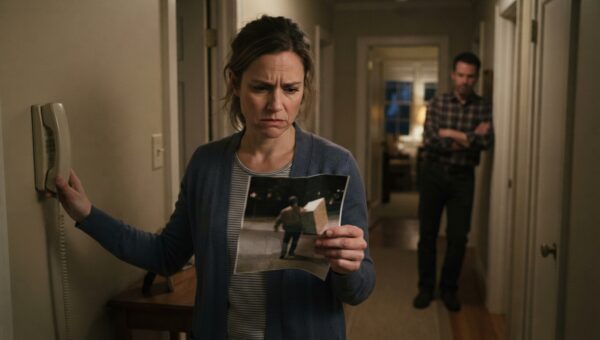
Three years. That was how long my father sat in his blue Buick in the third row of the visitor lot at noon every single day, watching the office doors. I didn’t know until the security guard told me. At my father’s funeral. In the parking lot of Grace Lutheran.
The service inside had been small, just a handful of retired machinists from the plant and a few cousins from up near Oshkosh who sat stiffly in their Sunday clothes.
My mother had been gone since I was nineteen, so it was just me standing by the open gravesite holding a program that felt entirely too light. When the brief gathering broke up, I lingered near my sedan, trying to summon the energy to drive back to my apartment and face the pile of unopened mail on the kitchen table.
That was when Ray walked up. Ray works the day shift at the office park where I earn my fifty-four thousand dollars a year as a corporate accountant. He had changed out of his uniform into a dark jacket that looked two sizes too small in the shoulders.
He pulled me aside near the trunk of my car. He looked down at his shoes before he spoke. “Mrs. Ellis, I need to tell you something about your father.”
I had seen Ray around the lobby of our building a hundred times.
He was always wiping down the brass handrails or signing for packages from FedEx, a steady, quiet presence who knew every tenant by name. I never imagined he knew my father.
“Ray,” I said, my voice thin from the cold wind off the lake. “What is it?”
“Your father parked in the visitor lot every day at noon,” Ray said. “Same spot. Third row. Blue Buick. He ate a sandwich. Watched the front door.”
I stared at him. The gray gravel crunched under someone else’s footsteps near the church entrance. “For how long?”
Ray looked right at me then, his eyes steady and tired. “Three years. Since 2022. When you stopped talking to him.”
The church bulletin crinkled in my fist. The paper was glossy and cheap, smelling faintly of printer ink and old hymns. I couldn’t make my lungs work right for a second.
“I asked him once why he came,” Ray continued, his voice dropping an octave. “He said, I just need to see her walk through that door. That’s how I know she’s okay.”
I started shaking. My knees felt like dry saltine crackers ready to snap under any real weight. I had cut my father off three years ago after that screaming match in my kitchen over my divorce, telling him he never showed up when it mattered, telling him his silence during my worst financial months was proof he didn’t give a damn about me. I had slammed the front door in his face and changed my phone number by the weekend. I had told myself I was protecting my peace.
Ray didn’t let me fall. He reached out and touched my elbow, steadying me against the fender of my car.
“There’s something else,” Ray said, and his voice cracked just a little bit. “Every day, he had a second sandwich on the passenger seat. Wrapped in foil.”
The memory of 2022 rushed back with the ugly force of a backed-up drain.
I remembered the rain hitting my kitchen window that Tuesday afternoon when Arthur had stood by the sink, his hands stuffed into his corduroy pockets, staring at the floor while I listed every single way he had failed as a father after Mom died. He had taken it all without yelling back. He had just nodded slowly, put on his wool cap, and walked out to his car. I had mistaken his quiet endurance for coldness. I had told myself he went home to his quiet house and forgot about me by dinner.
“He never came inside,” Ray said, bringing me back to the damp air of the churchyard. “I told him more than once he could use the lobby visitor chair if the wind was blowing hard. He shook his head. He said, ‘No, Ray. She made her boundary. I’m not here to crowd her. I just need to see her coat go past the glass.'”
Ray reached into his coat pocket and pulled out a heavy metal key on a faded red floating fob. He held it out toward my palm.
“He kept a box in the glove compartment,” Ray said softly. “He told me if anything ever happened to him, I was supposed to hand these to you in person. Not at the house. Here.”
I took the key. The brass was cold, worn smooth on the edges where a thumb had rubbed it thousands of times. It didn’t feel like a dead man’s key. It felt like an anchor.
“The blue Buick is still parked over on Elm Street by his apartment,” Ray told me, stepping back toward his own rusted pickup. “You should go look, Mrs. Ellis. Just go look.”
I didn’t go straight home. Instead, I drove thirty blocks north past the gas station and the car wash until I found the blue Buick sitting quietly under a bare maple tree near the curb. The paint on the hood was chalky and dull from years of sun, and a light dusting of oak leaves had settled in the wipers.
My hands were shaking so hard I dropped the key twice into the gutter before I managed to slide it into the driver-side lock. The door gave a heavy, solid thud when I pulled it open, releasing that familiar, unmistakable smell of my childhood: stale peppermint drops, old upholstery, and a faint hint of wood smoke.
I slid into the driver’s seat. The vinyl was cracked on the left bolster where my father’s hip had pressed against it every workday for a decade. I looked over at the passenger seat.
There was nothing on it now. Just the empty expanse of worn gray fabric. But I could see it as clearly as if it were still there, a small, neat square of crinkled aluminum foil sitting right in the middle, waiting for someone who never crossed the parking lot.
My breath caught in my throat. I leaned across the console and popped the latch on the glove compartment.
Inside sat a small spiral-bound notebook with blue lines and a black leatherette cover. Beneath it lay a plain white envelope with my name written across the front in my father’s heavy, deliberate machinist’s script: *For Clara.*
I didn’t open the envelope right away. I opened the notebook.
The first page was dated Monday, October 10, 2022. The handwriting was neat and straight, written with a fine-point ballpoint pen.
*Clear morning, about forty degrees. Clara wore the yellow cardigan I bought her back in Lansing. Walked fast with her head down, carrying the leather briefcase. Looked tired, but she made it inside by twelve-fourteen.*
I turned the page. Then another. Day after day, month after month, through the brutal Wisconsin winter slop and the humid July heat waves. Every single entry was just like the first, a simple record of weather, my coat, my pace, and whether I looked like I was holding up. There were no complaints about my harsh words in 2022. No self-pity. Just a lonely old man sitting in a third-row parking space for fifteen minutes every noon, making sure his daughter was still breathing.
*Wednesday, March 14, 2023.*
*Raining hard. She had the black umbrella with the broken rib. Didn’t see her smile today, but she was carrying a stack of green folders. Doing her work. She always was good with numbers.*
*Friday, November 3, 2023.*
*First snow. Buick heater took ten minutes to kick on. She wore the heavy wool coat. Looked up at the sky right as she hit the lobby door. Hope she’s eating enough. Got the roast beef today. Rye bread from the bakery on Fourth.*
I stopped reading because the tears were falling too fast to let me see the ink. My chest felt hollowed out, scraped clean by the realization of everything I had refused to see. I had thought my independence meant rejecting him, and he had simply turned himself into a quiet sentinel fifty yards away from my desk, asking for nothing except the privilege of knowing I was safe.
Finally, I picked up the white envelope and slid my finger under the flap.
Inside was a single sheet of lined paper and a cashier’s check made out in my name for forty-two thousand dollars drawn from the credit union downtown.
*Clara,*
*I never knew how to say the right thing when your mother died, and I guess I never learned how to fix things when you were hurting. You told me I wasn’t there when you needed me. You were right. I didn’t know how to carry your grief on top of my own. But I knew how to drive a car, and I knew how to pack a lunch.*
*I made two sandwiches every morning because I always hoped today might be the day you’d walk over and tell me to sit down. Even if you didn’t, seeing you walk through that door was enough to keep me going until the next morning. Keep the car. Use the money to pay off that credit card debt you told me about back when we still talked. You don’t have to forgive me to use it. Just take care of yourself.*
*Love, Dad.*
I sat in that silent car for a long time while the afternoon shadows stretched across the asphalt. The steering wheel was cold under my palms.
The following Monday, I didn’t go straight into the office at noon. I packed a sandwich on rye, wrapped it carefully in aluminum foil, and walked out past the glass lobby doors. I stopped by the third row of the visitor lot, right where the blue Buick used to sit, and I stood there in the bright autumn air, looking up at my office window with a quiet, steady heart.