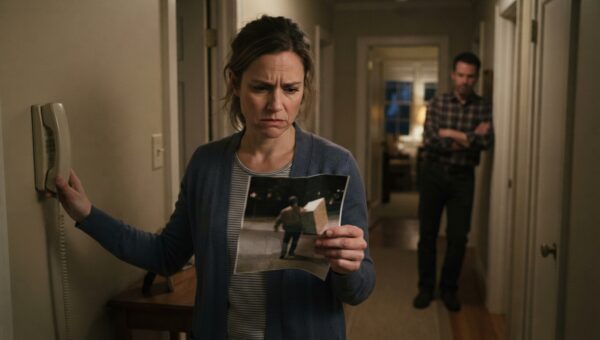
The morning coffee always left a fine gray film across the inside of the enameled pot if you let it sit past four, and I was standing at the sink scrubbing at it with a wire pad when David’s coat slipped off the bent-wood chair by the back door. It was heavy, winter-weight wool even though the Alabama air outside was just starting to lose its bite, and when I picked it up to hang it in the hall closet, my knuckle caught on something hard and small tucked deep into the bottom lining.
I pulled it out before I even thought about it. It was a brass key, no bigger than my thumb, with a jagged little bit and a small brass tag dangling from a rusted ring. Stamped right into the metal were the words Unit 38.
David came down the hall buttoning his cuffs, smelling of bay rum and stale office air. I didn’t hide it. I held it up between my thumb and forefinger, waiting for him to laugh and tell me which old toolbox or lawnmower shed it belonged to.
He didn’t laugh. He just stopped half a step past the pantry door, his fingers hovering over his left sleeve.
“Where did you dig that up?” he asked. His voice was too flat, too level, like he was reading off an invoice.
“In your coat lining,” I said. “What’s Unit 38, David? An old locker from your apartment on Elm Street?”
“Must be,” he said, turning back toward the kitchen island to grab his leather briefcase. “Throw it in the junk drawer, honey. I haven’t thought about that place in a decade.”
He kissed the top of my head on his way out, the way he had done four thousand times before, and the heavy oak front door clicked shut behind him with its familiar, solid thud.
I stood there by the sink for a long time watching the water drip from the faucet. Sixteen years of marriage teaches you the cadence of a man’s breathing, the exact pitch of his heels on the hardwood, and the subtle shift in his shoulders when he is sliding past a lie. David hadn’t lived on Elm Street since before we bought this house. He hadn’t kept a single thing from those days, or so he always claimed, because he liked a clean slate.
I didn’t go back to the dishes. I dried my hands on the tea towel and walked out to my station wagon.
There are four storage places between our house and the county line. I don’t even know why I remember this part, but my father had a couple of old outboard motors stored down by the river years ago, and I knew how those places operated. You rent a box, you pay cash or use a card, and nobody asks any questions as long as the monthly fee clears on the first.
The first place on Miller Road had fifty units, but they were lettered, not numbered. The second place, over by the old feed store, had numbers, but Unit 38 was a tiny four-by-four locker meant for winter tires, and the latch was rusted shut with thick yellow grease that hadn’t seen a hand in twenty years.
Maple Creek Storage was the third one. It sat back off the highway behind a row of scrub pines, a long, low metal building painted a dull institutional gray with a keypad gate that stayed propped open with a cinder block.
The manager was an old man named Earl who was half-asleep behind a laminated counter with a transistor radio playing soft country music. He didn’t look up when the bell above the door jingled.
“Office is closed for lunch,” he mumbled, not opening his eyes.
“I’m looking for Unit 38,” I said. My voice sounded thin even to me. “My husband lost his pass. David Vance.”
Earl scratched his neck, squinted at a greasy ledger book by his elbow, and turned a page with a yellowed thumb. “Vance? No, ma’am. That unit’s registered to a Mr. Marcus Hall. Paid up through the end of November. Automatic draft every month like clockwork.”
Marcus Hall. The name hit me right behind the eyes like a cold stone. Marcus had been David’s best friend back when they worked together at the lumber mill, before Marcus packed up his truck and moved out West after his mother passed away. We hadn’t heard from him in fifteen years. David used to shake his head and talk about how Marcus fell off the face of the earth.
“Right,” I said, keeping my voice steady. “Marcus asked us to check on some things for him. He’s traveling.”
Earl slid a ring of master keys across the grease-stained counter without another word. “Row C. Third building back. Don’t leave the door banging in the wind.”
Row C smelled of hot tin roofing and old dust. The sun was beating straight down on the corrugated metal, turning the narrow corridor into an oven. I walked down the row past padlocked doors until I found thirty-eight. The latch was clean, silver, and modern, completely out of place on a building that looked twenty years old.
I slid the little brass key into the lock. It turned with a dry, heavy click that echoed off the metal walls.
The door rolled up with a screech of dry rollers, and the air that rolled out of that dark space didn’t smell like old tires or spare furniture. It smelled like cedar shavings and expensive French perfume that I hadn’t smelled in a lifetime.
I reached inside and flicked the plastic pull-chain hanging from the ceiling bulb.
The light flickered yellow before steadying.
It wasn’t a storage unit. It was a room. Someone had paneled the concrete walls with cheap pine boards and laid down a braided oval rug that looked identical to the one my grandmother used to have in her sitting room. Against the back wall sat a narrow twin bed made up with white cotton sheets and a heavy wool quilt with a blue star pattern.
On the wall above the bed hung a dozen framed photographs, all taken from a distance, all of the same woman.
I took two steps inside and stopped dead.
The woman in the pictures had my hair, cut in the exact shoulder-length bob I wore back when David and I first started dating in the fall of 2008. She was wearing a green cardigan I had given away to the Goodwill truck three summers ago because I thought I’d outgrown it. In another photo, she was walking out of the grocery store with two brown paper bags in her arms, looking over her shoulder with that slight squint I make when the sun hits my eyes just right.
“What is this,” I whispered to the empty tin walls.
My eyes moved from the wall to a small wooden dresser against the side partition. On top sat a row of glass perfume bottles, all half-empty, and a tortoise-shell hairbrush with long strands of dark brown hair caught in the bristles. I reached out and touched the wood of the dresser. It was real. Everything in the room was real.
I pulled open the top drawer. Inside lay neat stacks of underwear, socks, and cotton blouses, every single one of them in a size small. My size.
A green plastic folder sat at the bottom of the drawer. I pulled it out and flipped open the cover. It was a lease agreement from Maple Creek Storage, dated October 14, 2013, signed with a scrawl that bore the name Marcus Hall. Attached to it were carbon copies of money order receipts and bank routing slips. One hundred and seventy-five dollars every single month, without fail, for one hundred and thirty-two months.
$23,100.
I did the math right there in the dim, humming quiet of that metal box, my thumb smudging the ink on a receipt from six years ago. Twenty-three thousand one hundred dollars spent to keep a room locked away behind a dead man’s name.
And then I saw the date on the first photograph on the wall. October 9, 2013.
The memory hit me with the force of a physical blow. That was the weekend David went down to the state park for the annual forestry conference, the one where he called me from a roadside diner to say his truck battery had died and he was staying the night in a motel eighty miles away. I remembered sitting at our old kitchen table eating cold soup by myself, feeling sorry for him because he hated being stranded on the highway.
Except he hadn’t been stranded.
I stood there in the center of that room for nine minutes. I timed it by the sweep-second hand on my watch because my brain simply refused to jump to the next thought. Nine minutes of staring at a twin bed that had never been slept in by anyone who belonged there, surrounded by clothes I didn’t remember packing and pictures I didn’t remember posing for.
I didn’t cry. Anger didn’t come yet, and neither did panic. There was just a cold, hollow space where my life used to be, like someone had come in during the night and swapped out the foundation of the house for balsa wood.
I reached into my pocket, pulled out my phone, and pressed three numbers.
“Maple Creek Storage,” I told the dispatcher when she answered. “Unit 38. You need to send someone. My husband has been keeping a dead woman in here.”
Detective Miller looked less like a police officer and more like a high school history teacher who had spent thirty years grading papers in a room with bad fluorescent lighting. He wore a rumpled beige suit jacket with shiny elbows and carried a small black notebook that he flipped through with blunt, ink-stained fingers.
We were sitting in my kitchen while two patrol cars sat out by the gravel drive, their blue lights turned off but the engines idling low enough to make the front windows rattle.
“Your husband’s name is David Vance,” Miller said, looking up from a plastic evidence bag containing the small brass key I had pulled from the coat lining.
“Yes,” I said. My hands were wrapped around a mug of lukewarm tea I hadn’t touched in twenty minutes. “We’ve been married sixteen years. He works for the county water department.”
“And the storage unit was leased under Marcus Hall,” Miller said, his pen tapping twice against his knee. “We ran Marcus through the state database about an hour ago. He didn’t move out West, Mrs. Vance. Marcus Hall died of a heart attack in an Ohio motel room back in the winter of 2011. Someone kept his old driver’s license active through a local P.O. box down in the industrial park.”
The silence in the kitchen felt heavy, pressing down against my eardrums. Outside, a blue jay landed on the porch rail and pecked once at the peeling white paint before darting away.
“Who is she, Detective?” I asked.
Miller sighed, a long, tired sound that seemed to come from the soles of his shoes. He reached into his coat pocket and laid a glossy black-and-white photograph on the laminate tabletop. It was an old missing person flyer, the edges yellowed from being folded and unfolded a thousand times.
A young woman with dark hair cut into a blunt bob stared up at me. She had my nose, my jawline, and the same small mole just below her left collarbone.
“Clara Vance,” Miller said softly. “No relation to David, despite the last name. She was a botanical surveyor who worked out of the state university agricultural extension office back in twenty-thirteen. She vanished on a Friday afternoon after telling her supervisor she was meeting David Vance to look at some timber tracts near the county line.”
I looked down at my own hands resting on the table. They looked old, the skin thin across the knuckles, the veins standing out like blue thread.
“David told me she was a girl he knew in college who moved to Chicago,” I said, my voice barely audible even to myself. “Years ago, when we first moved into this house, he showed me a picture once. He said she was an old friend who broke his heart by leaving. He told me I had her same laugh.”
“He didn’t just have her laugh in mind, Mrs. Vance,” Miller said, leaning forward. “We searched the crawlspace beneath the floorboards in Unit 38 about twenty minutes ago. We found Clara’s purse, her university ID, and a leather journal with entries dating up to the day she disappeared. We also found receipts for hair dye, specific brands of soap, and clothing orders shipped to a drop-box in a neighboring town, all purchased in your size, starting three weeks after she went missing.”
The kitchen seemed to tilt slightly, just enough to make me grip the edge of the laminate.
“He didn’t just keep her things,” I said, the words tasting like copper in my mouth. “He was turning me into her.”
“He built a shrine,” Miller said quietly. “And he kept it running for eleven years because he couldn’t let go of what he did.”
We didn’t have to wait long after that.
At 5:15 in the evening, David’s sedan turned into the drive. We watched from the front window as he killed the engine, grabbed his briefcase from the passenger seat, and walked up the three wooden steps to the porch with his usual steady stride. He looked like a man coming home from a long day of checking water mains, tired around the eyes but settled in his routine.
He pushed the front door open, stepped into the hall, and stopped dead.
Detective Miller was standing by the coat rack. I was sitting at the kitchen table, the small brass key resting right in the center of the wood surface where the light from the window hit it like a target.
David didn’t look at me. His eyes went straight to Miller, then to the two uniformed officers blocking the hallway behind him. The color drained out of his face so fast it looked like someone had pulled a plug in his heels.
“David Vance,” Miller said, pulling a folded set of papers from his breast pocket. “I’m arresting you in connection with the disappearance of Clara Vance in October of 2013, as well as multiple counts of wire fraud, identity theft, and tampering with evidence.”
David’s mouth opened, closed, then opened again. He looked at me then, his eyes wide and pleading, the expression of a man who still believed he could talk his way out of a broken pipe.
“Elena,” he said, his voice cracking on the second syllable. “Whatever you found in that locker… it’s not what you think. I can explain every bit of it. It’s just… she was a friend. I panicked when things went wrong.”
I didn’t stand up. I didn’t yell, and I didn’t throw the tea mug at him the way I had imagined doing during those long nine minutes in the dark storage locker.
“You told me I had her laugh, David,” I said, my voice steady and cold as well water. “You spent sixteen years making sure I wore her sweaters, used her soap, and parted my hair on the left side just the way she did.”
“Elena, please, “
“Take him out,” I told Detective Miller.
They didn’t put the cuffs on him until they reached the front porch, but I heard the metal click through the open door just before the latch caught.
The house was very quiet after they left. The sun went down behind the tree line, turning the kitchen walls the color of bruised plums. I sat there at the table for a long time with the brass key sitting right where I left it, waiting for the trembling to start, waiting for the grief or the rage to break over me like a wave.
It didn’t come. There was just the sound of the refrigerator humming in the corner and the heavy, sweet smell of the tea cooling in my cup.
The next morning, I drove down to Elm Street past the brick storefronts with the yellow awnings until I found the small basement salon next to the dry cleaner’s where Marcy kept her clippers sharp.
The shop smelled of perm solution and cheap lavender spray. Marcy looked up from her magazine as the bell above the door chimed, her eyebrows lifting behind her thick plastic frames.
“Well, Elena,” she said, setting her coffee down on the counter. “You’re an early bird today. What are we doing? A trim?”
I walked past the waiting chairs and sat down in the tall vinyl seat in front of the mirror, looking straight at my own reflection without squinting, without looking for anyone else in the glass.
“Take it all off,” I said, reaching up to pull the tortoise-shell clip from the back of my head. “Every last inch of it.”
Marcy blinked, her scissors hovering for a second before she nodded and reached for the gray nylon cape. “You sure about that, hon?”
“I’m sure,” I said, watching the first heavy lock of dark brown hair fall past my shoulder and hit the linoleum floor. “I’m very sure.”