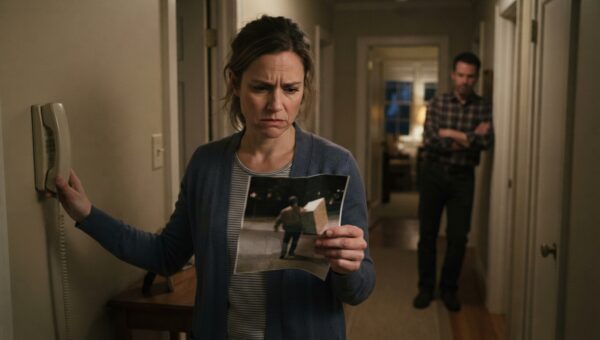
The spare keyring had lived in the wooden bowl by the pantry door for seven years, right beside the dried-up tube of superglue and three rolls of postage stamps. When Raymond misplaced his house keys for the second time in a single month, grumbling about how the kitchen counter swallowed everything after dark, I didn’t think twice. I picked up my phone, ordered a small square tracker for twenty-five dollars, and looped it onto his metal ring while he was out in the garage clearing the leaf blower.
He thought it was a cute gadget. I thought it was just a practical fix for a forgetful man who spent too much time hunting for his Honda fob.
Every Saturday morning around eight, Raymond poured his coffee into the heavy insulated mug with the chipped rim, kissed the top of my head, and backed out of the gravel drive. He always wore his gray canvas jacket with the paint splatters on the left pocket and told me he was heading down to the big home improvement store off Route Nine because the plumbing supplies were twenty percent cheaper before noon. I spent those quiet hours cleaning out the pantry, paying the electric bill, or sitting on the back porch with the neighborhood cat. I liked the rhythm of those weekends. I liked believing our life was steady, predictable, and built on twenty-two years of shared brick and mortar.
The shift happened on a rainy Tuesday when the app on my phone gave me a little ping about location history.
I had never bothered to check the map before, mostly because I didn’t have any reason to doubt a man who smelled like sawdust and cold morning air every Saturday at noon. But curiosity is a strange, quiet thing once it gets its teeth into you. I tapped the screen, scrolled past Tuesday and Wednesday, and opened Saturday’s log. Fourteen miles west. Not Route Nine. A neat, treeless cul-de-sac called Birchwood Lane. Sixteen Saturdays in a row. Exactly three hours and forty-two minutes each time.
I didn’t scream or throw my coffee mug against the wall. I just sat there at the kitchen table while the refrigerator hummed its familiar low note, watching the little blue dot on the screen blink against the satellite map. Sixteen weeks of hardware store runs that didn’t exist. Sixteen weeks of careful lies told over buttered toast. My chest felt tight, like someone had wrapped a heavy woolen blanket too high around my throat, but my hands stayed steady as I closed the app and locked my phone screen.
That Saturday, I didn’t wait for him to kiss the top of my head. I let him leave at eight, watched the gray Honda turn the corner past the mailbox, and waited fifteen minutes before I started my own car. The drive down Birchwood Lane took twenty-two minutes through the gray morning mist. Number forty-four was a split-level ranch with yellow siding and a rusted metal tricycle lying on the patch of dead grass by the driveway. A blue sedan I didn’t recognize sat parked near the front steps.
I cut my engine, sat in the silence of my sedan for a long moment, and walked up the three concrete steps. When I knocked on the front door, the footsteps inside were light and hurried. A woman with dark hair pulled back in a loose clip opened the wood door half an inch, her eyes still clouded with early morning sleep.
She looked at me once, took in my sensible wool coat and my bare hands, and let out a small, tired sigh.
“You must be his sister,” she said, her voice flat and dismissive, as if she had been prepped for an awkward family visit she never wanted.
I stood there on her welcome mat, feeling the cold wind off the lawn cut right through my sweater. “I’m his wife.”
She grabbed the edge of the door frame so hard her knuckles turned the color of chalk. The color drained out of her face until she looked almost translucent against the dark hallway behind her. “No,” she whispered. “He told me…”
Before she could finish, a little boy with a shock of thick brown hair and Raymond’s exact, distinct square chin toddled around the corner from the kitchen, dragging a plastic duck by a blue string. He stopped, blinked up at me with Raymond’s hazel eyes, and held out the duck. The silence in that small hallway was heavier than any shout or argument I had ever known.
“His name is Leo,” the woman said, her voice shaking so badly she could barely form the words. “He’s two.”
I didn’t go inside. I turned around, walked down the concrete steps, and got back into my car. I drove straight home, pulled into our gravel driveway, and turned off the ignition. And then I just sat there. For forty minutes, I watched the windshield wipers flick away a stray mist while my brain tried to glue together two entirely different lives that couldn’t possibly belong to the same man. Forty minutes of staring at the steering wheel until my fingers went stiff.
When I finally unlocked the front door, the house felt hollow, as if the walls had somehow thinned out while I was gone. I walked straight into Raymond’s small home office in the back room, where the smell of his pipe tobacco still lingered near the leather chair. His laptop sat closed on the cherry-wood desk, the blue indicator light pulsing softly in the dim afternoon light. It wasn’t locked. Raymond had never believed in passwords for things inside his own house, trusting blindly in the absolute privacy of a man who thought nobody would ever dare question him.
I opened the lid, clicked into the documents folder, and saw a file sitting right on the desktop with a title that made my stomach drop into a cold pit. Exit Plan.docx.
I double-clicked it. The document was forty-two pages of dense legal formatting, financial spreadsheets, and cold, calculated instructions. It was a complete blueprint for how to dismantle our marriage, liquidate our shared assets, and push me out of our home with next to nothing. It detailed the transfer of four hundred and ten thousand dollars in liquid equity and hidden savings accounts into a separate entity. It outlined a minimalist monthly support figure of one thousand dollars, designed to keep me quiet while he petitioned the court for full custody of our teenage daughter and younger son under the guise of maternal instability and emotional unfitness.
And at the very bottom of the document, tucked into the metadata and the signature block draft, was the name of the attorney who had drawn up the entire scheme.
Richard Vance.
The same Richard Vance who had handled my late father’s estate probate three years ago, and who had sat right at our dining room table drinking my sweet tea while he drafted our joint family trust and our marital home deed. Richard knew every brick of this house. He knew my father’s legacy, my children’s college accounts, and every single dollar we had built together since the day we walked out of the chapel.
The house stayed dead silent until the grandfather clock in the hallway chimed five times. Every tick sounded like a hammer hitting an anvil. I didn’t cry. The shock had burned itself out during those forty minutes in the driveway, leaving behind something much colder and much sharper. I plugged a small flash drive into the side of Raymond’s laptop, highlighted every single folder connected to the Exit Plan, and copied the entire digital paper trail in less than twenty seconds. I emailed the files to a secure drop, ejected the drive, and slipped it into the pocket of my coat.
By Monday morning, I was sitting across a scarred oak desk in a downtown office three towns over, looking at a woman named Elena Martinez. Elena was a forensic family attorney with iron-gray hair, sharp wire-rimmed glasses, and a reputation for eating predatory corporate lawyers for breakfast. She didn’t offer me tea, and she didn’t waste time with sympathy. She listened in absolute silence as I laid out the Tile tracker logs, the photos of the house on Birchwood Lane, and the forty-two-page Exit Plan drafted by Richard Vance.
“Well,” Elena said, adjusting her glasses as she scanned the signature block on page forty-one. “Mr. Vance has been very busy. And very, very stupid.”
“Is it legal?” I asked, my voice barely above a whisper. “Can he represent Raymond against me when he holds our family trust?”
“It’s not just illegal under state bar ethics rules, Mrs. Vance, or whatever you choose to call yourself after today, it’s a textbook conflict of interest that could cost Richard his license before the end of the month,” Elena said, a thin, dangerous smile touching the corners of her mouth. “He took your father’s probate fees with one hand and drafted your corporate exile with the other while sitting on your joint trust. Judges in this county do not look kindly on attorneys who try to act as secret architects for side families.”
Over the next seventy-two hours, Elena’s office moved with the quiet, devastating efficiency of a military operation. We subpoenaed bank records from three separate credit unions where Raymond had been quietly siphoning marital funds into an LLC registered under a post office box in Birchwood Lane. We locked down the home equity line of credit, froze every joint investment portfolio before the ink on his draft could dry, and drew up a formal ethics complaint against Richard Vance for gross professional misconduct and breach of fiduciary duty.
By Saturday morning, exactly one week after I had stood on the porch at Birchwood Lane, the house was quiet again. The sun was streaming through the kitchen window, catching the fine dust motes dancing above the granite counter. I had packed two weeks of Raymond’s clothes into two heavy-duty canvas duffel bags and set them neatly by the front door. On top of the bags sat a printed copy of the Exit Plan, the Tile tracker still blinking faintly on its metal ring, and Elena’s thick packet containing the frozen asset injunction and Vance’s disciplinary notice.
At 8:02 in the morning, the gray Honda pulled into the gravel drive. I heard the engine cut out, the heavy thud of the car door closing, and the familiar crunch of gravel as Raymond walked up the front steps with his insulated coffee mug in his hand. He unlocked the door, stepped into the hallway, and shook the morning mist off his canvas jacket.
“Morning, honey,” he called out, his voice smooth and easy as he tossed his keys into the wooden bowl by the pantry. “Traffic on Route Nine was a little rough, but I got the PVC fittings we needed for the basement.”
He rounded the corner into the kitchen, expecting the usual smell of coffee and toast. Instead, he found me sitting at the end of the long oak table, my hands resting quietly on the dark wood surface.
Raymond stopped dead in his tracks. His eyes flicked from my face to the two heavy duffel bags by the front door, and then down to the thick stack of papers sitting right in the center of the table where his breakfast should have been. The color drained out of his cheeks in an instant, leaving him looking older, smaller, and entirely hollow.
“What is this?” he asked, his voice catching slightly on the back of his throat.
I didn’t raise my voice. I didn’t need to. The silence in the room was absolute, and for once, it didn’t feel heavy at all.
“You left your keys behind, Raymond,” I said, sliding the little square Tile tracker across the table until it clicked softly against his coffee mug. “And you forgot to mention that Richard Vance was working for both of us.”