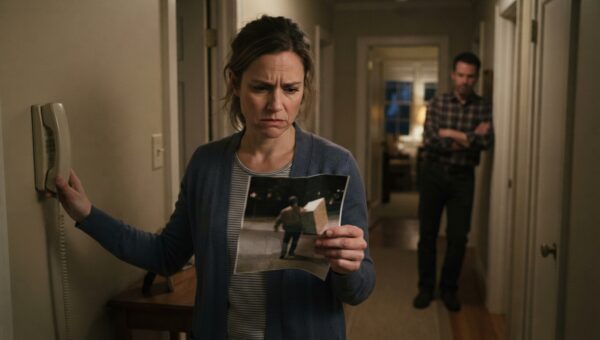
The laminate table at the corner of the diner on Vine Street had a small nick near the edge where the white plastic had chipped away to reveal dark brown particle board underneath, and I spent the first five minutes of our meeting staring right at it. Mia sat across from me with her coffee cup between her hands, not drinking, just watching the steam curl up into the cold air between us. She was twenty-four now, wearing a sharp navy blazer that somehow looked too heavy for her shoulders, though I knew those shoulders had been carrying things I refused to name for a very long time.
“You’re late,” she said. Her voice didn’t have any anger in it, which somehow felt much worse than if she had yelled at me. It just had that flat, professional drop to it, like an investigator reading from an intake log.
“Traffic on the bypass,” I said, though it was a lie. I had sat in my Buick for twenty minutes in the parking lot with the engine idling, watching her through the frosted glass, trying to find some way to turn the key and drive back home to my empty kitchen. “They’re paving near the off-ramp again.”
Mia didn’t answer that. She just reached into her bag and laid a small leather cardholder on the table, turning it so the metal shield faced me. Child Protective Services. Thirty-eight thousand dollars a year starting pay, according to what my daughter Brenda had complained about over the phone six months ago when Mia first took the job.
Brenda had called it a waste of a college degree. Brenda had said that girls who spent all their time digging into other people’s broken homes usually just had broken homes of their own they were trying to fix.
At the time, I had agreed with Brenda. It was easier to agree with Brenda than to listen to the way my own chest tightened every time the phone rang after dark.
“I need to tell you something I should have told you seven years ago,” I said. My fingers were trembling against the ceramic rim of my mug, and I hated how old I looked in the reflection of the glass.
Mia set her cup down. The ceramic made a sharp, dry click against the laminate. “You saw the bruises.”
The words didn’t float in the air; they dropped straight down like lead shot. I didn’t nod right away because my neck felt stiff, locked up by seventy years of bowing my head whenever a man in my house raised his voice or slammed a door.
“Easter dinner,” I finally whispered. “Your arms. The purple marks right above your elbows where someone had grip-checked you.”
“I know you saw, Grandma,” she said, leaning forward just enough that the overhead fluorescent light caught the sharp line of her jaw. “I watched you look at them. Then you looked at Mama. Then you poured more sweet tea.”
I gripped my coffee cup until my knuckles turned the color of lard. I wanted to tell her about the mortgages, about the way Brenda looked when Rick was drinking, about how small our world was in that little brick house off Route 4 where nobody ever locked their front doors until the world got mean. But none of that mattered against the memory of the blue cardigan I had worn that afternoon, the same one I still had hanging in the back of my closet with a faint stain near the hem from gravy I had spilled while serving the second ham.
“During grace, Rick squeezed my arm under the table,” Mia said, and her voice dropped an octave, steady and hard as iron. “I flinched. You were sitting right next to me.”
“I was afraid,” I said, and the confession tasted like copper in my mouth. “If I said something, your mother would have cut me off. You know how she is when someone crosses Rick. She hasn’t spoken to your aunt Carol in six years just because Carol said he looked at her sideways at a funeral.”
Mia looked down at her badge, tracing the eagle stamped into the metal with the pad of her thumb. “I protect children now because the people who were supposed to protect me chose to be comfortable instead.”
“I’m sorry,” I said.
“I know,” she replied, and her eyes finally came up to meet mine. “But sorry doesn’t undo three years of a man who counted my bruises like trophies. The day I decided no adult would ever protect me was Easter 2017. You were wearing a blue cardigan. You had sweet tea in your hand. And when I looked at you for help, you looked at your plate and said, ‘Who wants more ham?'”
The silence that followed was so thick I could hear the refrigerator humming behind the diner counter three rows away. That sentence had lived in my own head for seven years, rattling around like a loose screw in a tin can, but hearing her say it out loud made the walls of the restaurant feel like they were closing in.
“That’s the sentence I hear every time I knock on a door where a child is waiting for someone to stop pretending everything is fine,” Mia whispered. She stood up then, sliding her badge back into her bag with a quick, efficient zip. “You didn’t call me here to apologize, Grandma. Brenda let him back in the house last Tuesday, didn’t she?”
I couldn’t look away from her. My breath caught somewhere behind my ribs.
“Little Lily is nine years old now,” Mia said, looking down at me the way an officer looks at a witness who is withholding the one detail that matters. “She sits at that same dining table. She wears the same sweaters. And Brenda is telling her the exact same lies she told me about how Rick is just stressed from work.”
“She let him back in because the oil furnace broke down and he’s the only one who knows how to fix the blower,” I blurted out, hating myself even as the pathetic excuse left my tongue. “Brenda said they couldn’t afford a repairman.”
“A furnace,” Mia said, and her mouth twisted into a bitter, humorless line. “That’s the price. A warm kitchen in January is worth another little girl’s ribs.”
She turned toward the door before I could find another lie to hide behind. The little brass bell above the threshold gave a cheerful little ding that sounded ridiculous against the weight of what just happened between us. I sat there alone at the sticky table for a long time, watching the ice cubes melt in my cold coffee until they drifted together in a gray, watery ring.
The drive back to Brenda’s house took twenty minutes, but it felt like I was driving through a thick white fog that wouldn’t let me see twenty feet ahead of my headlights. The sun was starting to go down behind the interstate overpass, turning the sky the color of a bruised plum.
When I pulled my Buick into the gravel drive, Rick’s old rusted pickup truck was parked right beside Brenda’s sedan, dripping dark oil onto the fresh gray stones I had laid down myself last autumn. The kitchen window was glowing with that warm, yellow light that from the outside always made people think a house was safe and happy.
I didn’t turn off the engine right away. I sat there with my hands resting on the steering wheel, feeling the steady vibration of the six-cylinder motor through my palms. I thought about the blue cardigan hanging in my closet, smelling faintly of mothballs and lavender detergent. I thought about how many times I had told myself that keeping the peace was the same thing as being a good mother, as if God kept a ledger where cowardice counted as patience.
Through the screen door, I could hear the faint sound of television voices and the dull clatter of silverware against stoneware. Brenda was laughing at something, that high, nervous giggle she always used whenever Rick was around to make sure he knew she was on his side.
Then I heard little Lily’s voice, small and thin, asking if she could be excused from the table to go finish her homework in the back bedroom.
And then Rick said something low that I couldn’t make out through the double-paned glass, followed by that sharp, heavy silence that always meant everyone had stopped moving to see which way the wind was blowing.
I didn’t reach for the door handle out of courage. I did it because my stomach finally revolted against the taste of everything I had swallowed for forty years.
I walked up the two wooden steps of the back porch without wiping my shoes on the mat, pushing the screen door open without knocking the way I used to do when I still had a key of my own. The kitchen smelled like burned pork chops and cheap pine cleaner. Brenda looked up from the stove with a wooden spoon in her hand, her face going tight and sour the second she saw my coat.
“Ma? What are you doing here? We’re eating,” Brenda said, her eyes darting toward Rick, who was sitting at the head of the table with his sleeves rolled up to his elbows, revealing those thick, coarse hairs on his forearms that I had tried not to look at since the day he moved in.
Lily was sitting halfway down the bench, her fingers clenched tightly around her milk glass, her eyes fixed on the salt shaker between them.
“Get your coat, Lily,” I said. My voice didn’t shake. I was surprised by how steady it sounded, like someone else was standing behind me pulling the strings.
Rick leaned back in his chair, a slow, ugly grin spreading across his face as he reached for a roll from the basket. “Well, look who’s wandered in off the highway. Did you forget what day it is, Helen, or are you just lonely?”
Brenda set the wooden spoon down hard on the counter, the sauce splattering against the white tile. “Ma, don’t start this. We’re having a nice dinner. Rick fixed the heat this morning, and we don’t need you coming in here stirring up trouble just because you’re bored.”
“I’m not stirring anything, Brenda,” I said, stepping past the kitchen island and standing right behind Lily’s chair. I could smell the child’s shampoo in her hair, that sweet apple scent that hadn’t been ruined by fear yet. “I’m just taking my granddaughter home with me.”
Rick stood up slowly, his chair legs scraping against the linoleum with a sound that set my teeth on edge. “She lives here, old woman. You don’t have any say in what happens under this roof.”
“I saw what you did to Mia in seventeen,” I said, turning my head to look him straight in the eye for the first time in my life. “And I see what you’re doing to her shoes by the back door now. I was a coward then. But I’m too old to be scared of a bully who only knows how to hit little girls when their mothers are looking the other way.”
Brenda let out a sharp gasp, her hands flying to her mouth. “Ma! Have you lost your mind? He didn’t do anything!”
“Call the police yourself, Brenda, or I’ll do it from my car,” I said, reaching down and taking Lily’s small, cold hand out from under the table. “And if you ever let him back through your front door again, don’t bother calling me when you need rent money, because I’m burning the will tomorrow morning.”
Rick took a half-step forward, his face darkening into that purple rage I knew so well, but Brenda stepped between us, her arm outstretched like a policeman stopping traffic. For the first time in twenty years, Brenda wasn’t looking at Rick to see if he approved; she was looking at me with pure, unadulterated hatred, and somehow that felt like the cleanest thing I had ever seen.
“Get out,” Brenda whispered, pointing a shaking finger toward the screen door. “Get out of my house and never come back.”
“I won’t,” I said. “But Lily is coming with me.”
By the time we got out to the Buick, Lily was crying quietly in the passenger seat, clutching her school binder against her chest like a shield. I didn’t try to comfort her with empty promises. I just started the engine, turned the heater up high, and drove straight down to the county intake office where Mia’s silver sedan was parked under the flickering sodium lights of the parking lot.
The agency doors were locked for the night, but Mia was standing right there on the concrete porch waiting for us, her breath pluming white in the crisp night air, holding two paper coffee cups from the Vine Street diner.
I parked right under the yellow light, cut the engine, and turned off the headlights. I didn’t look back at the house on Route 4, and I didn’t think about the blue cardigan hanging in my closet.
Mia opened the passenger door, unbuckled Lily with steady, gentle hands, and then walked around to my side of the car. She didn’t smile, but she didn’t have to. She just handed me the extra cup of coffee through the rolled-down window, her fingers brushing mine for a second against the cardboard sleeve.
“You brought her,” Mia said softly.
“I brought her,” I said, and for the first time in seven years, the air inside my chest felt light enough to breathe all the way down.