My father left when I was 9. No calls, no birthday cards, just the sound of his heavy boots walking down the porch steps and the gravel crunching under the tires of his old Ford truck. He did not look back. My mother spent the next decade teaching me how to harden my heart against ghosts, locking away every framed photograph until the spaces on the wall were just paler squares of yellowed wallpaper.
I learned to live without him because the alternative was too exhausting to carry around every single day.
When I got into nursing school at 22, the tuition bill hit me like a physical blow. Thirty-four thousand dollars a year was a mountain I had no way to climb on my own. I sat at our small kitchen table until three in the morning, clicking through scholarship portals until my eyes burned, expecting every single application to dead-end in rejection. Then the notice came through the university financial aid office. An anonymous donor had covered eight thousand five hundred dollars a semester, every single term, for four straight years. Sixty-eight thousand dollars total, paid straight to the bursar. I never knew who to thank. I just put my head down, studied until my hands shook, and made the Dean’s list.
When I graduated, I started working at Merry Hospital pulling sixty-one thousand a year, paying rent on a tiny third-floor apartment that smelled faintly of old radiator iron.
I thought the mystery of the tuition was just a lucky break, some wealthy alumnus with money to burn on girls from blue-collar towns who wanted to wear white scrubs. I figured the world owed me that much after taking my childhood away. I kept working double shifts in the telemetry ward, measuring my life in IV drips and twelve-hour rotations, keeping my head down and my heart locked tight.
At 30, I got a letter from the university. The envelope was thick, cream-colored, and stamped with the seal of the registrar’s office. Your anonymous donor has passed away, the letter said. Per his instructions, we are releasing his identity. There was a name typed in heavy black ink and an address six miles from my apartment. Arthur Vance. The street name was unfamiliar, but the mileage wasn’t. He had been living less than ten minutes away from my apartment for the entire three years I had worked at Merry Hospital.
I drove there without calling, my hands gripping the steering wheel so hard my knuckles turned the color of skim milk. The house was a small, saltbox-style place with peeling white paint on the trim and a rusted screen door that hung slightly crooked on its hinges. A woman answered my knock before I could even raise my hand to try again. She looked to be in her late fifties, with kind, tired eyes and flour dusting the front of her faded blue apron. She didn’t look surprised to see me standing on her WELCOME mat. She just looked like she had been waiting for the other shoe to drop for twenty years.
Her name was Martha, and she invited me into a living room that smelled faintly of pine cleaner and old paper. She sat me down at a Formica table that had a chipped corner covered with a piece of gray duct tape.
He watched every graduation from the parking lot, she told me, her voice steady and quiet. She didn’t offer me coffee, and she didn’t try to smooth over the jagged edges of what she was saying. He wanted to come in, she said, looking right into my eyes. I told him you’d forgive him. He said you shouldn’t have to.
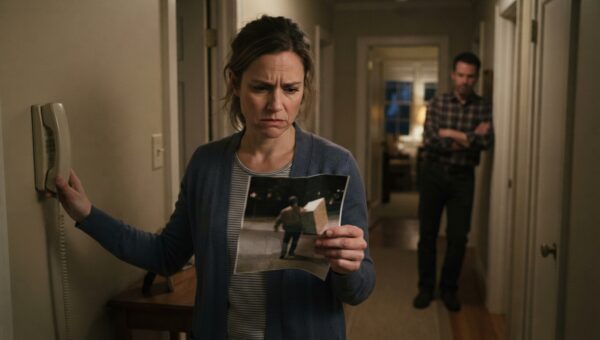
She handed me a worn cardboard shoebox tied with a faded piece of twine. Inside was every school photo I ever took, trimmed neatly around the edges with kitchen scissors. There were report cards with my name written in neat blue ink, little handmade Mother’s Day cards I remembered making in the third grade, and my wedding announcement clipped straight from the Sunday paper. He had kept track of every single milestone while I was busy pretending he didn’t exist. At the very bottom of the box was a crumpled, yellowed carbon receipt from Merry Hospital.
I picked up the receipt, turning the fragile paper over in my fingers as the ink began to blur behind my hot tears. He was there the night I was born, holding my mother’s hand before everything fell apart. And he was there the night I almost died at 7 from a severe hemorrhagic fever that kept me in the pediatric ICU for five days. The blood donor who saved me when my hemoglobin crashed to six was Arthur Vance. The blood donor who gave me a second chance at life before he ever walked out the door was my own father.
Martha sat across from me and explained the rest without making excuses for him. He lost the machine shop three years after I was born, she said, her fingers tracing the edge of the table. Pride is a terrible thing when you are broke. He thought he was doing you a favor by getting out of the way, because he believed his failures were contagious. When you got into nursing school, he remortgaged this house and took on night shifts at the rendering plant just to make the semester payments through the foundation. He never wanted you to know because he didn’t think he deserved the comfort of your gratitude.
She walked me out to the detached workshop behind the house, pushing open a heavy wooden door that creoked on ungreased hinges. Inside, it smelled of stale tobacco, cutting oil, and iron filings. A vintage lathe sat in the corner under a bare bulb, surrounded by stacks of old machine manuals and half-finished wooden trinkets. On the workbench lay a small, hand-carved wooden caduceus pin, sanded down until the grain of the maple glowed like honey. It was wrapped in a greasy scrap of paper with my initials written in his clumsy, heavy-handed printing.
I stood there in the quiet of that dusty workshop, looking at the tools he used to buy my future. The anger I had carried around like a heavy stone for twenty-one years didn’t vanish all at once, but it shifted, turning into something much harder to bear. He didn’t leave because he didn’t care. He left because he was broken, and he stayed away because he thought his shadow was too dark to let me grow. He paid for every single credit hour of my education with blisters on his hands and iron in his lungs, keeping his distance so I could become the healer he never had the discipline to be.
I walked out of that yard with the shoebox tucked under my arm and the wooden pin heavy in my pocket, driving back through the twilight toward my apartment with my chest aching in a way I hadn’t felt since I was a little girl. Martha didn’t ask me to come back, and I didn’t make any grand promises about what tomorrow would look like. We just shared a long, quiet look at the screen door, both of us knowing the debt had finally been settled in full.
The next morning, I walked through the sliding automatic doors of Merry Hospital at 6:45 for the early shift change. The fluorescent lights overhead hummed their usual morning tune, and the smell of industrial floor wax hung thick in the corridors. I walked past the nurses’ station where the night charge nurse was finishing up her charts, dropping off my heavy coat in the breakroom locker. Before I pinned my official plastic employee badge to the left pocket of my fresh white scrubs, I reached into my coat pocket and pulled out the small, hand-carved wooden caduceus. I pressed the tiny wooden pin right beside my name tag, feeling the steady, familiar pulse in my own wrist as I looked down at my hands. It was the same blood that had kept me alive twenty-three years ago, and it was the same quiet strength that had carried me through every single lecture, exam, and night shift since. I adjusted the pin, took a deep breath of the sterile hospital air, and stepped out onto the floor.