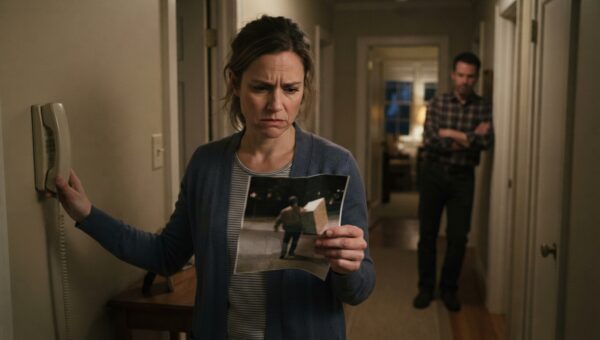
“She didn’t mean it,” my husband whispered as I lay curled up in pain on the linoleum floor of our front hallway. “Please… let’s keep this inside the family.”
That was the first thing Graham said after his sister Kendra shoved me down our porch stairs because I asked her to move her car out of my garden bed. My right side hit the bottom landing with a sickening crack, and I could barely draw a full breath without my ribs screaming in protest.
Graham didn’t run to check if my neck was broken. He didn’t grab the phone to dial three numbers. He crouched beside me, his hands hovering nervously over my shoulders, more worried about what the neighbors across the street might see through our sheer curtains than the way I was turning gray from the shock.
I remember the smell of damp mulch and car exhaust drifting through the open front door while I gasped for air. I remember how his eyes darted toward the driveway where Kendra was already sitting in her idling sedan, tapping her fingernails against the steering wheel like an inconvenience had just delayed her afternoon errands. I wanted to scream, but my lungs felt like they were trapped inside a closing vise. When I finally managed to nod because walking was out of the question, Graham didn’t call an ambulance. He hoisted me up by my good arm, hauled me out to his sedan, and drove me forty minutes past our local clinic straight to the county hospital on the other side of the ridge, hoping the nurses there wouldn’t ask too many questions.
By the time we reached the emergency room triage desk, the room was spinning. Every movement sent a sharp, stabbing ache through my ribs, and I struggled to stay upright in the squeaking wheelchair the intake nurse handed us. Graham kept leaning over the armrest, his voice a low, frantic drone near my ear.
“Just tell them you missed the step while carrying the groceries, Brenda,” he whispered again, his fingers digging into my wrist just a little too hard. “If the sheriff gets involved, Kendra’s probation officer finds out, and you know how my mother gets when the family name is dragged through the local paper.”
A triage nurse named Carla gave Graham a long, flat look that I should have paid closer attention to, but I was too busy fighting the nausea rolling in waves through my stomach. They got me into a curtained cubicle within twenty minutes because of the shallow breathing and the discoloration already blooming across my ribs.
The attending physician, a gray-haired man named Dr. Robert Vance whose name tag had a small gold cross pinned beside it, walked in carrying a metal clipboard and a tablet.
Dr. Vance asked me what happened, and for a split second, the words Graham had fed me all the way across the county line sat right on the tip of my tongue. I almost said I tripped. I almost blamed the loose wooden board on the bottom step that we had been meaning to fix since last autumn.
“She fell down the front porch stairs,” Graham piped up from the folding chair by the corner, his voice instantly smoothing over into that helpful, concerned-husband tone he used whenever we visited his mother for Sunday dinner. “The riser is a little uneven. I’ve told her a dozen times to watch her footing.”
Dr. Vance didn’t look at Graham. He looked at me, his eyes sharp and tired behind his wire-rimmed glasses, reading the tiny micro-expressions around my mouth.
He gently pressed two fingers against my lower right ribs, and the room went white for three full seconds. I let out a sharp gasp that ended the lie before it could leave my lips.
“I didn’t fall,” I whispered, the words tasting like dry ash. “I was pushed.”
Graham stood up so fast his metal chair scraped loud against the floor tiles. “Brenda, what are you talking about? You’re out of your mind from the pain.”
Dr. Vance held up one calm hand, silencing Graham without even turning his head. He ordered comprehensive digital X-rays and a low-dose chest CT without a moment’s hesitation, telling the technician to expedite the imaging. Graham spent the entire twenty minutes I was gone pacing a three-foot path beside the rolling privacy curtain, muttering under his breath about insurance hassles and how doctors these days were entirely too eager to run expensive tests just to pad their billing.
When I was wheeled back into the cubicle, Dr. Vance was already standing by the wall monitor, staring up at the glowing black-and-white cross-sections of my torso. His expression had gone completely neutral, the kind of stillness doctors get when they are looking at something they know is going to change the entire trajectory of someone’s day. He tapped the screen with the eraser end of a yellow pencil.
Minutes later, he returned from the nurses’ station with a look that made my stomach drop right down to my shoes. He studied the digital images again, his jaw set tight, then quietly stepped out into the hallway and asked a nurse to contact the hospital social worker and the local authorities. Graham went entirely pale, the color draining out of his face until he looked like skim milk.
The doctor turned to me, his voice steady and low. “These injuries don’t match an accident.”
Then he looked directly at Graham, who was now clutching the back of the metal chair until his knuckles were chalk-white, and added, “Someone in this room isn’t telling the truth.”
In that moment, standing under the hum of the fluorescent lights, I realized the hospital wasn’t just treating my injuries. It had uncovered a secret my husband’s family had been burying for years.
Dr. Vance stepped closer to the foot of my bed, tapping the illuminated scan files. “Mrs. Vance, look at the eighth and ninth ribs on your right side. You have a fresh, displaced fracture where a direct, high-velocity blunt force was applied at a downward angle. That doesn’t happen from a simple slip or a fall on wooden stairs. That happens when someone forcefully drives their weight into you.”
Graham let out a sharp, breathless laugh that didn’t reach his eyes. “That’s ridiculous. You’re misreading the film. She’s clumsy.”
“That’s not the interesting part,” Dr. Vance continued, ignoring Graham entirely as he zoomed in on a different quadrant of the skeletal map. “Look right here. See this older calcification along the seventh rib? That bone was fractured approximately eighteen months ago and healed improperly without medical intervention. In fact, if you look at the lower thoracic spine alignment, there are three distinct micro-fractures in various stages of historical remodeling.”
The silence in the small curtained bay became so heavy I could hear the faint beep of a heart monitor three rooms down. Eighteen months ago. That was the weekend of Kendra’s thirtieth birthday party, the night I supposedly slipped on the wet kitchen tiles while carrying a heavy roasting pan of turkey gravy. I remembered Graham holding an ice pack to my side while I cried for two days straight, refusing to let me call our family doctor because the deductible was too high.
“She fell in the kitchen back then, too,” Graham stammered, his voice climbing an octave higher than normal. “We didn’t have insurance coverage for an ER visit at the time. Lots of people don’t go to the doctor for a bruised rib.”
“Bruised ribs don’t leave clean linear displacement lines across the cortical bone,” Dr. Vance said coldly. “And they certainly don’t happen twice in the exact same household under identical circumstances of mysterious domestic clumsiness.”
The curtain pulled back with a sharp plastic ring rattle, and a uniformed female officer stepped into the cubicle, her heavy utility belt clicking against the door frame. Officer Bradley was a tall woman with silver hair cropped short and a notebook already open in her hand. She looked from Dr. Vance to Graham, then her eyes settled on me, holding a steady, professional gaze that asked every question I had been too terrified to answer for five years of marriage.
“I received a mandatory abuse notification from the attending physician,” Officer Bradley said, her voice calm and even. “Who pushed you, ma’am?”
Graham took a desperate step forward, his hands outstretched in a pleading gesture. “Officer, wait. You don’t understand how these things work out in the hills. It was a family disagreement. My sister has some health struggles, she gets overwhelmed, and Brenda understands how fragile things are with us. We’re handling it privately.”
“Nobody is handling anything privately anymore,” Dr. Vance said, pulling the privacy curtain completely shut and locking the fabric tab in place. “My duty is to my patient’s physical safety.”
I looked down at my hands resting on the rough hospital blanket. I thought about all those Sunday dinners where I sat quietly while Kendra threw plates across the dining room because the roast beef was overdone. I thought about how Graham’s mother always patted his arm and whispered that Kendra had a sensitive spirit and needed everyone to walk on eggshells. I thought about the way Graham looked at me right then, not with love or worry, but with the cold, bitter anger of a man whose carefully constructed illusion was finally falling apart.
“Her name is Kendra,” I said, my voice sounding hollow and strange even to my own ears. “Kendra Vance. She’s his sister.”
Graham let out a low, ragged sound, his face twisting into an ugly mask of betrayal. “You’re ruining everything, Brenda. You’re tearing this family apart over a shove. She has problems. If the police arrest her, my mother will never recover from the shame.”
Officer Bradley didn’t even blink. She clicked her ballpoint pen and stepped closer to the bedside, nodding toward me. “Tell me everything that happened on that porch, ma’am. From the very beginning.”
For the next twenty minutes, I talked. I told her about the garden bed, about Kendra’s screaming fit when I asked her to move her sedan, and about the two-handed shove into the wooden risers. I told her about the eighteen months prior, about the kitchen floor lie, and about every single time Graham had looked me in the eye and told me to swallow my pain to keep the peace. Officer Bradley wrote down every detail, her pen scratching against the paper with a steady, reassuring rhythm that felt like the first honest sound I had heard in years.
When I finished, Graham was practically shaking with rage, his back pressed against the metal sink counter. “You’re a cold woman, Brenda. You take a family dispute and you turn it into a federal case just because you never liked my sister.”
“She didn’t mean it,” I repeated back to him, using his exact words from the hallway with a flat, lifeless irony that made him flinch. “Isn’t that what you told me while I was bleeding on the floor?”
Officer Bradley looked at Graham and tapped the cover of her notebook closed. “Mr. Vance, I’m going to ask you to step outside the treatment area while hospital staff finish assisting your wife. If you attempt to interfere with the medical or legal process, I will arrest you for obstruction of justice.”
Graham looked like he wanted to lunge across the bed, but the quiet authority in the officer’s posture stopped him cold. He pointed one trembling finger at me, his eyes dark with malice. “Don’t expect me to be here when you get discharged. You made your bed.”
He turned on his heel and stormed out through the curtain, the fabric swinging violently behind him. The sudden quiet in the cubicle felt enormous, like the moment after a violent storm finally passes over a valley.
Dr. Vance quietly updated my pain management chart, then handed me a small plastic cup of water and a fresh dose of anti-inflammatory medication. A hospital social worker named Sarah stepped into the space a few moments later, carrying a folder of local shelter contacts, domestic advocacy resources, and temporary restraining order paperwork.
“You did the right thing,” Sarah said softly, pulling up a stool beside the bed and resting her hand gently over my knuckles. “It’s the hardest part, but you’re safe here.”
By evening, the paperwork was finalized, and the police department had already dispatched a unit to Kendra’s residence. I sat upright in the quiet recovery room, taking a full, steady breath despite the rigid pressure of the healing brace wrapped tightly around my ribs. The sharp pain was still there, but underneath it was something else, a deep, quiet strength I hadn’t felt in a decade.
I looked down at the wooden bedside table where the hospital discharge envelope lay next to the stamped, official card containing Officer Bradley’s direct badge number and the active police report case file. Graham was gone, his car keys already missing from the kitchen hook back home, his family’s fragile illusion shattered permanently against the hard truth of a medical scan.
Outside the high double-paned window, the sun was dipping below the ridge of the eastern Tennessee foothills, casting a long, amber glow across the parking lot asphalt. For the first time in five years, I didn’t have to keep anyone else’s secrets. I picked up the discharge papers, slid them carefully into my bag, and realized I was finally safe.