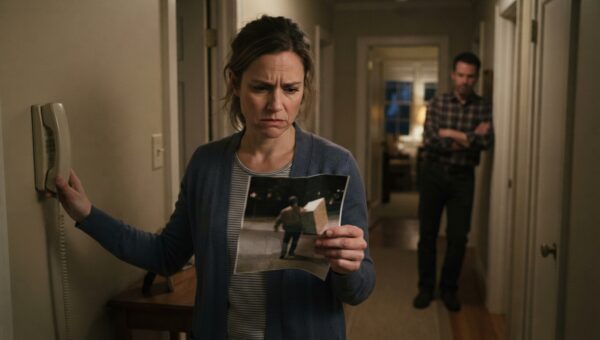
She didn’t mean it, Graham whispered as I lay curled up in pain on the laminate floor of our front hallway. Please… let’s keep this inside the family.
My ribs felt like someone had taken a sledgehammer to my chest. Every time I tried to draw breath, a sharp, white-hot knife twisted beneath my sternum. I couldn’t even yell at him.
I just lay there on the cold floor with my forehead pressed against the baseboard, watching dust motes dance in the late afternoon sun coming through the living room window.
Graham was kneeling beside me, smelling faintly of stale coffee and the pine air freshener from his truck. His hands hovered over my shoulders, hesitant, more worried about what the neighbors might hear through the open window than the fact that I was turning gray.
“Just tell them you missed the last step on the basement stairs,” he kept saying, his voice rising in that tight, panicky register he always got when things spun out of his control. “We’ll say you tripped carrying the laundry down. They won’t ask questions if we keep it simple.”
I didn’t trip. Meredith had shoved me hard enough to send me crashing into the corner of the oak dining table before I hit the floor.
My sister-in-law had stood right over me while I gasped for air, her face twisted in that familiar, ugly sneer that somehow always vanished the second Graham walked into the room. She had grabbed her oversized leather handbag, spat out something about me ruining everything, and walked out the front door without looking back.
Graham had come around the corner three minutes later, sliding right into his role as chief damage control officer for his sister. He didn’t ask what happened. He didn’t check my pulse. He just started rehearsing the lie.
“We have to go to the hospital, Graham,” I managed to rasp out, the words scraping my throat like gravel. “I can’t breathe.”
He finally gave up on the hallway floor routine when he saw my lips turning blue. He hauled me up by my good arm, ignoring the way I cried out, and shoved me into the passenger seat of his sedan.
The drive to the county medical center took twelve minutes, and every bump in the road felt like a physical blow.
By the time we reached the emergency room doors, I could barely stay upright in the borrowed wheelchair. An intake nurse named Brenda took one look at my shallow, rattling breaths and wheeled me straight back to Trauma Bay Three without even asking for our insurance card.
Graham hovered right behind my chair, his hand planted firmly on the push handle like he was steering a piece of luggage he didn’t want anyone else to inspect.
“She took a bad fall down the wooden basement steps about an hour ago,” Graham told the triage nurse, leaning in close with that earnest, church-deacon smile he used when he wanted people to trust him. “Hit her side right on the corner of a storage bin. She’s just clumsy when she rushes.”
The nurse, an older woman with sharp gray eyes and a silver nametag that read Gloria, didn’t nod. She just jotted something down on her clipboard, looked straight at me, and asked, “Is that how it happened, honey?”
I opened my mouth to say yes. I had spent eight years saying yes to whatever kept the peace in Graham’s family. I had lied about Meredith missing family dinners because of fake migraines. I had lied about why Graham’s mother stopped speaking to us for six months. I was tired.
“No,” I whispered.
Graham’s hand tightened on the back of my wheelchair until his knuckles went white. “She’s disoriented from the pain,” he cut in too quickly, his voice pitching up an octave. “The concussion angle, you know. She hits her head pretty hard on the way down.”
Gloria didn’t argue with him. She just clipped a pulse oximeter onto my finger and pressed the call button on the wall. Within two minutes, Dr. Ellis walked in.
Dr. Ellis was a tall, no-nonsense man with tired eyes and a stethoscope draped around his neck like a permanent scarf. He reviewed my vitals, checked my oxygen levels, and immediately ordered a complete portable chest X-ray and a contrast CT scan of my torso.
“We need baseline imaging right away,” Dr. Ellis said, his pen tapping softly against his chart. “Let’s get her prepped.”
Graham tried to follow us down to the radiology suite, but hospital policy drew a hard line at the double doors. He stood in the hallway outside, pacing back and forth, shooting me desperate, warning looks through the small glass window.
The technicians were gentle, but getting onto the flat imaging table felt like being pulled apart by wild horses. When the cold plastic plate pressed against my back, I bit down on my lower lip so hard I tasted iron.
Twenty minutes later, I was back in Trauma Bay Three, wrapped in a warm blanket that didn’t do a thing to stop the shivering.
Dr. Ellis didn’t waste time. He walked back into the cubicle holding a sleek tablet loaded with my digital scans. He tapped the screen twice, bringing up bright, glowing cross-sections of my rib cage.
“Well,” Dr. Ellis said, his voice dropping into that flat, professional register that doctors use when they are delivering news you can’t talk your way around. “You have three acute spiral fractures on your right seventh, eighth, and ninth ribs. There’s also significant internal bruising along the chest wall.”
Graham, who had managed to slip back into the room behind a transport worker, immediately leaned over the foot of the bed. “See? That’s what I said. She fell hard against the wooden storage bin. It’s right where the corner, “
“Mr. Vance,” Dr. Ellis interrupted, not even looking up from his tablet. “Look at the scans.”
Graham blinked. “I’m not a radiologist.”
“You don’t need to be,” Dr. Ellis said. He zoomed in on a dense white line on the screen. “A fall against a flat wooden box creates a broad, compressive impact. These fractures are clean, diagonal spiral breaks caused by direct, localized rotational force. Someone kicked her or drove a heavy blunt object directly into her side.”
The room went dead silent. You could hear the faint hum of the overhead monitor and the squeak of rubber-soled shoes out in the corridor.
Graham’s face drained of color. He looked like he had swallowed a handful of sand. “That’s… that’s impossible. She fell.”
Dr. Ellis scrolled down, bringing up a secondary scan of my right wrist. “And while we were running the thoracic series, we caught some incidental imaging of your wrist and forearm, Mrs. Vance.” He turned the screen toward me. “Looks like you have an older, healed micro-fracture on your distal radius. Happened about six months ago, judging by the bone remodeling.”
I stared at the glowing white lines on the screen. Six months ago. That was the afternoon Meredith had shoved me against the kitchen pantry during an argument over family finances, when I caught her skimming money from the business account Graham and I ran out of our spare room. Back then, Graham had bought me an ice pack, told me I was too sensitive, and convinced me I just needed to be more careful around the kitchen island.
“That was an accident too,” Graham blurted out, his voice cracking slightly. He reached out and grabbed my hand, squeezing it with a desperate, crushing force that sent a fresh wave of agony shooting up my arm. “Brenda, tell him. Tell him we’re a clumsy family. Tell him it was just a bad month.”
I looked down at his hand resting on mine. For eight years, I had let that hand guide me into every trap his family set. Every holiday dinner where Meredith insulted my cooking, every financial bailout Graham secretly funded behind my back, every lie we told to keep the peace.
Dr. Ellis watched the exchange for three seconds. Then he pressed a small button on the wall console.
“Security,” he said into the intercom. “Please ask Officer Morales to step into Trauma Bay Three. And have the hospital social worker join us.”
Graham let go of my hand as if I had suddenly caught fire. “You’re calling the police? Are you out of your mind? This is a private family matter!”
“Mr. Vance,” Dr. Ellis said, his voice dropping so low it was almost a whisper, “these injuries don’t match an accident. Someone in this room isn’t telling the truth.”
Officer Morales arrived three minutes later, a tall woman with a utility belt and a face carved from granite. She took one look at Dr. Ellis’s tablet, then looked at Graham, who was now sweating through his collar and shifting from one foot to the other like a trapped animal.
“Mr. Vance,” Officer Morales said, resting her hand lightly on her belt. “I need you to step out into the hallway with hospital security while I speak with your wife.”
“I am her husband!” Graham shouted, his voice finally breaking through the thin veneer of polite control. “She doesn’t want to talk to you! She fell down the stairs! Brenda, tell her!”
He looked right at me, his eyes wide and pleading, begging me to pick up the script one last time. *Please… let’s keep this inside the family.*
The silence in the cubicle lasted perhaps five seconds, but it felt like an hour. My ribs burned with every breath, but for the first time in years, my head was completely clear.
I looked past Graham at the monitor showing my own broken bones, then back up at Officer Morales.
“He didn’t push me,” I said, my voice shaking slightly, but clear enough to fill the room. “His sister did. Meredith Vance came to our house this afternoon, demanded I alter the business ledger to hide her theft, and when I refused, she kicked me into the dining room table.”
Graham let out a sound like a kicked dog. “Brenda, you’re lying! Why are you doing this?”
“And he told me to lie about it,” I continued, looking straight at the police officer. “He knew what she did. He’s known about her temper for years.”
Officer Morales stepped forward, taking out her notepad and clicking her pen. “Alright, Mrs. Vance. Let’s start from the beginning. I want every single detail about what happened in that house today.”
Graham started to lunge forward, but a hospital security guard stepped into the doorway, blocking his path with a solid, immovable forearm.
“Sir, you need to step outside right now,” the guard said.
Graham backed up half a step, his face dark with fury and panic. He pointed a shaking finger at me. “You are destroying everything we built. You think anyone is ever going to look at you the same way again after this?”
“Nobody has looked at me in years, Graham,” I said quietly.
Officer Morales gently guided Graham out into the corridor, pulling the privacy curtain shut behind them. Dr. Ellis stayed for a moment, checking my IV line before stepping back to give us room.
The social worker, a kind-looking woman named Sarah, pulled up a rolling stool and sat down beside my bed. She opened a fresh folder and handed me a tissue.
“You did the right thing,” Sarah said softly. “It’s going to be hard, but you’re safe here.”
I nodded, leaning back against the uncomfortable hospital pillows. For the first time in eight years, the air in the room felt clean.
Two hours later, the paperwork was complete. Officer Morales informed me that a patrol car had already been dispatched to Meredith’s apartment, and Graham was currently being questioned down at the precinct regarding obstruction and failure to report an assault.
They wheeled me down the long, linoleum-floored corridor toward the discharge doors. The evening sun was dipping below the horizon, casting a long, golden light across the parking lot.
My friend Clara was waiting by the sliding glass doors with my winter coat and a pair of soft walking shoes. When she saw me, her eyes filled with tears, and she hurried forward to help me into the car.
Before I stood up from the wheelchair, I reached into the pocket of my cardigan. My fingers brushed against the smooth, cold metal of my wedding band.
I slipped the ring off my finger. It slid away easier than I ever would have imagined.
I dropped the gold band into the small plastic personal effects envelope the nurse had given me, zipped the top shut, and slid it across the stainless steel intake counter without looking back.