The asphalt out on Maple Street has this slightly uneven crown right in front of our driveway where the county patched a water main break back in nineteen-ninety-something, and I was standing right there on that gray hump of road at six-forty-five in the morning, listening to the high-pitched whine of a hydraulic winch dragging my employer’s mobile calibration unit onto a flatbed.
Brenda Vance was standing three feet away on the strip of grass between the curb and the sidewalk, hugging her terrycloth bathrobe tight against the chill with both hands.
She had this wide, tight-lipped grin stretched across her face, the kind of smile people wear when they think they have finally won some petty war they started by themselves.
Our second car, Sarah’s gray sedan, was already winched up behind the van with its front tires chained to the cradle. The tow driver, a guy in a faded blue denim shirt with grease smudged across his knuckles, was latching the safety chains onto the bumper with sharp, metallic clangs that echoed up and down the quiet street.
Brenda rocked back onto her heels and let out a little puff of air. “Looks like I finally solved the parking problem,” she said proudly. Her voice had that carrying, nasal edge to it that used to drift through our open windows every time we left a garden hose out an hour past dusk.
I did not yell. I did not run across the grass or wave my arms.
I just stood there with my hands stuffed into the pockets of my hoodie, looking at the bright orange tag dangling from the driver-side wiper of my van.
“I couldn’t help but laugh,” I said, my voice dropping into that flat, level tone I usually reserve for difficult equipment recalibrations.
Brenda blinked, her grin wobbling just an inch around the edges. “What’s so funny?” she snapped, stepping back half a pace as if my laughing was something contagious she might catch if she got too close.
I reached out, hooked my finger through the plastic sleeve of the hanging placard, and tapped the thick black lettering printed across the top. “Nothing… except the fact that you now owe us about $25,000.”
Her smile disappeared instantly, replaced by a blank, hollow look that made her jaw go slack. “W-What are you talking about?” she stammered, her hands dropping from her chest as she stared at the plastic tag swinging in the morning breeze.
I let go of the placard and took a slow step toward her. “You really should have checked what that tag meant before calling the tow truck.”
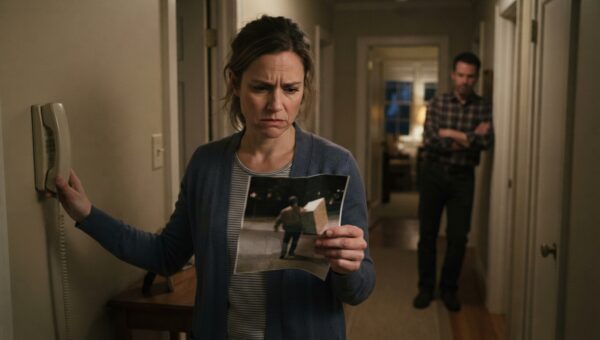
Three days earlier, the note had been stuck to Sarah’s windshield with three strips of yellow masking tape.
It was written in black permanent marker on the back of an old grocery receipt, the handwriting sharp and jagged like someone leaning too hard on a cheap ballpoint pen.
Sarah brought it inside while I was sitting at the kitchen table drinking black coffee out of my favorite chipped mug. She tossed it onto the laminate surface right next to my tablet, her face flushed with that familiar, tired frustration.
“Your friend Brenda strikes again,” Sarah said, leaning against the counter and rubbing her forehead. “She must have waited until we went to bed to stick it on.”
I picked up the scrap of paper. The message was scrawled in capital letters that took up the whole receipt. *One car per house! Move the extra junk off the street or deal with it.*
“We only have two cars,” I muttered, looking out the kitchen window toward the curb where Sarah’s sedan and my work van sat parked thirty feet apart. “And both of them are registered, insured, and legally parked on a public street.
There is no HOA. There are no parking covenants. She just likes having an unobstructed view of the cul-de-sac from her front bay window.”
“Ignore her,” Sarah said, pouring herself a cup of coffee. “If we answer her notes, she thinks she has a job. Just leave it.”
So we left it. We went to work, came home, cooked dinner, and watched the evening news, stepping right over Brenda’s little boundary war as if it were nothing more than a stray leaf blowing across the lawn. I had more important things to worry about anyway. My company, Regional Diagnostic Systems, had assigned me a mobile optical calibration unit for a major hospital hardware swap scheduled for the end of the week. That van was basically a rolling cleanroom packed with twenty-five thousand dollars’ worth of delicate laser-alignment sensors mounted on shock-absorbing brackets inside a custom aluminum housing.
The next morning, I went out to the van at five-thirty to check the environmental logs before heading out on my route. That was when I hung the bright orange municipal transit and utility placard from the rearview mirror. It was an official county-issued logistics permit designating the vehicle as active emergency medical support transport, complete with a bold warning printed in red ink across the bottom: *CRITICAL CALIBRATION CARGO – DO NOT TILT, TOW, OR MECHANICALLY LIFT WITHOUT CERTIFIED TECHNICIAN PRESENT.*
I remember tapping the laminated surface of that tag with my index finger, thinking it would keep the local kids from leaning their bikes against the side panels. I never once imagined Brenda Vance would walk up our driveway in the dark, peer through the windshield with a flashlight, and decide she knew better than the county department of transportation.
Back on the sidewalk, the tension in the morning air was thick enough to choke on. The tow driver paused with his wrench half-turned, looking back and forth between Brenda’s pale face and my expressionless stare.
“Hold on a second,” the driver said, standing up straight and wiping his hands on a greasy rag. He looked at Brenda. “Lady, you told me those vehicles were abandoned on private property without a valid placard. You signed the indemnity form at the end of my driveway twenty minutes ago.”
Brenda turned on him, her voice rising an octave in sudden panic. “They are abandoned! They never move for days! That van is an eyesore and it’s blocking my sightline when I back out of my driveway!”
“It’s a public street, Brenda,” I said quietly. “And that orange tag says municipal utility variance. Which means the city owns the curb, my company owns the van, and you just signed a binding legal document claiming you were the property owner authorizing an impound on a public right-of-way.”
The driver went completely still. He dropped the rag onto the flatbed floor, reached into his back pocket, pulled out a folded pink carbon-copy sheet, and stared at it as if it might bite him. “Wait a minute. You don’t own the street?”
“She lives at number forty-two,” I said, pointing across the lawn toward Brenda’s tan-sided split-level. “She owns about twenty feet of grass and zero inches of asphalt.”
The driver let out a sharp, swearing breath that turned into a cloud of white vapor in the cool air. He grabbed his radio off his belt and thumbed the mic. “Greg, you need to get out to Maple Street right now. Yeah, right now. We got a bad dispatch.”
Within twelve minutes, a white Ford pickup with an amber light bar across the cab pulled up hard against the curb, scattering a couple of stray sparrows from the grass. A heavy-set man in a yellow high-vis vest hopped out before the truck was even fully in park. His name tag read Greg Miller, and he looked like a man who spent his entire life cleaning up messes other people made.
“What’s going on here?” Greg asked, looking at the two cars winched up on the bed, then at Brenda, who was now shivering in her bathrobe while trying to look invisible behind a boxwood shrub.
“This lady here called us,” the driver said, holding out the pink slip like it was contaminated. “She signed the owner-agent impound form. Said these cars were trespassing on her private easement.”
Greg took the form, read the signature at the bottom, and then looked at me. I walked over to the side of the van, popped the rear cargo latch, and pulled open the heavy aluminum side door.
The interior of the van was lined with grey foam-padded transport racks. In the center sat the optical calibration unit, an intricate assembly of glass lenses, digital sensors, and gold-plated circuit boards cradled in a pneumatic suspension frame. But right now, the digital status panel mounted on the front of the rack was flashing a bright, angry red light.
I pointed at the blinking indicator. “You see that red light, Greg?”
Greg walked over, peered into the back of the van, and read the small digital readout next to the flashing diode. *SHOCK-LOG FAULT: MAXIMUM G-FORCE EXCEEDED.*
“That’s a twenty-five thousand dollar laser-alignment sensor,” I said, keeping my voice entirely even. “It’s calibrated to within a micron for hospital diagnostic work. When your driver winched this van up onto the flatbed without engaging the secondary pneumatic locks, the chassis flexed. That sensor assembly just took a severe mechanical shock. It’s out of alignment, the internal prisms are likely fractured, and it has to be completely replaced by factory technicians before it can even be turned on.”
Greg’s face lost whatever color it had left. He looked from the flashing red light back to Brenda, who was now backing away toward her front porch.
“She signed the indemnification clause,” Greg said, his voice dropping low as he pulled a clipboard from under his arm. He flipped to the second page of the dispatch agreement and shoved it under my nose. “Right here. *’The undersigned property owner / authorized agent assumes full civil and financial liability for any towing errors, vehicle damage, or wrongful impound disputes arising from this request.’* She swore she had legal authority over the parking space.”
“She didn’t,” I said. “And she left a signed note on my car three days ago proving premeditated harassment.” I pulled the grocery receipt out of my hoodie pocket and held it out for him to read.
Greg read the black marker scrawl, *One car per house!*, and let out a long, slow whistle through his teeth. “Well,” he muttered. “That’s pretty clear-cut.”
Right about then, a local police cruiser rounded the corner with its headlights on low beam, slowing down as it approached our driveway before pulling up behind Greg’s pickup. Officer Patterson stepped out, adjusting his duty belt with one hand while holding a plastic cup of coffee in the other. He looked at the tow trucks, looked at us standing in our pajamas, and sighed like a man who had already answered four noise complaints before seven in the morning.
“Alright,” Patterson said, walking up the driveway. “Who called this in, and why are two cars on a flatbed in the middle of a public residential street?”
For the next twenty minutes, the morning sun climbed slowly over the roof of Brenda’s house, casting long, sharp shadows across the dew-soaked lawn while Officer Patterson listened to the whole story. I showed him the municipal utility placard hanging from the rearview mirror. I showed him the taped note on the grocery receipt. Greg Miller handed over the signed Apex Towing indemnity contract bearing Brenda Vance’s signature along with her driver’s license number.
Brenda tried to interrupt twice, her voice shaking with a mix of indignation and rising panic. “They park too close to my driveway! Everyone in the neighborhood knows that space is practically mine because of how my garage sits!”
Officer Patterson didn’t even look at her until she finished. Then he turned his head slowly, taking in her terrycloth bathrobe and her bare feet in the wet grass.
“Mrs. Vance,” Patterson said, his voice steady and official. “This is a public municipal right-of-way. You do not own the street, you do not have an HOA charter, and you just signed a legal contract assuming full liability for an unauthorized tow of registered medical utility equipment.” He tapped the corner of his clipboard. “The tow company is dropping these vehicles back onto the asphalt right now at no charge to the homeowners. But you are going to receive a municipal citation for filing a false impound report. And as for the equipment damage inside that van…” He pointed toward the open cargo door. “That’s a civil matter between you, your homeowner’s insurance policy, and Regional Diagnostic Systems.”
Brenda opened her mouth to say something, but no sound came out. Her eyes darted from the police officer to Greg Miller, and finally to me. The bright, smug satisfaction she had worn on her face when we first walked out the front door had completely vanished, leaving behind the small, pinched look of someone who had just realized she played a game she didn’t know the rules to.
Greg didn’t waste any time. He waved his driver over, and within five minutes, both vehicles were carefully unhooked and lowered back onto the flatbed-free asphalt of Maple Street. The driver climbed back into his cab, muttered an apology through the half-rolled-down window, and pulled away from the curb with his amber lights flashing against the quiet suburban houses.
Patterson handed Brenda her copy of the municipal citation, told her to stay off the public right-of-way regarding neighborhood parking enforcement, and drove off down the street.
Greg stayed for another minute, jotting down my company’s insurance information and handing me his direct supervisor card. “We’ll cooperate fully with your subrogation claim,” he said quietly before climbing into his pickup truck. “She signed every line. Our legal department won’t have any trouble going after her policy.”
By eight-thirty, the street was quiet again. Sarah had already gone back inside to finish getting ready for work, her coffee mug sitting cold on the kitchen counter.
I stood by the driver-side door of the calibration van for a long moment, watching the morning sun catch the clean, unblemished windshield where Brenda’s note had been taped just three days before. Across the lawn, the front blinds of number forty-two twitched slightly, then snapped shut with a sharp, definitive click.
They stayed closed the rest of the day, and they haven’t been opened since.