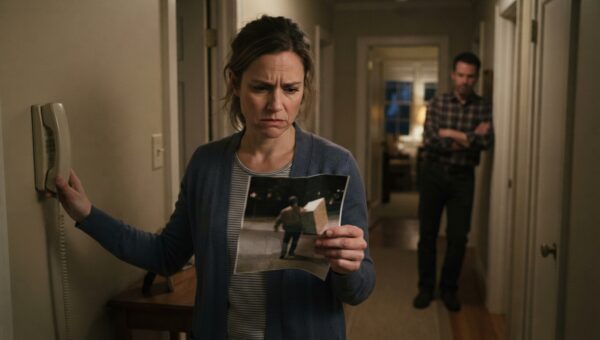
The smell of wet wool and floor wax always stays in the back of my throat whenever I think about the three nights I spent sitting in the green velvet armchair by our front window with my phone resting dead center on my lap. The screen had gone dark hours before, but I could still see Cass’s number glowing against the black glass in my mind, steady and accusing like a small red coal.
Outside, the rain was coming down hard enough to rattle the loose pane in the pantry window, but inside our living room, the house was so quiet I could hear the antique mantel clock ticking off the seconds. Sixty seconds to a minute. Sixty minutes to an hour. Three whole days of holding my breath while my granddaughter Maya lay sixteen miles away in a pediatric ward with a fever that wouldn’t break and blood counts dropping by the dozen.
Cass had called me at 4:14 on a Tuesday afternoon. I remember the exact minute because I had just finished scrubbing the breakfast skillet and was looking out at the yard where the first heavy frost was turning the grass gray. Her voice sounded thin and strained through the receiver, stripped of all that stubborn pride she got honestly from her father. She didn’t waste time with hellos. She just said, Mom, I need to know everything about Dad’s side.
Maya’s doctors are running out of guesses and they say we need a complete medical history from Sheldon’s family tree back to his grandparents to map these autoimmune markers or they can’t start the proper biologic infusions.
Here is what Cass didn’t know, and what had kept me awake for forty years behind closed eyes. The man who raised her, my sweet Sheldon, wasn’t her father by biological right. Back in the winter of 1979, I was twenty-two, terrified, and carrying a child by a man named Arthur Campbell who had smiled at me across a surveyor’s drafting table, taken my trembling hand, and told me he had a bright future ahead that didn’t include diapers or a sudden wedding. Arthur offered me three hundred dollars in crisp twenty-dollar bills folded inside a bank envelope, told me to find a clinic in St. Louis, and walked right out of my life before the ground had even thawed.
I was six months along and showing under my winter coat when Sheldon Vance walked onto my front porch with a sack of groceries and a quiet, steady look in his gray eyes that I didn’t deserve. Sheldon had worked for my uncle’s carpentry shop for three years, and everyone in town knew he kept to himself, building heavy oak cabinets and reading books by the wood stove in his rented room. He didn’t ask who the father was. He didn’t ask me to explain. He just looked down at my swollen middle and said, I’ve got a steady job, Evelyn, and I’ve got enough room in the house on Maple Street for two more plates at the table if you’ll have me.
We were married on a rainy Saturday in March by a justice of the peace who didn’t look up from his paperwork twice. Sheldon kept every single promise he made that afternoon, and he made only one: he would never, as long as he drew breath, let anyone make Cass feel less than whole.
When she was born with that shock of dark hair and my stubborn chin, Sheldon held her against his chest in the drafty delivery room and whispered, That’s my girl. And she was. He taught her how to ride a bicycle behind the VFW hall, patched her scraped knees with pink antiseptic that stung like fire, and sat through every single parent-teacher conference with his calloused hands folded politely in his lap. When Sheldon passed away five years ago after his heart finally gave out, he left the Maple Street house and sixty thousand dollars in his modest savings account directly to Cass, calling her my beloved daughter in the legal papers right down to the final signature.
Now, Maya was sixteen, and Sheldon’s clean, honest family history of steady hearts and strong backs wasn’t going to help her. Sheldon’s people came from Methodist stock out in Ohio who lived to ninety and died in their sleep. They didn’t have the rare, destructive autoimmune vasculitis that ran on Arthur Campbell’s side, a vicious little secret Arthur had never mentioned when he was sketching property lines on parchment paper. If I gave Cass Sheldon’s history, the doctors would stay blind to what was actually tearing Maya’s immune system apart from the inside out. But if I told her the truth, the only father she had ever known, the man who loved her with a devotion so pure it made my chest ache even now, would suddenly be reduced to a legal fiction in her eyes.
I sat there in the dark living room until the grandfather clock struck three in the morning, listening to the rain beat against the siding. I thought about Sheldon’s silver pocket watch sitting in the velvet-lined box on my dresser, the one he wound every Sunday night without fail. I thought about the way he used to look at Cass when she came home from college with her arms full of books, his face softening the way it only did for her. The silence in the house felt heavy, like wet wool draped over my shoulders, but the thought of Maya lying in that white hospital bed with monitors beeping a slow rhythm against her ribs finally broke something stubborn inside me.
I picked up the phone from my lap, my thumb hovering over the green call button before I pressed it down hard. It rang twice before Cass answered, her voice sounding raspy and hollow as if she hadn’t slept since the day she was admitted.
Mom? she whispered, and I could hear the faint, steady beep of a heart monitor clicking in the background through the receiver.
Get dressed, I said, and my voice didn’t shake nearly as much as I expected it to. I’m coming down right now, and I’m bringing everything you need.
The drive down to St. Jude Memorial Hospital took twenty-eight minutes through the gray pre-dawn mist that clung to the state highway. The wipers kept up a dull, rhythmic slap against the windshield while I kept one hand on the steering wheel and the other on the passenger seat where I had placed a faded cedar box wrapped in a linen dish towel. Inside that box lay Sheldon’s original marriage certificate from 1979, his hand-drawn will leaving everything to Cass, and a single manila folder containing the few bitter notes Arthur Campbell had sent me four decades ago along with his family’s known medical history that I had tucked away in the back of my cedar chest and never looked at again.
When I pushed through the heavy glass doors of the pediatric ward, the smell of antiseptic and warmed apple juice hit me all over again. Cass was standing by the nurses’ station with dark circles under her eyes and a paper cup of cold coffee clutched in both hands. She looked so much like me when I was twenty-two, standing there in her wrinkled cardigan, waiting for the floor to drop out from under her.
We didn’t talk in the hallway. I took her by the elbow and led her down toward the small family consultation room at the end of the wing where the chairs were bolted to the floor and a box of cheap paper tissues sat on a gray laminate table.
What’s wrong, Mom? Cass asked, setting her coffee cup down so hard the dark liquid sloshed over the rim. Is it about Dad’s medical records? Can’t the doctor use his old records from the clinic?
I sat down across from her, untied the linen cloth around the cedar box, and slid the manila folder across the table toward her fingers. The fluorescent light overhead flickered once, making a faint buzzing sound that seemed to fill the whole room.
Cass, look at me, I said softly. Your dad loved you more than anything in this world. He chose you before you drew your first breath, and he carried that choice every single day until his heart stopped.
She stared at me, her brow furrowing as she reached out and pulled the folder toward her. She opened the flap, and her eyes scanned the yellowed marriage certificate from March 1979, reading the date over again while her breath caught in her throat. Then she pulled out Arthur Campbell’s handwritten letter from the winter of that same year, the cold, curt words offering money to make a problem disappear, signed with a sharp, slanting signature that didn’t look anything like Sheldon’s neat, patient printing.
Cass didn’t cry right away. She just sat there, her fingers tracing the edge of Arthur’s letter as if it were made of thin ice that might break if she pressed too hard.
Who is this? she whispered, and her voice sounded smaller than it had when she was six years old and scraped her knee on the gravel driveway.
That was the man whose blood runs in your veins, I told her, and the words felt like gravel in my mouth. His name was Arthur Campbell. He was a surveyor from Peoria. When I told him I was carrying you, he gave me three hundred dollars and told me to find a doctor who could fix it.
Cass looked up from the paper, her eyes wide and dark, staring at me with a mix of horror and sudden, heavy comprehension. And Sheldon?
Sheldon walked onto my porch three months later with a bag of groceries and a ring he bought with his own savings, I told her, and my voice finally cracked on the edges. He knew everything, Cass. He knew you weren’t his by blood, but he looked at me and said he wanted to be your father anyway. He never wanted you to know because he was afraid it would make you feel less loved. He loved you more than his own life. That sixty thousand dollars he left you in the will, that house on Maple Street, every single birthday card he ever signed, he meant every word of it. To him, you were his child from the very first second he laid eyes on you in that hospital room.
Cass let out a long, shuddering breath, her shoulders collapsing inward as the tears finally spilled over her lower lashes and ran down her cheeks in thin, hot tracks. She didn’t scream, and she didn’t throw anything. She just pulled Sheldon’s handwritten will out of the folder and ran her thumb over his signature at the bottom, where he had written my beloved daughter Cassandra in that careful, sloping hand he practiced every time he signed a receipt for lumber.
He knew? she asked, her voice barely a whisper against the hum of the wall heater. All those years, he knew?
He knew every single day, and he thanked God for you every night at the kitchen table, I said, reaching across the laminate table to cover her trembling hand with mine. But Arthur’s side of the family carried this rare autoimmune marker, Cass. That’s what Maya’s doctors need to save her life. Here is his family medical tree. Take it to the desk right now.
Cass looked down at the medical notes I had preserved for forty years in the back of the cedar box, her fingers trembling as she clutched the papers to her chest. She stood up so fast her chair scraped against the linoleum floor with a sharp screech, but she didn’t look back at the table. She clutched the folder against her sweater and hurried out the double doors toward the nursing station, her footsteps echoing down the linoleum hallway until the heavy doors swung shut behind her.
I sat there alone in the quiet consultation room for a long time, listening to the hum of the fluorescent light and watching the rain streak the windowpanes outside. About twenty minutes later, Dr. Harrison walked into the room with the manila folder open in his hand, his professional exhaustion replaced by a sharp, focused glint in his eyes.
Mrs. Vance, where did you get these clinical notes on the Campbell family line? he asked, leaning against the edge of the table.
From forty years ago, Doctor, I told him. Does it give you what you need?
It gives us the exact genetic mutation we’ve been hunting for since Thursday, he said, letting out a short breath of relief. It’s an aggressive autoimmune vasculitis linked to a specific chromosomal marker on the paternal side. Because we have the precise lineage now, we can bypass the trial-and-error protocols and start targeted biologic infusions immediately. She’s going to respond to this.
By Sunday morning, the fever that had kept Maya chained to her bed for ten agonizing days finally broke. When I walked into room 412 just after sunrise, the harsh overhead fluorescents were turned off, and the room was bathed in the soft, gray light of a rainy autumn dawn. The steady, frantic beeping of the cardiac monitors had slowed down to a calm, rhythmic pulse that filled the corners of the room with peace.
Cass was sitting in the vinyl armchair right beside Maya’s narrow bed, her head resting against the mattress where she had fallen asleep holding her daughter’s hand. Maya was breathing easily now, her color returning from that frightening, waxy gray to a soft, natural pink, her chest rising and falling in a steady, painless rhythm.
On the small bedside table, right beside a plastic cup of water and a box of tissues, Cass had placed Sheldon’s heavy silver pocket watch. The lid was open, and the brass gears inside were clicking away with a clear, steady sound that seemed to fill the quiet room from floor to ceiling. As I pulled a chair up beside them, Cass opened her eyes, looked over at me with a face worn down by grief but cleared by truth, and reached out to squeeze my hand without saying a single word.