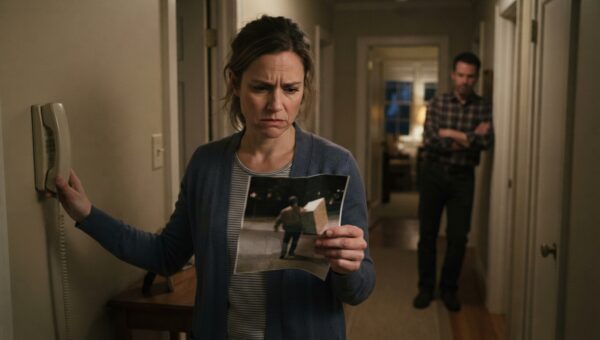
The smell of heavy grease and damp blacktop stayed on my hands for three days after I came back from the impound lot. Dale was fifty-one when his semi-truck drifted across the median on I-84 and hit a bridge pillar. Twenty-three years of marriage, and it ended with a state trooper handing me a clear plastic bag containing a wedding band that was slightly squashed and a silver pocketknife with a broken tip.
I didn’t cry right away. I just sat at my kitchen table with the paperwork from the towing company and tried to figure out how someone who drove those highways twice a week for twenty years could simply vanish in a single morning.
The truck had to be cleared out before the bank could release the lien on the financing, so I drove out to the salvage yard off Route 9 on a Tuesday morning. The gravel in the yard was crushed slate that crunched under my boots. The cab smelled of stale coffee, old diesel exhaust, and peppermint. I worked through the glove compartment with a heavy heart, tossing out wads of toll receipts, empty packs of gum, and grease-stained napkins.
At the very back, wedged behind the owner manual, my fingers caught on something cold and small.
It was a brass key. Not a truck key, and not a house key.
Just a small Yale key with a blue plastic tag looped through the ring with a fine wire. Stamped into the blue plastic in neat white lettering was: Unit 14-C. Coleman Road Self-Storage. Climate-controlled.
I didn’t think much of it at first. Dale had tools, spare parts, and camping gear he swapped out between long hauls. But when I checked the glove box further, I found a laminated receipt from the storage facility dated six months back. The amount was $1,890. And beside it, written in Dale’s familiar block handwriting on a yellow sticky note, were the words: Paid 9 years in advance.
Nine years. That was more than two thousand dollars a year paid out in cash or cashier’s checks I had never seen on our joint statements.
I drove straight to Coleman Road because staying home in that quiet house felt like suffocating. The facility manager was a young man with ink-stained fingers who looked at my marriage certificate and my driver’s license before sliding the heavy metal gate open for me.
Unit 14-C was halfway down the third indoor corridor, tucked under an overhead vent that hummed a low, steady note.
When the padlock clicked open and the heavy roll-up door rattled into the ceiling, the smell hit me first. It wasn’t old cardboard or dust. It smelled like lavender laundry detergent and baby powder, clean and terribly out of place.
I stepped inside and clicked the overhead bulb on.
There was a queen-size mattress standing on its side against the wall, wrapped in plastic sheeting. Next to it sat two matching oak nightstands with brass handles I had never seen before in our twenty-three years together. Further back, near a row of neatly stacked plastic bins, sat a white wooden crib, fully assembled, with a mobile of felt stars hanging motionless from a crooked metal arm. Beside the crib was a pink toddler bedroom set, complete with a small bureau and a dollhouse painted cream and rose.
I walked down the narrow aisle between the furniture and pulled open the top drawer of the bureau.
Inside were folded stacks of women’s clothes. Size six. I’m a twelve, and Dale knew it as well as I knew my own name.
At the very bottom of the drawer lay a brown manila folder stuffed with papers. I pulled it out into the hallway light. Inside were utility bills, electric and water statements, spanning nearly eight years. The service address was printed clearly at the top: 1614 Sycamore. And right below it, in the signature line for the lease agreement, was Dale’s signature alongside a second name I had never laid eyes on in my life.
I sat down right there on the concrete floor of the storage unit with my back against the metal wall. The hum of the ventilation system was the only sound in the building. I held those papers in my hands and felt the floor drop out from under me, not with a bang, but with the slow, sickening realization that my whole life had been built on air.
I didn’t go home until evening. When I walked through my front door, the silence was heavier than it had been when the troopers first knocked. I went straight to the cedar chest in the spare room where I had stored the memorial service items. At the bottom sat the black leather guest book from the chapel, its pages filled with the signatures of neighbors, trucking buddies, and cousins from out of state.
I flipped back through the names until I found the date of the funeral.
Near the bottom of the page, written in a sharp, hurried script that didn’t match anyone I knew, was a name I recognized instantly from the utility bills in the storage unit.
Clara Vance.
I remembered her now. I had seen her from a distance during the service, standing near the back row behind the heavy oak pillars, dressed in a plain black coat that looked too thin for the November wind. She had two children holding onto the hem of her coat, a boy who couldn’t have been more than nine and a little girl peering out from behind her skirt with wide, frightened eyes. Before any of us could turn around after the benediction, she was gone.
I spent the next two days tracking that name the way a person tracks an old debt. Public records, county property rolls, and old utility filings led me to a modest split-level house on the north side of town, just four miles from the interstate interchange where Dale used to park his rig between runs.
On Thursday afternoon, I drove my sedan out to Sycamore Street. The neighborhood was quiet, lined with overgrown maples dropping yellow leaves onto cracked sidewalks. Number 1614 had a faded blue front door and a plastic tricycle lying on the patch of dead grass by the driveway.
I sat in my car for ten minutes with my hands gripping the steering wheel so hard my knuckles went white. I rehearsed a dozen things to say, ranging from cold fury to broken tears. But when the front door actually opened and a woman stepped out carrying a basket of damp laundry, all the rehearsed words simply vanished.
She stopped short when she saw my car idling by the curb. She wasn’t much past thirty-five, with dark hair pulled back in a loose clip and tired circles under her eyes. She looked down at the two children peeking out from behind the screen door, then back at me as I stepped out of the driver’s side.
“Mrs. Miller?” she asked softly. Her voice didn’t shake. It had the flat, worn-down tone of someone who had been expecting the other shoe to drop for a very long time.
“Clara Vance?” I said.
She nodded once, her hand tightening around the edge of the laundry basket. “I figured you’d find the unit eventually. Dale told me once you were thorough about things like that.”
“He kept a whole life here,” I said, my voice barely audible over the hum of a passing delivery truck. “For nine years.”
Clara lowered the basket onto the top step of the porch. She didn’t invite me inside, but she didn’t turn away either. “He told me he was divorced when we met out in Ohio,” she said, looking off toward the street corner where the maple leaves were blowing. “He said his first wife stayed back east and they hadn’t been together in years. By the time I found out the truth, when Leo was starting school, we already had Mia. I told him to pack his things and get out. I wouldn’t live like that.”
“When was that?” I asked.
“Two years ago,” she said, her eyes meeting mine with a painful, steady honesty. “He rented that storage unit the week I threw him out. He couldn’t bear to throw the kids’ things away, but he didn’t have anywhere to put them without you finding out. He paid the whole term upfront so he wouldn’t have to think about it anymore.”
I thought about the brass key in my coat pocket, the crib with the star mobile, and the pink toddler bed sitting in the dark under the vents on Coleman Road. Dale had lived his whole life in transit, dividing his heart between two kitchens, two sets of bills, and two versions of himself until the highway finally stopped him.
“Why did you come to the funeral?” I asked.
“The boy asked where his daddy was going,” she whispered, her voice cracking for the first time. “I couldn’t lie to him anymore than Dale lied to us. We stood in the back so we wouldn’t cause a scene. I just wanted them to have one last look before the ground took him.”
We stood there on the pavement for a long time, neither of us moving, the autumn wind rustling the dry leaves between our feet. There was no screaming, no dramatic confrontation, and no satisfaction in the wreckage. There was only the heavy, shared weight of a man who had tried to build two houses on a foundation of sand and left us both to sweep up the dust.
I reached into my pocket, pulled out the brass Yale key on its blue plastic tag, and walked slowly up the wooden steps.
I laid the key right on top of the laundry basket, beside a folded stack of children’s shirts.
“The lease is paid up for another seven years,” I told her quietly. “It’s all in Unit 14-C. The crib, the beds, the dresser. It belongs to your children.”
Clara looked down at the key, then back up at me with tears standing bright in her eyes. She didn’t say thank you, and I didn’t expect her to. Some debts can’t be settled with politeness.
I turned around, walked back to my car, and drove away from Sycamore Street without looking in the rear-view mirror.
That evening, I took the black leather funeral guest book from the cedar chest and dropped it straight into the donation box by the front door. I opened the tall windows in the living room to let the crisp autumn air blow through every corner of the house, chasing out the smell of stale diesel and old lies. Then I poured myself a clean cup of black coffee and sat down at the kitchen table in a house that was finally, truly, my own.