“He and Anya had dated way longer than anyone realized and that he was cheating on my mom for two years and got…”
My dad didn’t finish that sentence because my stepmom Anya shoved her hand right over his mouth, laughing it off like he was just telling some harmless joke from the old days. But the music in the backyard was still playing, and the rest of the guests were still clinking their plastic cups together near the patio grill, and the sound of my dad’s voice just dropped dead right there in the grass.
I stood there holding a paper plate with half a burger on it, and I didn’t say anything back to either of them. My brain didn’t want to make sense of the math. I just looked at my dad’s red face and the way Anya’s eyes darted around to see if anyone else had heard him over the classic rock station.
Twelve years. My parents split up when I was five years old, back when we lived in that drafty rental house down by the elevator tracks in Waverly. My dad spent every single one of those years making sure I knew exactly whose fault it was. According to him, my mom was a cold, selfish woman who cared more about punching the clock at the county records office than she did about keeping a roof over our heads. He used to sit me down at the kitchen table on my visitation weekends and shake his head like he was mourning a death.
He would talk about how she had the absolute nerve to go back to work six months after I was born instead of staying home like a proper wife. He would complain about how she planned date nights when he was working late at the grain elevator, like wanting to spend an evening with your husband was some kind of unforgivable sin. I grew up listening to that same broken record until I knew every single verse by heart.
Three years after the ink dried on the divorce papers, my dad married Anya. They moved out to the brick house on the edge of town, and pretty soon they had three kids of their own running around the hardwood floors. Anya was always very careful with me, but she had this sharp way of shutting down any time I mentioned my mom. If I said something simple like, “Mom made pancakes like this,” Anya would smile that tight, thin smile of hers and say, “Well, we do things a bit differently here, don’t we.” Whenever my dad started in on his favorite speeches about how hard my mom made his life back then, I learned to just stare at my sneakers and keep my mouth shut.
If I tried to defend her, Anya would step in right away. “Don’t be so quick to defend her, kiddo,” she’d say, her voice dropping into that sweet, poisonous tone that made my teeth itch. “You don’t know half of what your father went through.”
And I believed them. For a long time, I really thought my mom was the bad guy in the story. I thought she broke our family because she wouldn’t stay home and bake bread.
The night of Anya’s thirty-ninth birthday party started out normal enough. Dad had been standing by the keg since four in the afternoon, pouring himself tall plastic cups of bourbon and ginger ale. By eight o’clock, he was loud and loose, slapping the backs of his coworkers and laughing at jokes that weren’t funny. I was sitting on the back porch steps, trying to scroll through my phone and ignore my half-sister crying over a scraped knee, when my dad wandered over.
He dropped down beside me on the wooden step, smelling like cheap liquor and stale cigarette smoke, and threw a heavy arm around my shoulders. He squeezed me a little too hard, the way he always did when he was feeling sentimental and plastered.
“You’re a good kid,” he muttered, leaning in close so the other guests wouldn’t hear him over the music. “Not like your mother. You know, people think I just walked out one day, but they don’t know the half of it. I gave that woman the best years of my twenties. I was working double shifts at the co-op while she was out running around. And Anya, God bless her, Anya was there for me way before the ink was even dry on the old papers. In fact, me and Anya had dated way longer than anyone realized and that he was cheating on my mom for two years and got…”
That was when Anya materialized out of nowhere, her bare hand clamping over his mouth with a force that made his head snap back. Her face wasn’t pale, because people don’t go pale like they do in the movies, but her jaw locked up so tight the skin around her mouth turned white. She dragged him up by his elbow, hissing something in his ear, and hauled him toward the back screen door while apologizing to me over her shoulder about how much the birthday wine had gone to his head.
I didn’t move off that step for twenty minutes. The music kept playing. My little brother ran past me chasing a glowing frisbee. But my hands were shaking so bad I had to set my paper plate down on the floorboards because I couldn’t hold it anymore.
Three days later, the house was quiet. Dad was out at the yard with the loaders, and Anya was at the grocery store with the twins. I was home alone with my thoughts, and the math finally started clicking together in my head like a bad gearbox. I went straight up to my dad’s old cedar storage trunk in the corner of the guest bedroom. It wasn’t locked. He never locked anything because he never thought anyone would dare look. I pulled out the heavy cardboard photograph boxes from the year of my parents’ divorce and the years right before it.
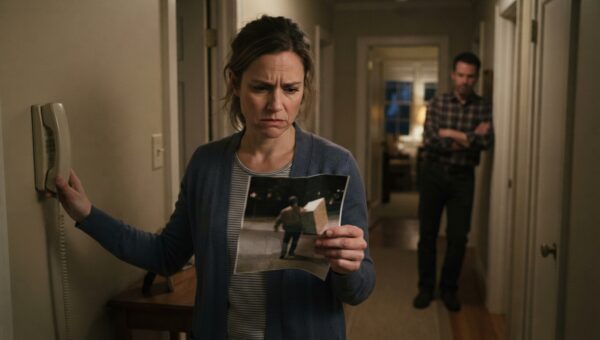
The dates on the back of the prints didn’t lie, even if my dad had spent a decade rewriting them. There were pictures of Anya at our old Fourth of July cookout, smiling right next to my mom while I sat on my dad’s shoulders. The date stamp on the white border said two full years before my parents ever separated. My dad hadn’t been working double shifts at the co-op because he was devoted to the family; he was working those shifts because he was slipping out to an apartment across the county line. All those complaints about my mom going back to work? That was just his way of clearing the house out so he could have his girlfriend over without tripping over laundry. All those bitter speeches about date nights? He was projecting his own guilt onto a woman who was just trying to save a marriage that had already been gutted from the inside out.
Three weeks later, I had the county registry printouts in my backpack, pulled from the courthouse terminal during my lunch break at school.
I cornered him in the gravel driveway on a Tuesday evening right after he climbed out of his Ford pickup. The sun was sitting low over the flat fields, casting long, orange shadows across the hood of the truck. He slammed the driver’s side door shut and reached for his tool belt, acting like he had all the time in the world.
“Hey,” he said, giving me that easy, practiced grin. “You need a ride to track practice tomorrow morning, or are you catching a ride with that buddy of yours?”
“I don’t need a ride,” I said. My voice didn’t even shake, which surprised me. I pulled the folded court papers and the photo prints out of my jacket pocket and held them out toward his chest. “I need you to finish the sentence you started at Anya’s birthday.”
He stopped dead with his hand still on the leather strap of his tool belt. The grin didn’t vanish all at once; it just kind of slid off his face like wet clay. “What are you talking about, kid. I had too much to drink. You shouldn’t be listening to garbage people say when they’re three sheets to the wind.”
“You said you and Anya were together for two years before the divorce,” I said, stepping closer so he couldn’t walk past me. “And then you got cut off because Anya jammed her hand over your mouth. But the registry says Anya’s oldest boy was born six months after my parents’ final separation. Which means you weren’t just cheating, Dad. You had another family waiting in the wings while you were sitting at our kitchen table telling me my mom was a cold bitch for wanting to go back to work.”
“Lower your voice,” he snapped, his face flushing dark red, the veins in his neck bulging out against his collar. “You don’t know how things were. Your mother made it impossible to live in that house. She was cold. She didn’t want a husband, she wanted a machine.”
“Don’t do that,” I said, and my voice cracked just a little bit on the edge, the twelve years of built-up garbage finally burning up in my chest. “Don’t sit there and lie to me again. Not today. You blew up our life because you couldn’t keep your hands to yourself, and then you made me spend my whole childhood hating the only person who actually stuck around.”
Anya must have heard us from the kitchen window because the back screen door banged open and she came marching down the gravel path, her face twisted up in fury. “Don’t you talk to your father that way!” she yelled, pointing a finger right at my face. “We took you in! We raised you when your mother was working sixty hours a week and couldn’t even be bothered to make you supper on time! We gave you a home!”
“You gave me a lie,” I told her, and I looked right into her eyes until she dropped her hand. “Both of you.”
Dad tried to reach out and grab my shoulder, his voice dropping into that wheedling, injured tone he always used when he was cornered. “Now hold on just a minute, son. Family is family. We can talk about this inside over supper. Your mother poisoned your head against us, didn’t she? That’s what this is.”
“My mom never said a single bad word about you in twelve years,” I said, and for the first time, I realized how much strength there was in that simple truth. “Not once. Even when you were coming over here every weekend telling me what a failure she was. She just kept her mouth shut and went to work.”
I turned around and walked back inside the house before either of them could say another word. I didn’t yell, and I didn’t slam any doors, because I didn’t need to make a scene anymore. The anger was gone, replaced by something cold and heavy and completely clear.
I went straight to my bedroom and pulled my old green duffel bag out of the top of the closet. I didn’t pack everything, just my clothes, my track medals, and the framed photograph of my mom and me at the county fair from when I was seven years old, back when I still thought the world made sense.
Thirty minutes later, I walked out the front door with the bag over my shoulder. Dad was standing by the kitchen counter inside, looking out through the screen with a bottle of beer in his hand, his mouth half-open like he was trying to figure out what argument he hadn’t used yet. Anya was sitting at the dining table with her face buried in her hands, crying the kind of bitter, angry tears people shed when they realize the script they wrote has finally burned down to ash. I didn’t look back at them. I just pulled the front door shut until the deadbolt clicked into place with a dry, sharp snap that echoed across the porch.
An hour later, I was sitting in the corner booth of the all-night diner down on Main Street, right across from the grain elevators where my dad used to work.
My mom slid into the vinyl seat across from me without a word. She didn’t ask why I had my duffel bag with me, and she didn’t look panicked. She just reached across the laminate table and set a heavy white ceramic coffee mug down in front of me, the steam curling up into the air between us like a quiet breath. A plate of short-stack pancakes sat right in the middle of the table, dripping with butter and maple syrup.
“You want some coffee?” she asked softly, her eyes calm and steady the way they had always been, even when things were falling apart around us.
“Yeah,” I said, and my chest finally stopped aching. “I think I do.”