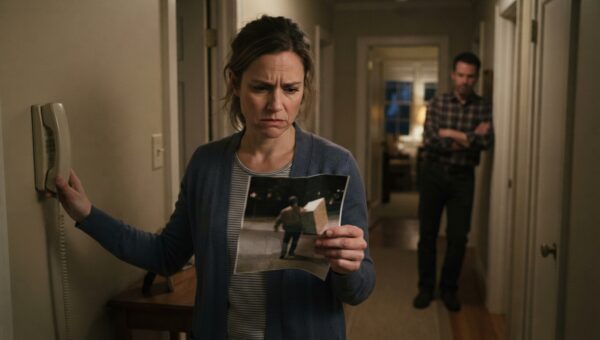
My kids, Sheila and Brian, spent the whole drive to the clinic trading smirks behind my back. I could feel their eyes on the rearview mirror. They were taking me to the OB-GYN, but it wasn’t because they were excited to meet their sibling. They were taking me to prove I was delusional. I was sixty-seven, and I was nine months along.
I knew it in my marrow. I sat in the front seat, clutching a small, soft bag that held a pair of tiny yellow booties, and I honestly felt like a girl again.
“Mom, just let them check you out,” Sheila had said earlier that morning. She sounded like she was talking to a toddler. She didn’t look at my face. She looked at her phone.
“I am perfectly fine,” I told her. I looked out the window at the gray New York sky. I didn’t care what she thought. I had felt the kicks for months. It was a rhythmic, solid thrumming against my ribs that no doctor could talk away. When we got to the waiting room, I sat near the window. Brian leaned over to Sheila and whispered something. They both laughed. It was a short, sharp sound. I held the booties tighter. I just wanted them to see.
I wanted them to realize that their mother wasn’t losing her mind. I wanted them to see that life could still bloom in the quiet, late corners of a person’s years.
Dr. Evans was a man I had known for thirty years. He looked tired when he walked into the exam room. He kept his head down as he adjusted the monitors. He had already been briefed by my children in the hall. I could tell by the way he avoided my eyes.
“Just a quick check, Clara,” he said softly. His voice was too careful. It was the voice you use with a wounded animal or someone who is about to break.
I lay back on the crinkling paper. I pulled up my shirt, baring the large, firm curve of my stomach. Dr. Evans applied the cold gel. He moved the wand in slow, steady circles. I watched his face.
I was waiting for the smile. I was waiting for him to look up, wink at me, and say, “Look at that, Clara, he’s a healthy one.”
But the smile never came. Dr. Evans went silent. The room felt like it had been sucked dry of all the air. He pressed harder. He stared at the monitor, his brows pulling together into a single, jagged line. Then, the color drained out of his face. It didn’t just fade. It vanished, leaving his skin the color of old parchment. He stopped moving the wand. He didn’t say a word. He looked at the screen, then at me, then back at the screen. His eyes were wide and filled with a sudden, terrible recognition.
“Dr. Evans?” I asked. My voice sounded thin in the quiet room.
He didn’t answer. He reached out and slammed the emergency button on the wall. A bell started ringing. It was a harsh, insistent sound.
“Get them out,” he shouted toward the door. He wasn’t talking to me. “Clear an OR. Call oncology. Now!”
The door flew open. Nurse Miller rushed in, her face set in a mask of practiced efficiency that shattered the second she glanced at the screen. She let out a piercing, jagged scream that sounded more like a woman in pain than a medical professional. Outside the door, I heard Sheila. “Mom?”
My daughter pushed past the nurse. She looked at the monitor, then at me. Her bag slipped from her shoulder and hit the tile floor with a heavy thud. The tiny yellow booties tumbled out, rolling across the floor in the chaos like little lost ghosts. I watched them roll. I watched Sheila’s face crumble. The smugness, the impatience, the casual cruelty of the last few months, it all evaporated. She looked at me, and for the first time in my life, I saw her truly afraid.
“It’s not a baby,” the doctor whispered, his voice trembling. He was already peeling back the paper, his hands moving with a frantic, desperate grace. “Clara, you need to listen to me. It’s a mass. It’s a massive, invasive sarcoma. It’s taken everything.”
Everything went into a blur after that. They moved me so fast the hallway walls turned into a smear of beige and light. I felt the sharp sting of an IV in my hand. I heard the frantic rhythm of wheels on the floor. I didn’t feel like a mother anymore. I felt like a patient, a body, a vessel that had been hollowed out from the inside while I was busy dreaming of nurseries.
The surgery lasted seven hours. When I finally woke up, the world was white, sterile, and quiet. The air smelled of alcohol and something metallic. My stomach was flat. The weight was gone. The kicks were gone. I lay there for a long time, staring at the ceiling tiles, trying to remember what it felt like to believe. I had spent so much of the last year living in a dream that the reality of the empty space inside me felt like a physical amputation.
The door creaked open. Sheila and Brian walked in. They looked like they had aged ten years in a single day. They weren’t looking at their phones anymore. They were looking at the floor. Brian’s eyes were rimmed with red. Sheila had been crying, her makeup smeared across her cheeks in dark, frantic streaks. They walked to the bedside and stopped. They didn’t know what to do with their hands.
“Mom,” Brian started, but his voice cracked. He looked at the IV, then at the bandages under the thin hospital gown. “We didn’t know. We thought, “
“I know what you thought,” I said. My voice was raspy, but it was steady. I didn’t want their apologies. Apologies felt like cheap currency in a room that had been stripped of everything but the truth. “You thought I was crazy.”
“We were so wrong,” Sheila whispered. She reached out to touch my hand, but I pulled it back. I wasn’t being mean. I just didn’t have the room for their guilt. My own grief was heavy enough.
“You didn’t see me,” I said. I looked at the window, where the sun was beginning to set over the Hudson. “You saw an old woman who was inconvenient. You saw a nuisance. You didn’t see the person who was actually dying right in front of you.”
They stood there in silence. The guilt was visible on them. It was a heavy, suffocating thing that made them hunch their shoulders. I thought about the yellow booties. I thought about the months I spent sewing, imagining a life, imagining a future that had never been real. I had been hijacked by my own body, tricked by cells that grew with a hunger so profound they mimicked the very shape of love.
“We brought your things,” Brian said after a while. He set a plastic bag on the foot of the bed. It contained my clothes, my phone, and the yellow booties. They were clean, pristine, and entirely useless.
“Thank you,” I said. That was all.
They stayed for an hour, but it was an hour of awkward, hollow talk. They wanted to fix it. They wanted to turn back the clock and take back the smirks, the eye-rolls, and the humiliating trip to the clinic. They wanted to make the past go away so they wouldn’t have to carry the weight of what they’d done. But you can’t fix a broken world just by saying sorry.
When they left, the room returned to that heavy, sterile quiet. I sat up slowly, feeling the ache of the incisions, the soreness of a body that had been forced to fight a war it didn’t even know it was in. I looked at the plastic bag at the end of the bed. I reached over and pulled out one of the yellow booties.
I didn’t cry. I had done all the crying I had left in me on that exam table when the nurse screamed. I held the little shoe in my palm. It was soft, hand-knit, and perfectly shaped for a foot that would never exist. It wasn’t a symbol of a lost child anymore. It was a symbol of my own endurance. It was proof that I had faced the most terrifying truth a person can face, that my own mind and body had betrayed me, and I had survived.
I placed the bootie on the polished bedside table. I left it there, sitting quietly under the hum of the hospital lights. I didn’t want to hide it. I didn’t want to throw it away. I wanted it to be there when I woke up, a monument to the space where I had lived for nine months.
I was not the same woman who had driven to the clinic that morning. The illusion was gone, but so was the need to prove myself to anyone. I had spent my life playing the part of the mother, the grandmother, the sensible woman, the one who kept the peace. I didn’t have to play those parts anymore. I had fought a sarcoma and I had come out the other side.
The nurses came in to check my vitals. They were kind, professional, and entirely unaware of the wreckage I had just left behind. I let them do their work. I looked out at the river. The water was dark and moving, indifferent to the lives of the people on its banks.
My children would come back tomorrow. They would bring flowers and magazines. They would try to be better. They would try to be the people they thought they were, but they would always carry the memory of that waiting room. They would always know that when I needed them to see me, they had chosen to look away.
I closed my eyes. The pain was still there, a sharp reminder of the surgery, but for the first time in a very long time, I felt clear. I was alone, and yet, for the first time in my life, I felt like I was finally my own. I didn’t need to be pregnant to be whole. I didn’t need to be right to be worthy. I just needed to exist in the quiet space of my own truth, no matter how hard that truth had been to uncover.
I reached out and touched the side of the yellow bootie one last time. I left it sitting there, a small, quiet anchor in a room that felt like the start of something else. I wasn’t going to look back. I had spent enough time looking at what wasn’t there. It was time to start living in the reality of what remained.