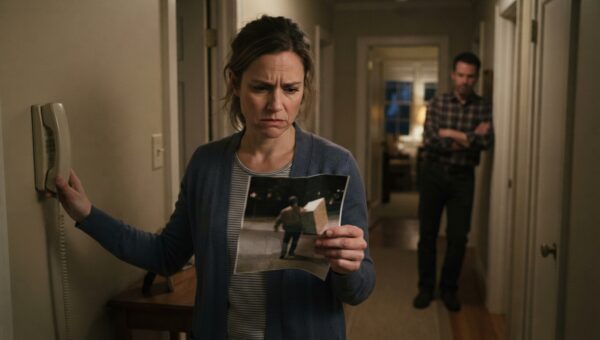
The delivery truck had been gone for maybe ten minutes when my mother walked through the screen door without knocking, her arms crossed tight over her floral cardigan like she was bracing against a winter draft that only she could feel. She didn’t look at me. She walked straight past the kitchen island where the cardboard boxes were still piled up, headed right for the back patio door, and stared out at the yard where my son, Caleb, was wiping down the chrome handlebars of his new bicycle with a yellow shop rag.
“He’s not riding that to his cousin’s,” she said. Her voice had that flat, administrative tone she always used when she was delivering a verdict rather than starting a conversation. “Leo wants to take it for a spin this afternoon. You tell Caleb to leave it unlocked by the side gate.”
I was standing by the sink rinsing a coffee mug, and I just kept the water running for a few seconds longer than necessary to watch the foam spiral down the drain. I didn’t turn around right away. I had spent seventeen years watching my mother treat Caleb like an adjustable shelf in her own house, something to be shifted around whenever Leo needed more room or a better view. Leo was my brother Thomas’s boy, three months younger than Caleb, and according to my mother, the sun didn’t just rise and set on Leo; it practically paid him rent.
“Caleb worked six days a week all last summer at the marina to pay the difference on that frame,” I finally said, turning the tap off with a sharp click. “It’s not for Leo.”
My mother turned her head then, her chin lifting with that familiar look of offended dignity she kept polished for family gatherings. “They’re cousins, Charlene. Family shares. You’ve always taught that boy to be selfish, and now look at him. He won’t even lend his things to family.”
She said it with such absolute certainty, as if she were reading from a ledger she had audited herself. I looked out the glass at Caleb. He was eighteen now, broad-shouldered and quiet, with grease under his fingernails from the hours he spent down in the garage trying to get the gear ratios right on a frame he bought off an old mechanic down on River Road. He hadn’t asked his uncle for a dime.
He hadn’t asked my mother for a card. He had just kept his head down, worked the dock shift at five in the morning, and built something with his own two hands.
“He’s not lending it,” I said quietly.
“We’ll see about that,” she muttered, letting the screen door slap shut behind her on her way out.
The next few hours were quiet, the kind of heavy, pressurized quiet that usually meant Thomas was dialing my phone. Thomas was four years younger than me, but he had inherited my father’s knack for treating other people’s money like a municipal bond that matured whenever he needed a new truck or a kitchen remodel. When Thomas decided Leo needed an outdoor graduation party to rival the ones they threw down at the country club, he didn’t ask if I could help fund the catering. He simply called me up in April and told me I was taking care of the tent rental and the prime rib, as if my checking account was an extension of his own payroll department.
“You’re the one with the steady salary,” Thomas had told me over speakerphone while my mother hummed approval in the background. “And Caleb’s not going to college anyway, so you’ve got the extra cash just sitting there.”
That sentence had stayed in my head like a pebble in my shoe for two months. Caleb wasn’t going to college because he had been accepted into a heavy equipment apprenticeship program three towns over, a trade that started him at twenty-two dollars an hour with benefits while Thomas’s golden boy Leo was sitting in freshman English at the state school complaining that his dad hadn’t bought him the right brand of laptop. But to my mother and Thomas, Caleb’s path was just a hobby, something he did until Leo needed a ride somewhere or a favor on the weekend.
I sat down at the kitchen table and pulled up my banking app on my phone. The balance for the graduation party catering deposit sat at exactly $7,200, waiting for the final vendor sign-off on Thursday. I looked at the confirmation number. Then I looked out the window where Caleb was carefully adjusting the saddle height, his shoulders slightly rounded from fatigue but his face lit with that rare, easy smile I hadn’t seen on him since his dad died five years ago.
I didn’t call Thomas. I didn’t call my mother. I opened the vendor app, tapped the cancellation button, and requested the immediate refund. It took less than two minutes.
Then I walked out to the garage, pulled my laptop from my canvas tote, and transferred those exact funds from the party account straight into the custom parts invoice for Caleb’s build, paying off the remaining balance on the lightweight carbon wheels he had been eyeing for months. While he stood there looking confused, I set my phone on the workbench, hit record, and watched him lift the rear wheel off the concrete to feel how true it spun.
“Take it for a real ride, Cal,” I said, my voice shaking just a little bit. “It’s yours. All of it.”
I uploaded the forty-second clip to my personal Facebook page right there from the driveway, no caption, just the date and a simple checkmark emoji.
Within four minutes, my phone buzzed against the wooden bench. It wasn’t my mother. It was Thomas.
“We need to talk,” the message read.
I stared at the glowing screen for three heartbeats, the afternoon sun warming the back of my neck. I didn’t rush. I tapped out my reply with one thumb, my hands surprisingly steady now that the decision was behind me.
“Is this about the bike,” I wrote back, “or about the party you no longer have?”
The three little typing dots appeared immediately, vanished, appeared again, and then stopped. A minute later, my phone started ringing with Thomas’s caller ID flashing across the display in bright white letters. I let it ring out to voicemail, watching the counter roll over to zero as the screen went dark.
The house stayed quiet for almost an hour before my mother called. I didn’t answer that one either. By six o’clock, the driveway gravel crunched under the tires of Thomas’s silver truck, the engine roaring a little too loud as he threw it into park right behind my car to block me in.
Thomas didn’t bother knocking. He shoved the screen door open so hard it hit the drywall with a hollow thud, his face red and shiny with sweat from the drive over.
“Have you lost your absolute mind?” he shouted from the hallway, not even waiting for me to step out of the kitchen. “Mom’s sitting at home in tears because Leo’s graduation dinner is sitting there with no caterer three days before the guests arrive! What kind of person cancels family over a bicycle?”
I was standing by the stove stirring a pot of pasta, the steam rising up into the quiet kitchen. I didn’t turn around until the wooden spoon hit the bottom of the pot with a soft clatter.
“The kind of person who’s done paying your bills, Thomas,” I said, finally turning to face him.
He stopped two steps inside the kitchen, his mouth opening slightly as if he had rehearsed an entirely different argument and my voice had derailed his notes. He looked around the room like he expected to find some hidden explanation, some joke we were all supposed to be laughing at.
“That money was earmarked for the family,” Thomas said, his voice dropping into that low, dangerous register he used when he wanted people to think he was being reasonable. “Mom told you months ago that the party was our priority this summer. Caleb’s got his little bike; he doesn’t need a golden platter. Leo worked hard for his general studies credits. He deserves a proper send-off with the whole county watching.”
“Then you should have paid for it yourself,” I said.
The words sat in the narrow space between us, small and hard like river stones. Thomas took a step forward, his hands balling up into fists at his sides.
“You funded the deposit,” he said, his voice rising again. “Everyone knew you were handling the catering. It was budgeted into the summer schedule. You can’t just pull the rug out from under your own nephew because your kid threw a temper tantrum over sharing.”
“Caleb didn’t throw a tantrum,” I said, my voice flat and even, the hospital-shift calm taking over that always settled over me when things got broken beyond repair. “He worked forty hours a week at the docks while Leo was sleeping until noon. And that $7,200 wasn’t ‘budgeted’ by anyone except you and Mom treating my salary like an ATM attached to your front porch.”
Thomas stared at me, his face dark with genuine disbelief. He still didn’t get it. To him, the last seventeen years of quietly shifting resources from my roof to his wasn’t favoritism; it was just the natural order of things, the way the water flowed downstream from my side of the family into his.
“Mom is going to call you tonight,” he said, shifting his weight from one foot to the other like a teenager being told he couldn’t take the car out. “And she’s not going to be nice about this. You’re cutting your own blood out over a piece of aluminum.”
“It’s carbon fiber, Thomas,” I said, looking down at my apron. “And she can call all she wants. My phone’s on silent.”
He stood there for another ten seconds, waiting for me to crack, waiting for the old habit of appeasement to kick in where I’d apologize, write a check for the caterer, and pretend everything was fine for the sake of Sunday dinner peace. When I didn’t move, when I just stood by the stove with the wooden spoon in my hand, something in his face finally shifted from anger to a cold, hard realization that the lever he had been pulling for two decades had snapped off in his hand.
“You’re making a huge mistake,” he muttered, turning on his heel and heading back down the hall without another word.
I watched from the kitchen window as he backed his truck out, the tires spinning a little too fast in the gravel before he straightened out and roared down the road toward my mother’s house. The front door drifted open an inch from the draft he left behind, swinging slowly on its hinges.
I walked over, turned the deadbolt with a sharp, heavy click that echoed in the empty hallway, and locked it tight.
Outside in the fading twilight, I heard the faint, clean sound of Caleb shifting gears as he coasted down the long asphalt driveway toward the trees, the new wheel bearings humming softly in the evening air, moving forward into a quiet that belonged entirely to us.