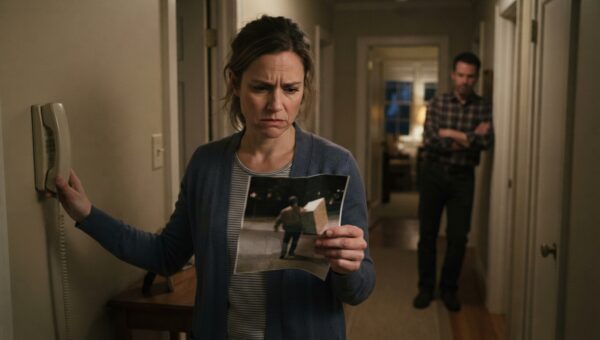
The smell of damp wool and old pine needles always stayed in my coat long after I walked in from the cold. I was seventeen, wearing a green cardigan that belonged to my older sister, and my hands would not stop shaking around the ceramic mug of tea. The kitchen in my parents house was quiet that afternoon except for the hum of the refrigerator.
Leo had stood by the screen door, his jacket unzipped, staring out at the gravel drive as if he were already halfway down the road. He did not look back when he told me what I was worth to him. I can still hear the flat, dead way he said it, like he was reading an item off a grocery list.
“You’re just a mistake I made,” Leo had said, his hand resting on the latch. “If you keep this kid, don’t expect a cent.”
Then he pulled the door shut, and the latch clicked into place with a dry, final sound. He was gone before I even finished my tea. Two months later, after crying into every pillow in that house until my throat burned, I signed the surrender papers at the county courthouse. The ink was wet on the page, and I felt like I was handing away my own pulse.
Years passed the way they always do when you are trying to bury something alive. I worked the register at the hardware store, then picked up evening shifts at the diner down on Main Street, keeping my head down and my breathing shallow. I married Arthur when I was twenty-nine. He was nearly twenty years older, a quiet man who ran the lumber mill with steady hands and never raised his voice.
Arthur did not talk much, but he was always there when the floorboards creaked or the winter wind rattled the windowpanes. When we found out we could not have children of our own, he just reached across the table, covered my hand with his calloused palm, and said we would be enough for each other.
“We are a complete house just as we are,” Arthur told me back then, his thumb rubbing my knuckles. “Don’t you go borrowing trouble from tomorrow.”
I believed him because I wanted to. I let the empty nursery become a spare room for winter coats and old trunks, and I pretended the ache in my chest was just an old injury that acted up when the weather turned damp.
I built a life out of small routines, church suppers on Wednesdays, garden boxes in the spring, and quiet evenings watching Arthur read the paper by the stove.
Yet the ache never quite died. It just went to sleep, waiting for a quiet Tuesday when the house was empty.
It happened on a rainy afternoon in November when the state finally opened up the old registry archives for closed adoptions prior to 1995. My fingers felt clumsy on the plastic mouse as I typed in my maiden name, the date of birth at the county hospital, and the file number I had memorized decades ago. I honestly thought I was just looking for a ghost. I wanted a name, maybe a city name, something to pin against the dark.
The page loaded slowly, the little blue circle spinning on the screen while the rain tapped against the glass. The scanned document popped up in a gray box, grainy and faded around the edges.
I leaned closer, my glasses sliding down the bridge of my nose, squinting at the cursive handwriting of the intake clerk.
At first, the words did not register. I saw the date, October 14, and the weight of the baby, six pounds four ounces. Then my eyes dropped down to the section marked Adoptive Parent / Guardian on record.
The name typed neatly into the box was Arthur Miller.
I sat there for a long time. The clock on the kitchen wall ticked off the seconds, loud and heavy, like a hammer hitting an anvil. My brain felt hollow, as if someone had scooped out the middle and left only the shell behind.
“No,” I whispered to the empty room. “That’s not right.”
I scrolled down to the signature line at the bottom of the second page. There it was, in Arthur’s own distinct, block-letter handwriting, penned three months before we were even married, back when I thought he was just a quiet customer who occasionally stopped by the diner for black coffee and a slice of pie.
The front door clicked open, and the smell of wet earth and pine drifted into the hallway. Heavy boots scraped against the scraper mat by the door.
“The south gate is rusted shut,” Arthur called out, hanging his heavy canvas coat on the peg by the door. “We’re going to need a new hinge before the freeze sets in.”
He walked into the kitchen, wiping his damp hands on his trousers, looking like the man I had shared a pillow with for twenty-four years. He stopped when he saw my face, his eyes dropping to the open laptop screen resting on the kitchen table. The color drained out of his cheeks, leaving him looking older than his years.
“You found it,” Arthur said. It wasn’t a question. His voice was barely a whisper.
I stood up so fast my chair tipped backward and hit the linoleum with a loud crash. I didn’t even look down at it. My hands were shaking so hard I had to grip the edge of the counter to keep from falling.
“You knew,” I said, my voice shaking with a cold fury I didn’t recognize. “You knew the whole time.”
Arthur didn’t try to run, and he didn’t try to touch me. He just reached out and gripped the back of a wooden chair, his knuckles turning white.
“I didn’t steal him from you,” Arthur said, his voice cracking on the words. “You were seventeen, broken, and terrified. You didn’t have a dime to your name, and that boy was going into a system that chewed kids up. I had the lawyer, I had the means, and I had a clean record.”
“You lied to me,” I shouted, taking a step toward him. “Every single day we sat at this table, you let me mourn him. You let me think some stranger out there had my baby.”
“He wasn’t with a stranger,” Arthur said, and a tear finally slipped down the side of his nose, cutting a clean path through the gray stubble on his cheek. “He was right here. In this town. I made sure he went to a good family first, through the legal channels, but when that fell through a year later, I took him in myself. I raised him as my own blood because he was yours, and I loved you before you even knew my name.”
The room tilted for a second. I grabbed the edge of the upper cabinet as the pieces ground together in my head, terrible and bright. The boy we raised, the one who went off to college in Knoxville and now worked down at the county engineering office, the one I had baked birthday cakes for every July, he wasn’t my stepson.
“He’s mine,” I whispered, the breath rushing out of my lungs all at once. “He was always right here.”
“I was a coward,” Arthur said, looking down at his boots. “Every time I looked at you, I wanted to tell you the truth, but I was scared you’d look at me like I was a monster who tricked you into a life. I kept the secret because I was terrified of losing you.”
I couldn’t look at him anymore. I walked past him, my coat still hanging by the door, and pushed my way out into the cold November drizzle without a word.
The rain felt sharp against my face as I walked down the gravel drive toward the old truck. I drove without thinking, my hands gripping the steering wheel until my knuckles ached, heading straight down the highway toward the brick office building where my son sat behind a desk looking at blueprints.
When I walked through the glass doors of the county office, the receptionist looked up from her desk, frowning at my wet jacket and wild hair.
“Can I help you, ma’am?” she asked.
“I need to see Ethan,” I said, my voice hard and steady for the first time all day. “Tell him his mother is here.”
Ethan came out through the inner door a minute later, holding a roll of blueprints under his arm, a puzzled look on his face. He looked so much like Arthur around the jaw, but when he blinked, I saw my own mother’s eyes looking back at me from thirty years in the past.
“Mom?” Ethan asked, taking a step forward. “What’s wrong? Did something happen to Arthur?”
I stood there in the middle of the linoleum floor, the cold water dripping from the hem of my coat onto the tiles, staring at my boy.
“Everything is wrong,” I said, reaching out to touch his sleeve. “And everything is about to change. Come outside with me, Ethan. We have a lot of talking to do.”
We sat together on the wooden bench outside the office building while the rain slowed to a fine mist over the foothills. Ethan listened as the words spilled out of me, the story of a seventeen-year-old girl in a green cardigan, the cold kitchen, the adoption papers, and the man who had kept us both under the same roof for thirty years.
He didn’t yell, and he didn’t pull away. He just stared out at the wet asphalt for a long time, processing a life he thought he knew.
“He raised me,” Ethan finally said, his voice thick. “Arthur was always just… my dad.”
“He was my husband,” I said, looking down at my hands. “And he lied to us both.”
Later that evening, the sun went down behind the ridge, leaving a cold, violet light over the valley. I walked back up the gravel drive to the house where the kitchen light was still burning in the window.
Arthur was sitting at the wooden table, his head in his hands, looking smaller than I had ever seen him. The laptop was closed, shoved off to the side next to the cold coffee pot.
I didn’t say anything. I hung my coat on the peg by the door, walked over to the stove, and poured two cups of coffee without looking at him. I set his mug down on the wood grain across from where he sat, the ceramic clinking softly against the table.
We sat there in the quiet kitchen as the floorboards settled around us, waiting for the front door to open again.