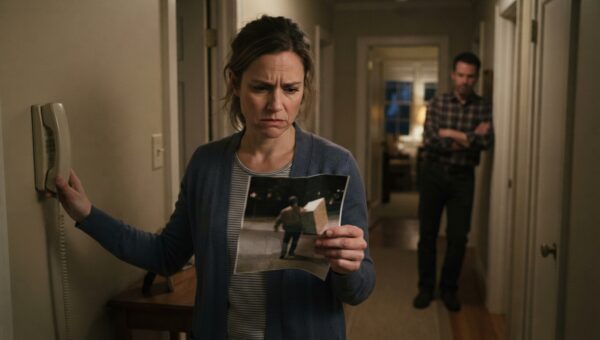
The tape dispenser made that sharp plastic rattle every time I pulled another length across the flap of a brown box. Our living room in Kettering smelled entirely of packing tape and old dust that had lived under the sofa since we bought the place back in nineteen ninety-eight. Alan had been downstairs in the garage for an hour sorting through his old golf clubs, moving slow, his shoulders curved under the weight of a failure we had spent six months pretending to accept.
We were three days away from the closing agent taking the final signatures on a forced short sale that was supposed to clear our ledger. The bankruptcy lawyer in downtown Dayton had looked us both in the eye over a stack of yellow legal pads and told us the house was the only casualty. I believed him because I loved Alan and because the numbers on the statements were so large they stopped looking like real money and started looking like weather. A storm we just had to weather.
Then my phone buzzed against the hardwood floor right beside my knee.
The caller ID showed a local real estate office downtown, a number I did not recognize. I wiped my palms on my jeans and picked it up, expecting some routine question about the utilities transfer or the gas meter reading before tomorrow morning.
“Is this Arlene?” the woman on the other end asked, her voice tight and hurried. “I’m Brenda with the title company.
We are running through the final encumbrance checks for the morning wire, and there is a secondary lien on the property we need your husband to clear right now.”
I stood up so fast my left knee popped, a dull ache shooting down my shin. “What lien?” I said.
Brenda paused, the sound of keyboard clicking stopping dead in her ear. “The twelve-thousand-dollar private mortgage lien from two years ago. It has both your signatures on the satisfaction of debt rider, but the buyer’s lender needs the original release notarized before they will clear the escrow.”
The room tilted just a fraction of an inch, the way it does when you step off a moving walkway at the airport. We had no private loans. We had the mortgage with Fifth Third and two small car notes we had already settled. I told her there was some mistake, that she must be looking at the wrong parcel number, but she interrupted me before I could finish the sentence.
“I am looking right at the scanned PDF from the county recorder’s office,” she said. “I can email it to your phone right now.”
Ten seconds later the notification chime pinged. I opened the attachment with a thumb that suddenly felt clumsy and thick. The document was a standard security agreement on cream-colored paper, dated March fourteenth of two years ago, right when Alan claimed his concrete supply business had hit that terrible winter slump. At the bottom where our names were printed, my signature looked clumsy, the letters cramped and leaning the wrong way.
Above it was Alan’s signature, clean and looping. Except for the capital M on the lender line. He always looped the middle leg down below the baseline when he signed his old middle name on Christmas cards, a little habit his grandfather had taught him. The lender was listed as Meridian Holdings LLC.
I stared at the glowing screen until the auto-lock darkened it to black.
“Arlene?” Brenda’s voice crackled from the speaker. “Are you still there?”
“Yeah,” I whispered. “I’m here. I’ll call you back.”
I walked down the hallway toward the basement door, each step feeling heavier than the last, the old pine boards groaning under my sneakers.
The smell of cedar and damp concrete rose up to meet me as I pushed the door open. Alan was standing by the workbench under the fluorescent strip light, holding a seven-iron and wiping the clubface with an old flannel rag.
“Everything okay upstairs?” he asked, not turning around. “We still need to clear out that bottom shelf in the pantry before dark.”
“Who is Meridian Holdings?” I said.
The rag stopped moving on the steel shaft. Alan did not drop it, but his knuckles went white against the grip, the skin pulling tight over his fingers. He stayed bent over the workbench for three long seconds before he straightened up and turned around to face me.
“Where did you hear that name?” he asked, his voice entirely too quiet, the tone he used when he was trying to negotiate a discount on a truck repair.
“The title office called,” I said, holding the phone out like a shield between us. “They say there is a twelve-thousand-dollar lien on our house from two years ago. Right when you said the bank was about to seize our operating accounts. They say we owe it to a private company.”
“It’s just an internal corporate restructuring,” he said, taking a slow step toward the stairs. “A paper entity to protect the equipment from the Chapter Seven filing. My lawyer recommended it so the creditors couldn’t touch the truck loans.”
“You forged my signature on it, Alan.”
He stopped at the bottom of the wooden steps, his jaw working once, twice, chewing on something invisible. “You were stressed about the whole thing,” he said, and the reasonableness in his tone made my stomach turn over. “I didn’t want to bother you with the legal details while you were dealing with your mother’s hip surgery. It was just paperwork to keep the lights on.”
I did not scream. I did not throw the phone at him. I just looked at the man I had made coffee for every morning for twenty-four years, and I realized he looked like someone I used to sit next to on a bus. A stranger wearing a familiar gray sweatshirt with grease on the cuff.
“I’m going out,” I said.
“Arlene, don’t be dramatic,” he called out as I turned my back. “We have the movers coming at seven in the morning. Don’t make this harder than it already is.”
I didn’t answer him. I got into the Buick and drove straight to Bernard’s office behind the hardware store on Main Street. Bernard had done our taxes since the Carter administration, a small, bird-like man with ink-stained fingers and glasses that always slid halfway down his nose. He didn’t even look up from his ledger when the bell above the door jangled.
“If this is about the capital gains exclusion on the sale,” Bernard muttered, “you need to talk to the bankruptcy trustee, not me. I told Alan six months ago that filing was premature.”
I laid the printed PDF flat on his blotter. “Bernard, look at the lender on this line. Meridian Holdings.”
Bernard adjusted his glasses, squinting down through the lower bifocals. He traced the line with the blunt end of a yellow pencil. The room smelled of old paper and peppermint lozenges. After a long minute, he let out a dry, rattling sigh that sounded like dead leaves sliding across a sidewalk.
“Meridian,” Bernard said softly. “That’s an anagram of your middle name combined with his old high school street. He asked me about setting up LLCs in Delaware two springs ago. I told him it was a terrible idea for a sole proprietorship.”
“Who owns it?” I asked.
Bernard looked up at me then, and for the first time, his eyes behind the thick glass looked genuinely sorry. “He listed himself as the sole managing director, Arlene. When the house sells tomorrow, the closing attorney is required by the court order to satisfy all recorded liens before splitting the remainder. Since this one was filed two years ago as a primary encumbrance, the twelve thousand goes straight to the account listed on the routing page.”
“Which is where?”
“A private commercial trust in the Cayman Islands,” Bernard said, closing the folder with a quiet tap. “Registered under his name alone. The bankruptcy trustee doesn’t even know it exists because it’s technically a secured debt against the property prior to the filing date. He engineered the whole default so the house would be forced into sale, and the equity would pay off his private loan before you saw a single dime of your share.”
I sat there in the vinyl chair until the hum of the small oscillating fan on the filing cabinet seemed to fill my entire head. Every small detail from the last two years clicked into place with the cold precision of a deadbolt sliding home. The sudden late nights at the office when the shop was already closed. The way he insisted we couldn’t afford to visit my sister in Toledo for Thanksgiving. The endless talk about how we were sinking and had no other choice.
“Thank you, Bernard,” I said, standing up so fast the chair scraped loudly against the linoleum.
“Arlene, what are you going to do?” he asked, reaching out a ink-stained hand as if to stop me. “You can’t just stop a court-ordered closing by yourself.”
“Watch me,” I said.
I drove to the Fifth Third branch on Monument Avenue fifteen minutes before the lobby doors locked for the afternoon. The teller, a young girl with a silver name tag that read Chloe, looked up from her screen as I slid my driver’s license across the stainless-steel counter.
“I need to withdraw my fifty percent share of the remaining joint savings account balance,” I said, my voice steady in a way that scared me a little. “In cash or a cashier’s check made out directly to my personal name.”
Chloe blinked, tapping her keyboard twice. “Mrs. Miller, with the pending bankruptcy notice on file, large withdrawals from joint accounts usually require the secondary signature of both parties unless, “
“Unless it’s a statutory partition of individual non-exempt assets prior to final decree,” I said, repeating the phrase the legal aid paralegal had whispered to me over the phone five minutes earlier while I sat in my car in the parking lot. “Look at the account origination date, Chloe. That money was deposited from my inheritance account five years ago before we ever merged the operational ledgers. If you don’t release my half right now, I will file a joint liability claim against this branch before five o’clock.”
Chloe swallowed hard, her fingers flying across the keys with a frantic clicking sound. Ten minutes later, I walked out of the bank with a cashier’s check for twenty-eight thousand four hundred and ten dollars tucked securely inside the inner zipper of my purse.
From there I went straight to the Kettering police station on West Dorothy Lane.
The desk sergeant, a large man with graying temples named Miller coincidentally, didn’t look up from his paperwork when I dropped the printed lien document and the bank statements on the high wooden counter.
“We don’t handle civil property disputes, ma’am,” he said, sighing. “You need to talk to your divorce attorney or the bankruptcy court downtown.”
“This isn’t a civil dispute,” I said, leaning my hands flat on the scarred wood until he finally looked up into my eyes. “My husband forged my signature on a fraudulent twelve-thousand-dollar private loan using a shell company he created to steal our home equity before a forced bankruptcy sale tomorrow morning. Here is the notarized document. Here is the accountant’s affidavit confirming the routing number goes to an offshore account. And here is my driver’s license showing I never signed that paper.”
Sergeant Miller stared at the cream-colored sheet for ten seconds. Then he picked up a red pen, pulled the document closer, and reached for his desk phone. “Sit down in chair four,” he said, not unkindly. “Let’s call the title company.”
The morning sun was already hitting the plate-glass windows of the title agency on Courthouse Square when I walked through the double doors at nine o’clock sharp. Alan was already sitting at the long mahogany conference table beside our bankruptcy lawyer, a man named Vance whose suit always looked like it had been slept in. Alan looked up as I came in, wearing his best cooperative, tired-husband expression, the one he had practiced for months.
“Arlene, where have you been?” Alan said, standing up and reaching for my elbow with a solicitous little frown. “The closer is waiting for the final release signatures. We need to get this done so we can clear the escrow before noon.”
I pulled my arm away from his hand, letting my coat fall open. I didn’t sit down in the empty chair beside him. Instead, I walked right around the table, laid a thick manila envelope flat on the polished wood surface in front of the closing officer, and stood there with my hands resting on the back of my chair.
“We aren’t signing anything today, Alan,” I said.
Alan let out a short, forced laugh, looking over at Vance with an amused shake of his head. “She’s just stressed about the move, Doug. You know how hard this has been on her.”
Vance adjusted his wire-rimmed glasses, looking mildly annoyed. “Mrs. Miller, if we don’t execute the release of liens this morning, the buyer’s financing falls through, and the trustee will automatically convert this into a Chapter Seven asset liquidation with zero retention rights for either of you. You’ll lose the truck, the remaining equity, everything.”
“There is no Meridian Holdings,” I said, looking straight at my husband while the room went very still. “There is only Alan’s shell company in the Caymans and a forged signature on a two-year-old document you forgot to have properly witnessed.”
Alan’s face didn’t go white. It went gray, the color of wet concrete when the mix is too heavy on the sand. He dropped back down into his leather chair so hard the springs groaned under his weight.
“What is she talking about?” Vance asked, looking between the two of us with sudden professional wariness.
Before Alan could find his voice, the frosted glass door of the conference room swung open and Sergeant Miller stepped inside, followed by a younger officer in uniform holding a clipboard. Miller didn’t look at the lawyer or the closing agent. He walked straight over to Alan’s side of the table and placed a folded yellow copy of a police report right on top of the closing papers.
“Mr. Alan Miller?” the sergeant asked, his voice flat and heavy in the small room. “I have a warrant for your arrest on charges of wire fraud, identity theft, and filing a fraudulent encumbrance to obstruct bankruptcy proceedings. Stand up and put your hands behind your back, please.”
The room erupted into a flurry of papers and sharp protests from Vance, but I didn’t watch them snap the cuffs onto Alan’s wrists. I didn’t look at his face when he finally raised his eyes to mine, searching for some trace of the woman who had packed his lunch boxes for twenty-four years and found nothing there at all.
I walked out of the title office alone, leaving the keys to the Buick and the house on the receptionist’s desk.
That was six months ago. The bankruptcy case was thrown out once the trustee audited the shell company accounts, and the house was retitled entirely in my name under a court-supervised settlement that left Alan facing federal indictment down in Cincinnati. The forced sale was canceled before the wire could ever clear.
Now, the autumn air has that sharp, clean bite that only comes in late October, smelling of woodsmoke from the neighbor’s chimney across the street. A single cardboard box marked Keep sits right in the middle of my front porch, no longer packed for a forced departure, but waiting to be unpacked as I turn my brass key in the front door lock all by myself, owning every single square inch of the silence inside.