My grandma lived in that small brick house for forty-two years, long enough for the porch steps to remember her weight, long enough for the neighbors to learn her routines down to the exact minute she put the kettle on. I told everyone my moving in after the funeral was just practical. I said the rent was free, the commute to my drafting job manageable, and the house needed someone to air it out.
It was a clean story that kept people from asking too many questions. But it wasn’t the whole truth. It was grief, sure, but it was also something darker that I couldn’t quite put my finger on during the wake.
The air inside that house felt heavy, as if the walls had absorbed every whispered phone call and every nervous glance cast toward the street. The floorboards in the hallway groaned in a specific way right outside the linen closet, a dry, familiar squeak my grandma had lived with for decades. But within twenty-four hours of bringing my boxes over, I realized the house was not just old. It was watched. Curtains twitched across the asphalt whenever I walked the trash to the curb. Smiles from the women tending their hydrangeas felt rehearsed, tight around the edges like cheap store-bought frosting.
I was standing in the small galley kitchen on a Tuesday afternoon, wiping down Formica that still smelled faintly of Grandma’s peppermint tea, when Mrs. Keller crossed the street.
She didn’t use the crosswalk; she just ambled over in her floral house dress and sensible walking shoes, stopping right at the base of those worn red brick steps. I pushed the screen door open two inches, letting the humid September air push past my face.
“Your grandmother had habits,” Mrs. Keller said, and her voice didn’t carry any of the soft sorrow you expect from an eighty-year-old neighbor three weeks after a funeral. It had a sharp, metallic edge to it, testing the waters.
I leaned against the doorframe, trying to keep my voice level. “She had a lot of routines, Mrs. Keller. She liked things orderly.”
“Oh, they were orderly all right,” she replied, and her eyes flicked past my shoulder into the dark hallway before settling back on me with a look that wasn’t quite a smile. “Just hope you don’t go digging around in places that don’t concern you, dear. Some things are better left buried with her.”
She turned around before I could answer, her sensible shoes clicking against the pavement with steady, deliberate rhythm. I stood there for a long time, listening to the cicadas start up in the oak trees, because my brain kind of stopped working for a second. That wasn’t neighborly concern. That was a warning shot fired across my bow.
By Thursday night, the unease had turned into an itch under my skin that I couldn’t scratch by just ignoring it. I started in the master bedroom, pulling out drawers of linen that smelled of cedar and old mothballs, but nothing felt out of place until I dropped a heavy dictionary behind the cedar chest in the back corner of the closet. When I reached down to grab it, my knuckles scraped against a loose section of plywood near the baseboard. It wasn’t nailed down like the rest.
It slid sideways with a dry scrape of old pine against grit.
Inside the cavity beneath the floorboards sat three thick manila envelopes tied together with weathered twine. I pulled them out into the pale light of the bedside lamp and sat right down on the carpet. My hands were shaking just a little bit, not from cold, but from that sudden drop in the stomach when you realize someone has been lying to you for a very long time.
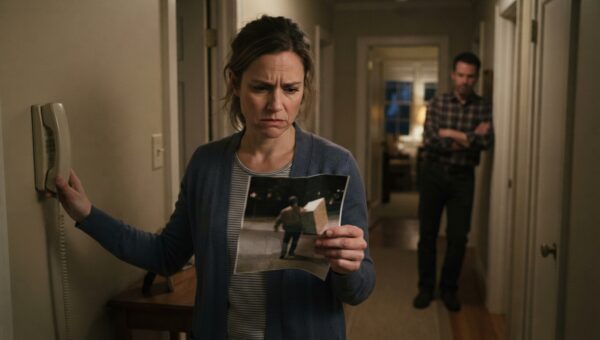
The first envelope contained external photographs of my grandmother coming and going, taken from across the street with a zoom lens. The dates stamped in orange digital ink went back four years, capturing her carrying groceries, checking her mailbox, and standing on these very porch steps talking to a municipal inspector. The second envelope held a meticulous timeline log, handwritten in blue ink, detailing every time a stranger knocked on the door or a strange car idled by the curb.
I untied the third envelope and tipped it over. A small black USB thumb drive rolled out onto the carpet, alongside a folded sheet of heavy cream paper bearing Mrs. Keller’s looping, overly polite handwriting. The note didn’t mince words. It was an inventory of documents missing from the county records office, alongside a chilling tally of properties acquired during the 1974 town expansion.
They weren’t neighbors keeping an eye out for a lonely old widow. They were running a systematic psychological containment strategy, testing her memory gaps with manufactured disruptions and logging her routines to see what she had managed to preserve before she passed. My grandmother wasn’t just a retired seamstress living out her final years. She was the sole remaining witness and custodian of a decades-old neighborhood secret involving a concealed land fraud engineered by original local developers, including the Kellers, who had quietly bought up adjacent deeds under false pretenses.
I spent the rest of the night plugging the flash drive into my old laptop at the kitchen table. The screen flickered to life, revealing a complete digital ledger and timestamped audio files recorded from hidden microphones or directional bugs planted somewhere near the property line. Voices I recognized buzzed through the cheap laptop speakers, discussing how to rattle her nerves, how to make her question her own sanity, how to ensure she never made it down to the county courthouse with the original land-grant deeds she had stashed away.
By 5:45 in the morning, the eastern sky was turning the color of wet slate. I slid the thumb drive and the photographs back into their envelopes, but I kept Mrs. Keller’s handwritten note out. I walked out the front door, letting the screen door slam behind me with a sharp metallic clack that echoed down the quiet street.
I crossed the empty asphalt, walked straight up to Mrs. Keller’s front porch, and wedged her own threatening note firmly between her brass door handle and the wood. Then I took three steps back and waited.
It took less than two minutes for the front door to jerk open. Mrs. Keller stood there in a pale blue bathrobe, her face flushed and her eyes darting from the note in her door to where I stood on her welcome mat.
“What in the world is wrong with you?” she hissed, stepping out onto her porch and trying to snatch the paper down before anyone else on the street could see it.
“You left this in the wrong mailbox,” I said, my voice barely above a whisper, and honestly that felt more dangerous than shouting. “I brought it back.”
“You are trespassing,” she snapped, her hands trembling as she crumpled the note into a tight ball against her chest. “I am calling the police right this second. You’ve been harassing me since the minute you moved onto this street.”
She didn’t wait for me to reply. She spun around, slammed her front door, and within ten minutes, a black-and-white cruiser came rolling down the street with its lights off, pulling right up to the curb with a soft crunch of gravel.
A tall officer with graying temples and a tired expression stepped out, adjusting his belt before walking up the path. That was Detective Rios. He looked at Mrs. Keller, who was standing on her porch now with a tissue pressed to her eye, and then he looked at me standing calmly by my grandmother’s brick wall across the street.
“Ma’am says you’ve been leaving threatening items on her property and harassing her daily,” Detective Rios said, stopping halfway between our yards.
“She dropped that note off at my house three weeks ago, Officer,” I said, holding up the heavy manila envelope I had brought across the street with me. “And if you look inside this, you’ll see why she’s really panicking.”
Mrs. Keller’s voice cut through the morning air, shrill and desperate. “He’s unstable! He’s trespassing on an elderly woman’s property, just like his crazy grandmother used to do before she finally went, “
“Quiet down, Mrs. Keller,” Detective Rios said without raising his voice, but there was an absolute wall of authority in it that shut her up instantly. He walked over to me, took the heavy manila folder from my hands, and flipped back the cardboard flap.
He didn’t rush. He pulled out the timeline log, read through three entries of timestamped harassment, and then his thumb brushed against the black plastic casing of the USB drive. He looked up at me, his eyes narrowing just a fraction as the pieces clicked into place in his head.
“Is this what I think it is?” he asked quietly.
“It’s four years of logs, photos, and digital recordings proving a coordinated harassment campaign,” I said, pointing across the street toward the Kellers’ house. “And if you check the county archives for the 1974 land deeds, you’ll find out why they spent four years trying to break her down before she died.”
Detective Rios didn’t answer right away. He slid the papers back into the folder, buttoned the clasp with a solid click, and turned his head slowly to look at Mrs. Keller, who was now gripping her porch railing so hard her knuckles were bone-white.
“Mrs. Keller,” the detective called out across the dew-soaked grass, his voice steady and cold. “Looks like we need to have a conversation down at the station about property titles and some very specific municipal complaints your old friends filed a long time ago.”
The color drained right out of her face, and she didn’t say another word. She just turned around and vanished behind her front door, the heavy oak swinging shut with a dull, final thud.
The police report was filed by noon, and by mid-afternoon, municipal investigators had arrived with clipboards to pull the historical property files my grandmother had spent her final years protecting. The neighbors stayed inside behind their drawn curtains, and the silence on the street was total, absolute, and heavy.
I walked back across the street, climbed the worn brick steps of the house, and sat down right in the middle of them as the sun began to dip below the tree line. I held the heavy brass key to the front door in my palm, feeling its cold metal warm up against my skin, watching those closed curtains across the asphalt while the brick walls stood firm behind me.