The linoleum floor by the deli counter always had that slight greasy scuff from the floor buffers, right where the linoleum met the tile of aisle four. I remember looking down at my sneakers because the man behind the slicer was taking his sweet time with a half-pound of honey ham, wrapping the white butcher paper with that rhythmic slap of yellow masking tape.
Then she stopped three feet away from my cart. She didn’t just glance over. She locked onto me like she had seen a ghost walking between the rotisserie chickens.
Ten seconds is a long time in a grocery store. People usually shuffle around you or say excuse me when you block the display cases. She just stood there with her wire basket hanging from one red-knuckled hand, her breathing going shallow.
“You look exactly like someone I used to know,” she said. Her voice had that dry, paper-thin rattle that comes from too many decades of black coffee and early mornings.
I gave her a polite half-smile and shifted my weight. “Happens to everybody, I guess.”
She shook her head, not breaking eye contact for a single second. “A girl named Catherine. She died in 1987. Car accident.”
That stopped the noise in my head. The slicer motor hummed in the background, but my own name hit the air like a cold drop of water.
“My name is Catherine,” I told her, my voice dropping an octave without my permission. “I was adopted in 1987.”
She dropped her basket. The wire clattered hard against the composite floor, and a plastic tub of potato salad wobbled out, popping its lid against the baseboard. She didn’t look down at the mess. She crossed the gap between us in two heavy strides and grabbed my right forearm with a grip that bruised.
“What’s your birthday?” she demanded.
“March 14.”
She covered her mouth with both hands, her fingers trembling so hard her wedding band clicked against her front teeth. “That was her birthday.”
My parents always told me the story with the careful, practiced smoothness of people reciting a script they had memorized for a bank loan. They paid a private adoption agency twelve thousand dollars in the spring of 1987, handing over cashier’s checks in a linoleum-floored office in downtown Shreveport while the rain beat against the frosted glass.
They were told the birth mother was a young girl from up-state who had signed away her rights and vanished back into the pine thickets before the ink was dry. By 1991, that agency had locked its doors for good, leaving behind empty filing cabinets and a paper trail that ended in a burned dumpster behind an abandoned strip mall. Whenever I looked at my reflection in the mirror, I saw nobody but myself. No family nose, no familiar arch in the eyebrow, just a blank slate with a faint crescent-shaped birthmark on the inside of my left wrist.
“Who are you?” I whispered, looking down at her hand still clamped to my sleeve.
“Clara,” she said, her voice catching on a dry hitch. “Clara Vance.”
She didn’t let go of my arm. Instead, she reached into the heavy leather tote bag slung over her shoulder with her free hand, rummaging through a tangle of receipts and loose mints until her fingers curled around a worn vinyl wallet.
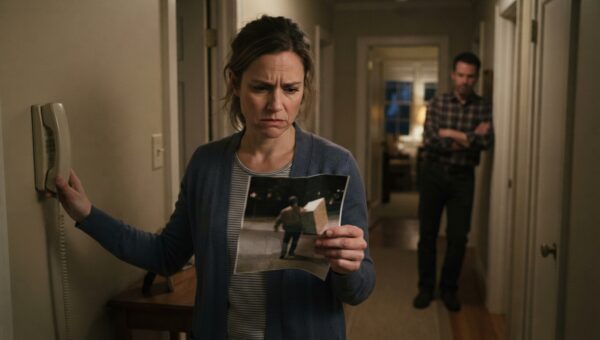
She unsnapped the plastic sleeve with a sharp flick of her thumb and pulled out a photograph so faded the edges had turned the color of weak tea.
It was a Polaroid from the eighties with the glossy finish curling at the corners. A young woman with dark hair falling across her forehead sat on a floral porch swing, holding an infant wrapped in a yellow flannel blanket. The baby’s tiny left wrist was propped up against the blanket’s edge, exposing a distinct, crescent-shaped birthmark.
The exact same mark I had stared at every time I washed my hands since I was five years old.
“The woman in the photo was my…” I couldn’t finish the sentence. My tongue felt too big for my mouth.
“My sister,” Clara said, her eyes boring into mine with a fierce, terrified desperation. “Elena. And she didn’t die in any car accident.”
We abandoned the deli counter right then. The young man behind the glass was staring at us, holding half a pound of honey ham in a square of butcher paper, wondering if we were going to pay for our sliced meat or cause a scene in front of the dairy coolers. Clara left her spilled potato salad right where it landed. She hooked her arm through mine, her fingers still trembling against my coat sleeve, and steered me toward the automatic sliding doors like she was afraid I might dissolve into mist if she let go.
We ended up in her battered station wagon parked out by the cart return, the engine idling with a rhythmic metallic ping under the hood. She didn’t turn the heater on, and the interior smelled faintly of wet dog and spearmint gum. She laid the faded photograph flat on the cracked vinyl console between us.
“The agency told my parents you didn’t make it,” Clara said, staring straight ahead through the frosted windshield at a row of stray shopping carts. “They said Elena crashed the Ford near the county line on a Tuesday night in March. They said the car went into the ditch and the baby was gone. They buried an empty casket because the state police report had too many blanks to argue with.”
“Who told them that?” I asked.
“A man named Henderson,” she spat, her jaw tightening until the skin went white around her mouth. “He ran that private placement outfit out of a second-floor office over the hardware store. He handled everything. The cash, the signatures, the silence. He told us Elena was too out of her head with grief to know what happened to her baby, but the truth is he took you out of that hospital room before she even woke up from the sedation.”
I looked down at my own wrist, turning my hand over under the dim dashboard light. “She thought I was dead for nearly forty years?”
“She still thinks the world is a cold place,” Clara said, turning to look at me, her eyes shining with tears she refused to let fall. “She lives alone now out past the river road in that old brick house our daddy built. She keeps a box of baby clothes in the bottom of her cedar chest like a shrine. Every March 14, she bakes a little yellow cake with white frosting and leaves it on the kitchen table until it goes stale.”
The silence in the car felt heavier than the engine noise. I thought about the twelve thousand dollars my adoptive parents had scraped together from second mortgages and overtime shifts at the mill, believing they were rescuing an orphan when they were actually paying a middleman who traded in stolen heartbreak. They were good people, my folks. They loved me fiercely and raised me right. But every time I looked in the mirror and wondered where I came from, I was looking at a ghost story manufactured by a man who shredded his files the day before the state auditors came knocking in 1991.
“Can you take me to her?” I asked.
Clara didn’t answer with words. She just reached over, put the car into drive with a heavy thud, and pulled out of the Walmart lot without turning on her blinker.
The drive out past the river road took twenty minutes through the flat, gray Louisiana countryside where the pine trees grew too close to the blacktop and choked out the sunlight. The houses got further apart, replaced by rusted farm equipment sitting high in the weeds and sagging porches wrapped in rusted screen wire. Clara’s station wagon rattled over the cattle guard at the end of a long gravel driveway that cut through a grove of pecan trees, stopping right beside a white-painted porch where a rusted metal glider swayed slightly in the damp breeze.
“Wait here a second,” Clara said, killing the engine. The sudden quiet was deafening.
She got out and walked up the wooden steps, her boots crunching on the dry leaves. She didn’t knock; she just pushed open the screen door and stepped inside. Through the front window, I saw her vanish into the dim interior of the house, shadows moving across the yellowing lace curtains.
I sat there with my hands pressed flat against my knees, my heart beating hard against my ribs. For thirty-nine years, my origin story had been a neat little paragraph about a closed agency and a vanished birth mother who didn’t want me. Now, sitting fifty feet from a porch swing I had never seen before, I realized my entire life had been built on a ledger sheet forged by a crook in a cheap suit.
The front door creaked open again.
Clara came back out, but she wasn’t alone.
A woman stood behind her in the doorway, her shoulders slightly stooped, wearing an oversized gray cardigan that looked like it had seen twenty winters. Her hair was silver-gray, pulled back into a loose clip, but as she stepped out onto the porch and squinted against the afternoon glare, her eyes found mine across the roof of the station wagon.
She stopped dead on the top step.
Her right hand reached up slowly, fingers touching the side of her own throat, exactly the way I touched my own neck when I was nervous or trying to remember something.
“Clara said you were in the store,” the woman said. Her voice was lower than Clara’s, trembling with a fragile, hesitant disbelief that cut right through me. “She said you had my wrist.”
I got out of the car, my boots crunching on the gravel just like Clara’s had. I didn’t say anything because my throat had tightened up completely, but I pulled up the sleeve of my jacket, turning my left arm so the crescent birthmark caught the gray afternoon light.
Elena didn’t walk down the steps. She ran.
She crossed the gravel driveway with a stumbling, frantic speed that made me catch my breath, her arms open wide. When she reached me, she didn’t just hug me; she collided against my chest with a force that knocked the wind straight out of my lungs, burying her face in my shoulder. Her hair smelled of old cedar and vanilla, the exact same scent that lingered inside my mother’s cedar chest back home.
“My baby,” she sobbed into my coat, her fingers gripping the wool of my shoulders so tight her knuckles turned white. “They told me you were gone. They told me you didn’t make it out of the wreck.”
“I’m here,” I managed to say, my own tears finally spilling over onto her silver hair. “I’m right here.”
We stood there in the middle of that gravel driveway for a long time, holding onto each other while the afternoon sun dipped low behind the pecan trees, turning the sky the color of bruised plums. The lie that had separated us for nearly four decades didn’t vanish all at once, and the empty years couldn’t be refilled by a single afternoon, but as Elena pulled back just enough to trace the edge of my jawline with her thumb, I knew the ledger had finally been balanced.
Later that evening, inside the warm, wood-paneled kitchen that smelled of coffee and lemon oil, Elena walked over to the mantelpiece above the brick fireplace. Without a word, she picked up an old, silver-framed photograph of the March 14, 1987 nursery tag with its faded blue ink, and set it carefully down right next to a fresh digital print of the three of us standing together on the porch, smiling through our tears.