The smell of antiseptic and floor wax always hangs too thick in the waiting room of St. Jude’s.
My mother passed five years ago, so when the hospital called on a Tuesday morning to say my father had collapsed in his garage, I was the only emergency contact on file.
The drive across town took fourteen minutes.
My knuckles were white against the steering wheel, and my foot kept pressing a brake that was already all the way down.
When I finally got to room 214, the rhythm of the oxygen concentrator sounded like a clock ticking down seconds I didn’t want to lose.
Doctor Vance told me it was a stroke, moderate in size, and that the next forty-eight hours would tell us everything we needed to know about how much of him would come back to us.
Dad lay there with his eyes closed, his breathing heavy and uneven, his right arm resting limp over the white sheet.
By evening, the machines had settled into a steady hum, and the nurses told me I should go home and get some sleep.
My husband, Wyatt, couldn’t come to the hospital right away because of a late meeting at his office downtown, so I drove back to Dad’s house alone to pick up a change of clothes and his mail.
The house on Elm Street still smelled exactly like him.
It smelled of brewed Folgers, old paper, and the peppermint candies he kept in a glass dish by the front door.
I unlocked the front door at 8:52 in the evening, the brass key cold against my palm.
The hallway was quiet, lit only by the amber glow of the porch light spilling through the living room window.
I walked straight back to his bedroom to grab a few shirts and his toiletry bag from the closet.
That was when I noticed the floorboards.
They didn’t creak the way they usually did near the cedar chest.
Dad’s bedroom closet always had a faint smell of cedar and mothballs, but tonight there was something heavier in the air, or maybe it was just the exhaustion talking.
I pushed aside three of his old wool jackets that hadn’t seen daylight since my mother’s funeral.
Behind them, tucked into the dark corner where the baseboard met the drywall, sat a heavy brown cardboard box sealed with wide strips of yellowed packing tape.
It wasn’t labeled.
Dad was a retired accountant who labeled every jar, folder, and utility bill with neat black ink, but this box had nothing on it.
I pulled it out by the edges.
It was heavier than I expected, sliding across the worn floor with a dry scrape.
I sat down right there on the edge of his unmade bed, the floral quilt my mother had sewn still folded at the foot, and used my car keys to slice through the old tape.
The top layer wasn’t hidden.
It was just sitting there under the flaps.
A stack of color photographs, printed on glossy paper that felt thicker than regular printer stock.
I picked up the first one.
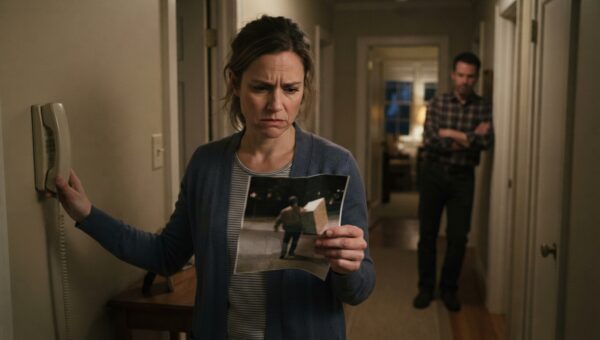
It showed Wyatt standing outside a brick apartment building I had never seen before, talking to a woman whose face was blurred with a black marker.
The date stamp in the corner read October 14, four years into our marriage.
I didn’t even know Wyatt had ever lived in that part of the city.
My heart did a strange, heavy thud against my ribs, but my brain refused to catch up for a second.
I reached deeper into the box.
There were bank statements, folded legal notices, and page after page of handwritten notes in Dad’s precise, cramped accounting hand.
I turned on the bedside lamp, the yellow light casting long shadows across the faded wallpaper.
The notes began seven years ago, right around the time Wyatt and I got engaged.
I remember my wedding day like it was yesterday, mostly because of what happened right before the doors opened.
The organ music was playing softly through the speakers in the back of the chapel, and the smell of white lilies was almost too sweet to breathe.
I was standing in the small antechamber in my heavy lace dress, trying not to wrinkle the tulle, when Dad pulled me aside.
He didn’t look at my dress.
He looked straight into my eyes, his face tight and pale.
“Are you absolutely sure he’s the right one?” he had asked quietly.
I laughed then, squeezing his hand because I thought he was just being an overprotective father who didn’t want to let his only daughter go.
“One day, you’ll see his good side too,” I told him, smoothing his lapel.
Dad had forced a smile and nodded, but the worry never left his eyes, not even when we walked down the aisle together.
Over the years, he stayed polite whenever Wyatt came over for Sunday pot roast.
He kept his mouth shut, passed the potatoes, and asked about Wyatt’s consulting firm, but he never really looked him in the eye.
I always figured it was just old-fashioned stubbornness, because Dad had always been hard to please.
Now, sitting on his bed with the box open between my knees, the pieces started clicking together in a way that made my stomach turn over.
I picked up a stapled packet of bank records from three different local institutions.
They weren’t Dad’s accounts.
They were Wyatt’s.
Except the name on the account headers wasn’t Wyatt’s full legal name, or at least not the one he had given me when we met at the bookstore in 2017.
There was a series of cashier’s checks totaling $42,500, all routed through a PO box in a neighboring county.
Attached to the bank slips was a printed registry from a county courthouse showing a civil judgment against Wyatt under a completely different last name for breach of contract and unpaid business loans dating back to 2014.
Dad had highlighted the court docket number with a yellow marker.
Further down in the box was a folded letter on cream-colored stationery, dated six years ago.
I unfolded it with fingers that felt stiff and cold.
It was signed by a woman named Clara Vance.
“Mr. Miller,” the letter began.
“I received your inquiry regarding my former fiancé, Daniel Wyatt Mercer. I cannot tell you how relieved I am to know someone is looking out for your daughter.
Everything I told you on the phone is true. He left me with $18,000 in credit card debt after draining our joint savings to fund a project that never existed. He uses charm like a shield, and when people start asking questions about where the money goes, he simply moves to another town and changes his middle name. Please keep my name out of this if you can, because I am finally safe, but God bless you for protecting your family.”
The paper shook in my hand.
Daniel Wyatt Mercer.
Wyatt had dropped his first two names the year he moved to our town, claiming he just wanted a fresh start after his parents passed away in a car accident.
I sat there in the quiet bedroom for a long time, listening to the hum of the refrigerator down the hall, until my phone buzzed on the quilt.
It was a text from Wyatt.
“Still at the hospital? I’m heading home now. Do you want me to pick up some takeout?”
I looked at the screen, then down at the box of files, and something inside me just snapped.
It wasn’t a loud break.
It was like a wire pulling taut until it finally gave way with a clean, sharp ping.
“Come home,” I typed back.
“We need to talk.”
The drive back to our house took twenty minutes, but it felt like five.
When I pulled into the driveway, Wyatt’s sedan was parked right behind my SUV, its headlights still glowing against the garage door.
I walked through the front door and found him sitting at the kitchen island, scrolling through his phone with his suit jacket draped over the back of the barstool.
“Hey,” he said, not looking up right away.
“How’s your dad doing? The doctors give any updates?”
I didn’t answer.
I set the heavy cardboard box right in the middle of the kitchen island, right on top of the mail holder and the fruit bowl, with enough force to make the apples rattle.
Wyatt blinked and looked up, his expression shifting from casual concern to something guarded.
“What’s that?” he asked.
“Open it,” I said.
My voice didn’t shake.
I sounded entirely calm, which somehow seemed to rattle him more than screaming would have.
Wyatt didn’t move his hands from the counter.
“Honey, what is this about? I’ve had a really long day at the office, “
“I said open it, Daniel.”
The moment I used that name, the color drained right out of his face.
It wasn’t a slow process; his skin went flat and gray under the pendant lights above the island.
He stared at me for three seconds before he reached out and flipped open the top flap of the box.
His eyes scanned the photographs of the old apartment building, the court documents, and Clara Vance’s letter.
“Where did you get this?” he whispered.
“In Dad’s closet,” I said.
“Behind the old wool coats where he kept everything he couldn’t tell me while I was too busy being in love with you to listen.”
Wyatt stood up so fast his barstool tipped backward and hit the hardwood floor with a loud thud.
“Your father has been meddling in things he doesn’t understand,” he said, his voice rising, the smooth charm completely gone, replaced by a cold, sharp edge I had never heard before.
“People make mistakes when they’re young. That doesn’t mean, “
“It wasn’t a mistake, Wyatt,” I cut in, stepping closer to the counter so he couldn’t back away.
“You didn’t just make a mistake. You built an entire life out of fake names and stolen money, and you were doing it to me too. Look at these bank statements. Look at the transfer dates.”
“You’re overreacting,” he snapped, taking a step toward me with his hands raised in that familiar, placating gesture he always used when he wanted to smooth things over.
“This is ancient history. I changed. I’m not that person anymore.”
“You lied to me on the day we met,” I said, my voice dropping into a register that felt heavier than stone.
“You lied to my father while he shook your hand at the altar. And while I was sitting by his hospital bed tonight, praying he wouldn’t die before I could tell him I was sorry, you were probably checking the balance on the accounts you hid from me.”
Wyatt stared at me for a long beat, his jaw working as he tried to calculate his next angle.
When he saw there wasn’t one left, his shoulders slumped.
The anger vanished, leaving behind only that slick, hollow stranger I had never really known.
“Fine,” he muttered, turning away toward the hallway.
“If that’s how you want to play it, I’ll go stay at a hotel tonight. But you’re making a massive mistake.”
“Get out,” I said.
“And don’t bother coming back for the rest of your things until my lawyer calls you.”
He didn’t argue anymore.
He grabbed his suit jacket from the back of the chair, walked out the front door without looking back, and the gravel in the driveway crunched under his tires as he backed out into the night.
The house was so quiet after he left that I could hear the hum of the refrigerator again.
I stood in the middle of the kitchen for a long time, surrounded by the papers my father had spent years collecting in secret, wishing more than anything that I could pick up the phone and call him.
The next morning, I went straight back to St. Jude’s.
The sun was just starting to clear the rooftops across the street, painting the hospital windows in shades of pale gold.
When I walked into room 214, Dad was awake.
His eyes were open, clearer than they had been the day before, and he turned his head slowly toward the door as I walked in.
I sat down in the plastic chair beside his bed and took his hand.
His fingers were cool and dry, but he squeezed mine back, weak and slow, but enough.
“I found the box,” I whispered, leaning in close so he didn’t have to strain to hear me.
Dad didn’t look surprised.
He just let out a long, shaky breath, and a single tear slipped down the side of his wrinkled cheek into the white pillowcase.
He didn’t say anything, because he didn’t need to.
I stayed there holding his hand for hours, listening to the steady beep of the monitor, knowing at last what it meant to be truly protected.
A week later, after Wyatt had cleared out his remaining clothes and my attorney had frozen the hidden accounts, I went back to Dad’s house to help him settle in after the hospital discharged him.
He was sitting in his old armchair by the front window, wrapped in a plaid blanket, looking out at the maple tree in the front yard.
On the small cherry-wood table beside his lamp, right where it had always sat before the stroke, I placed his heavy silver pocket watch.
The ticking sound filled the quiet room, a steady, unbroken rhythm of truth and time finally reclaimed.