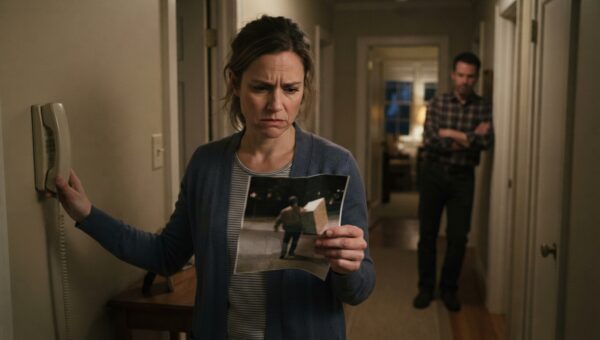
The house had that heavy kind of quiet that usually comes right after the furnace clicks off for the morning. I was looking for a roll of packing tape in David’s desk drawer, down in the bottom left corner where he always kept the spare keys and the old receipts we never threw away. My thumb caught on the corner of a heavy manila envelope instead of the tape dispenser.
I pulled it out because it was sticking slightly on the wood grain.
The birthday card inside said Happy 12th Birthday, Lily. It was sitting right there in the drawer, already stuffed into an envelope with a Forever stamp pressed neatly in the top right corner. A $200 Visa gift card was tucked inside the fold, the plastic edge catching the gray morning light from the window. Our boys are sixteen and thirteen, and I know the name of every kid on this street, every cousin on both sides of our family, and every single person David has ever worked with. We do not have a Lily.
I pulled the card open. The handwriting was David’s. I have looked at his grocery lists and tax forms for nearly twenty years, so I know the way his capital letters lean to the right. Lily, you are twelve today. Your dad would be so proud.
I made him a promise. I am keeping it. Love, Uncle David.
I set the card back down on the dark wood of the desk. The kitchen clock sounded louder than usual, ticking off the seconds while my chest felt tight and hollow. I did not touch anything else in that drawer. I just pushed it shut with my thumb and walked back out to the kitchen, staring out the window at the neighbor’s truck parked by the curb until my pulse stopped hammering in my ears.
David came home at six o’clock. He dropped his briefcase by the back door just like he always did, the leather thumping against the baseboard with a familiar, heavy sound. I was standing by the stove stirring a pot of beans, but I did not look up when he walked into the room.
I said, Who is Lily?
He stopped dead in his tracks. His hand was still on his briefcase strap.
He looked at me, then down at the kitchen island where I had laid the envelope right in the center, square against the grain of the butcher block.
He put his briefcase down. Looked at the card. He said, Marcus’s daughter.
The name hit the kitchen air like a dropped plate. Marcus had been David’s best friend back in college, a loud, restless guy who used to drop by our first apartment with six-packs of cheap beer and wild plans about starting his own contracting business. Marcus died twelve years ago on a construction site over near Amarillo when a scaffolding bracket snapped under his weight. David had been a pallbearer at the funeral, carrying the front right corner of the dark oak casket while crying so hard his shoulders shook under his suit jacket. He had told me back then that Marcus had no family left, no wife, no brothers, no children to leave behind.
I said, You told me Marcus was alone.
David sat down at the kitchen table, pulling out one of the wooden chairs and dropping his hands flat onto the seat of the chair next to it. He did not look at me. Marcus had a daughter, Lily. He found out about her three weeks before the accident. He called me from the hospital after the doctor confirmed it. He said, If something happens to me, promise me you will make sure she is okay.
I stood there by the stove with the wooden spoon in my hand, feeling the heat rise off the burner. Twelve years, I said. You have been sending this girl cards for twelve years.
$200 every birthday, David said quietly. $2,400 total.
I said, Who is her mother?
He closed his eyes. Sarah. Sarah.
The next three days passed in a strange, thick fog where every word in our house felt like it was wrapped in cotton. David slept on the guest room mattress upstairs, and I stayed in our room, staring at the ceiling and doing math in my head. Twelve years of birthdays meant twelve Christmases too, though I did not want to think about whether those envelopes went out in December as well. Every time I looked at our sixteen-year-old son, Noah, sitting at the breakfast table eating toast, my chest tightened because I kept wondering what else was hiding in the corners of our life.
I told David on Thursday morning that I wanted to know where Sarah lived. He tried to argue, saying it would only cause trouble, that Sarah had nothing to do with him anymore and that the whole point was to keep it quiet so nobody got hurt.
I said, You kept a secret for twelve years under my roof, and you think you get to decide when it is over? We are going over there this afternoon.
We drove out to the north side of town in David’s old Ford truck, the tires humming against the asphalt while the dry Texas wind rattled the side mirrors. Sarah lived in a small, neat brick duplex with a porch that had a few pots of dead marigolds sitting by the screen door. The street was quiet, lined with old cottonwood trees dropping brown leaves onto the hoods of parked sedans.
When Sarah opened the door, she looked older than the girl in the faded college photographs David had kept in the bottom of his old trunk, but her eyes had the same sharp, tired look. She was wearing a faded gray sweatshirt and holding a basket of clean laundry against her hip. She did not look surprised to see David, which told me more than a hundred words could have.
David cleared his throat, looking down at the concrete step. Sarah, this is my wife.
Sarah shifted the laundry basket to her other hand and looked at me. Her expression was guarded, the kind of look people get when they expect someone to start shouting on their front porch.
I stepped past David and looked right at her. I need to know what he told you about those cards.
Sarah blinked once, her jaw tightening. She invited us inside, her boots clicking against the linoleum floor of a small, clean kitchen that smelled faintly of cinnamon and bleach. A little girl with dark hair tied back in a messy ponytail was sitting at the laminate table doing homework with a pink plastic eraser. That was Lily. She looked up at us through silver-framed glasses, her eyes wide and curious before going back to her math problems.
Sarah set the laundry basket on the counter and turned to face us. She said, David never came around here once after the funeral. He sent the first card in the mail three months after Marcus died. It had a money order inside for two hundred dollars and a short note saying it was from an old friend of her father’s. Every year since then, like clockwork, the envelope arrives right on her birthday.
I looked at David. You never told her who sent them?
David shook his head, staring down at his boots. No. I wanted her to think it was a community fund or some anonymous donor from the church. If I signed my name, she would have started asking questions about Marcus, and then Sarah would have started asking my wife, and I… I was a coward. I was terrified of losing what we had built.
Sarah crossed her arms over her chest, leaning her hip against the edge of the kitchen sink. She looked tired, but there was no anger in her voice, only a long, heavy exhaustion that had settled in over a decade of raising a kid alone. David, I did not need your money, she said softly. But I was poor, and the rent went up every year, and when you are trying to buy groceries for a growing girl, you do not turn down an envelope that shows up in the mailbox. I always wondered who was on the other end of those stamps.
I stood there in that small kitchen, watching the way Lily bent over her paper, her hand moving across the lines just like Marcus used to do when he was sketching out framing plans on the hood of his car. The anger in my chest did not go away all at once, but it shifted into something different, something colder and clearer. A twelve-year secret does not just vanish because you finally say it out loud in front of a stranger. It leaves marks on the people who kept it and the people who lived around it without knowing.
We stayed for twenty minutes. We did not fix everything, and we did not make any grand promises about becoming one big happy family by the weekend. But when we stood up to leave, Sarah walked us out to the screen door, and David looked at Lily through the wire mesh.
He said, Happy birthday, Lily.
She looked up from her homework, gave him a small, polite smile, and went back to her fractions.
The ride home was mostly silent, except for the hum of the engine and the wind hitting the windshield. When we walked back into our own house, the mail was sitting on the entry table, just a few bills and a grocery flyer. David went straight to his study, but I stayed in the kitchen and pulled out the small wall calendar hanging by the pantry.
I took a red pen from the drawer and drew a small, clean circle around the second Saturday of next month, right beneath the entry for Noah’s track meet. Then I walked down the hall to the guest room, picked up David’s spare pillow, and carried it back to our bed. We still have a long way to go before the house feels right again, but the drawer in the study is finally empty, and the cards are going to stop coming in secret.