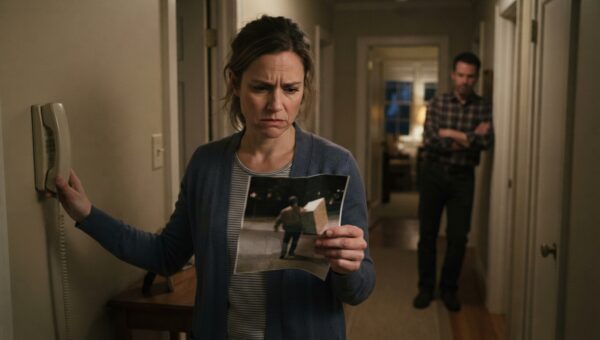
I was lifting our heavy mattress to search for an earring I had dropped behind the bedframe. I expected to find some dust, maybe a rogue sock, but what was carefully taped beneath his side of the mattress made me slowly sit down on the bare floor. It was a manila envelope, the kind that feels like stiff, dry skin against your fingertips.
It was thick, heavy, and held shut by three strips of reinforced brown packing tape that had yellowed with age.
“Clar, are you nearly ready?” Ethan called from downstairs.
“Give me two minutes!” I shouted back. My voice sounded thin, like it belonged to someone else.
He laughed. It was that familiar, warm sound that usually filled the house like sunlight. “You said that ten minutes ago.”
After seven years of marriage, that laugh still made my chest ache with how much I loved him. Ethan was the kind of husband who brought me coffee in bed every Sunday, remembered the exact date we met, and left handwritten notes on the bathroom mirror. He was solid. He was the ground I walked on. But as I sat there on the hardwood with that envelope in my lap, the ground felt like it was tilting.
I didn’t open it right then. I shoved it deep into the back of my closet, beneath a stack of winter sweaters, and went downstairs.
I kissed his cheek, drank the tea he made, and spent the rest of the day acting like a woman whose life wasn’t suddenly split in two. It was a performance. I was good at it.
Seven years ago, when we first met at that little bookstore in downtown, he was a guy who didn’t talk much about his past. He said he moved here to get away from a city that didn’t fit him anymore. I never pushed. I liked that he was a mystery. I thought he was just a man who had been lonely and was finally ready to be found.
That night, after he fell asleep, I didn’t. I waited until his breathing was steady and deep. I crept back into the bedroom, retrieved the envelope, and took it to the kitchen island. The light from the stove was enough. My hands were shaking so hard I could barely pick at the tape.
When I finally pulled it back, the smell of old paper and cedar hit me.
There were photographs. A young woman with tired eyes, a toddler in a striped shirt, and a man who looked exactly like Ethan, but younger, harder. There were legal papers, too. A marriage certificate. A custody agreement signed in a county I didn’t recognize. And then, a letter. It was handwritten, the ink faded, addressed to a name that wasn’t Ethan.
I read until the sun started to bleed into the sky. He hadn’t just moved away. He had erased himself. He had been forced into a corner by a family that saw his young wife and his son as a mistake, a blemish on their name. They had the money and the lawyers to make sure he lost everything. So he did the only thing he thought would save him from the grief, or maybe the shame. He vanished.
The next few days were quiet. Too quiet. I watched him make his coffee. I watched him write his little notes. Every time he smiled at me, I saw the ghost of the boy in the photographs. He wasn’t a stranger, but he was a man living in a house built on sand.
“You’ve been quiet,” he said on Thursday, leaning against the counter while I chopped vegetables.
I put the knife down. “I found the envelope, Ethan.”
The air left the kitchen. I don’t know how else to describe it. He didn’t turn pale, but his entire posture collapsed, like a puppet whose strings had been cut. He looked at the floor, then at me, and his eyes were full of a terror I had never seen before.
“I didn’t want you to know,” he whispered.
“You let me believe you were a man without a history,” I said. My voice was steady, even though my heart was hitting my ribs like a trapped bird. “But you have a son. Somewhere.”
“They took him,” he said, and then the dam broke.
He told me everything. He talked for hours. He spoke about the courtrooms, the threats, the feeling of waking up every morning knowing he had signed away his own blood just to keep the lawyers from ruining the woman he loved. He didn’t keep the secret because he didn’t trust me. He kept it because he was terrified that if I knew what kind of man he used to be, or what he had been forced to become, I would walk out the door. He thought his past was a poison that would infect me.
“I just wanted to be enough for you,” he said. He was sitting on the floor now, his face in his hands. “I thought if I didn’t tell you, it wasn’t real. I thought I could just be the man you deserved.”
I looked at him. Really looked at him. I saw the seven years of kindness. I saw the coffee, the notes, the way he held my hand in the dark. That wasn’t a lie. That was the most real thing in the world. But the silence, that was the lie.
“You were already enough,” I told him. “But this, this silence, it was eating you alive. And it was starting to eat us, too.”
We didn’t sleep that night. We sat on the kitchen floor, the documents spread out between us like a map of a place neither of us wanted to visit. We went through every page. I asked questions, hard ones, and he answered them. No more running. No more hiding. By the time the sky turned gray, we had a pile of things we were going to do. Calls to make. People to find. It wasn’t about erasing what happened. It was about facing the cost of it.
The rebuilding wasn’t easy. It was messy, and it was loud, and there were days when I looked at him and felt a sharp, cold anger that he hadn’t trusted me sooner. But we kept going. We didn’t have the luxury of silence anymore. We had to speak our truth, even when it hurt.
He started reaching out to the lawyers in that distant city. It wasn’t about getting his old life back, because that was gone, burned to ash a decade ago. It was about finding out if his son was okay. It was about closure. It was about making sure that the ghost he had been carrying finally got a chance to rest.
A few months later, I was cleaning the bedroom again. I stripped the bed to change the linens, and I caught sight of the bare mattress. I stood there for a long time, just looking at it. There was no tape. No hidden weight. Just the fabric, plain and honest.
I walked over to the bathroom. There was a fresh note taped to the mirror. It wasn’t poetic. It wasn’t dramatic. It just said: *No secrets left.*
I smiled, and for the first time in a long time, it felt like the floor beneath my feet was solid again. We weren’t a perfect story anymore. We were something harder, something deeper. We were a real life, and for all the wreckage it took to get here, I knew it was finally ours.
I grabbed my bag and headed downstairs. I could hear him in the kitchen, the sound of the coffee grinder humming, the same sound that had started every morning for seven years. Only this time, I wasn’t just walking into a house. I was walking into the truth. And that, I realized, was the only place worth living.