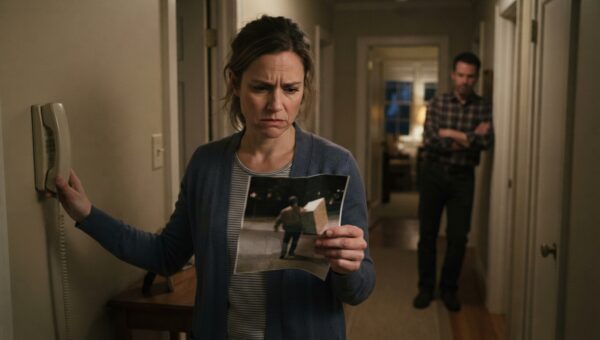
The hanger clicked against the wooden rod in the hall closet, a small, hollow sound that usually signaled the end of another quiet Tuesday. I reached into the deep pocket of David’s gray wool overcoat to shake out any stray lint or receipts before summer storage, and my fingers brushed against a crinkled slip of pink thermal paper. It didn’t belong to our local dry cleaners down by the parish hall.
The address printed at the top was forty miles north, in Lafayette, past the parish line where the swamp gives way to strip malls and housing developments. The total printed at the bottom was $145.20. For six suits. David owned two suits to my absolute certainty, a navy charcoal he wore to funerals and board meetings, and a light gray one he wore to weddings or Easter service.
I stood there in the narrow hallway with the pink paper pinched between two fingers, waiting for some mundane explanation to land in my head. Maybe he had dropped off coats for his brother Marcus, though Marcus lived three hours away and hadn’t visited since Thanksgiving. Maybe the clerk had hit the wrong keys on the register. But the date on the slip was from three days prior, a Saturday afternoon when David told me he was driving down to the bayou to check on our cousin’s old duck lease.
I remember handing him a thermos of black coffee and a sleeve of saltines right before he backed the rusted Buick out of the gravel drive.
The house felt suddenly too large, the ceiling too high, the air too thick with the lemon wax I had spent the morning rubbing into the oak baseboards. I didn’t yell or drop to my knees. I just walked into the kitchen, picked up the landline because my cell phone was sitting dead on the counter, and dialed the number printed beneath the Lafayette address.
A woman answered on the second ring, her voice crisp and practiced, retail-fluent. I didn’t give her my name. I just asked about ticket number 4419 and whether there had been some mistake on the garment count.
“No mistake at all,” the employee replied cheerfully, the sound of steam presses hissing in the background. “There are six suits under that account. They’ve been a monthly customer since 2021.”
“Six,” I said, and my own voice sounded small, like it was coming from inside a tin can.
“That’s right. Three tailored wools, two blends, and the dark tweed. Dropped off like clockwork every four weeks.”
The line hummed for a long second while my pulse beat behind my ears like a trapped bird. Back in 2021, we had been sitting at this very kitchen table during the hottest July on record, rationing our savings because the shrimp boats weren’t bringing in enough to cover the mortgage and my mother’s hip medication at the same time. David had looked across the linoleum with tired, bloodshot eyes and told me every penny counted. He told me we had to cut back on groceries. He told me he was wearing his old suits until the elbows gave out.
“Thank you,” I whispered, and hung the receiver back on its cradle before she could ask another question.
That night, David came home smelling of damp earth and stale gasoline, pulling his boots off by the back door just like he had every night for twelve years.
He kissed the top of my head while I stirred the gumbo, his hand warm and dry against my scalp. “Hot one today,” he murmured, hanging his cap on the peg by the pantry. “Ducks weren’t flying, but it was quiet out on the water.”
I watched the back of his neck in the dim amber light of the stove hood, watching the small freckle just below his hairline that I used to trace with my thumb when we were first married and living in that cramped apartment above the hardware store. He ate two bowls of gumbo, buttered three pieces of cornbread, and talked about a boat motor that had thrown a rod down at the landing. He looked completely normal. He looked like the man who fixed our front steps when they rotted and brought me sweet tea when the humidity made my ankles swell.
“You okay, Clara?” he asked around nine, catching me staring over my glasses while I pretended to mend a dish towel.
“Just tired,” I said, and smiled the way he expected me to smile. “Go on up. I’ll be there in a minute.”
I didn’t go upstairs. I sat at that kitchen table until the refrigerator compressor clicked off at 2:00 AM, letting my mind trace backward through every Tuesday and Saturday over the last three years. The business trips to Baton Rouge that always got extended by a day. The sudden need for David to handle our taxes entirely on his own because my eyes were getting bad. The quiet months when our savings account stayed flat despite extra overtime at the feed store.
By sunrise, the quiet resolve had settled into my bones like cold iron. I didn’t cry. There was no room for tears when your entire life turned out to be built on sand.
I drove north on Highway 90 just as the morning fog was lifting off the marshes, the dashboard clock reading 8:14. The dry-cleaning shop sat in a beige brick strip mall between a check-cashing place and a dental clinic. A bell chimed softly above the glass door when I pushed it open, bringing with it the sharp, chemical smell of perchloroethylene and hot steam.
The woman behind the counter was older than I expected, maybe fifty, with salt-and-pepper hair pulled back into a sensible clip and a silver name tag that read *Sarah*. She looked up from a stack of folded trousers, her eyes dropping automatically to my face, then to my hands.
“Good morning,” she said, though her voice lacked the cheerful ring from the phone the night before.
I walked right up to the counter, laying the pink receipt down on the Formica surface between us. “I’m here about account 4419.”
Sarah looked at the slip, then back up at me. A strange, heavy stillness settled between us, the kind of silence that happens right before a thunderstorm hits the coast. She didn’t reach for the receipt. She just folded her hands over the edge of the counter and let out a long, slow breath.
“He usually comes every Tuesday,” Sarah said quietly, her voice dropping an octave. “With his wife.”
My heart stopped dead in my chest, every drop of blood draining down to my toes. “I am his wife,” I answered, and the words came out harder and sharper than I intended.
The silence that followed told me everything I needed to know, far more than any confession ever could. Sarah’s face didn’t crumple into shock; instead, her eyes filled with a heavy, bitter exhaustion that mirrored my own. She looked at me not with guilt, but with the weary recognition of someone who had also been sold a very careful, very elaborate lie.
“Oh,” Sarah whispered, and the single syllable held the weight of three years of Tuesdays. “He told me… he told me his first wife passed away in New Orleans back during the flood. He said he was a widower.”
I stood there on the worn linoleum floor of that Lafayette strip mall, the fluorescent lights buzzing overhead, and felt every illusion of my marriage dissolve into ash. He hadn’t just cheated. He had built an entire parallel existence forty miles away, complete with another life, another routine, and enough wardrobe changes to keep a Lafayette cleaner in business since 2021. He had used our joint savings, our hard-earned grocery money, to finance a second domestic setup where he played the grieving widower turned doting husband to a woman who probably poured his coffee the exact same way I did every morning.
I didn’t scream at Sarah. I didn’t throw the receipt across the room. I simply reached down, picked up the pink slip, and tucked it back into my leather handbag with trembling fingers.
“Thank you for your time,” I said, my voice remarkably steady.
The drive home took twice as long. By the time I pulled our old Buick back into the gravel drive, the sun was high and hot, beating down on the weathered shingles of our porch. I didn’t go inside right away. I sat in the driver’s seat with the engine off, watching a pair of cardinals dart through the crepe myrtles, letting the anger curdle into something cold and useful.
The next three weeks were the quietest weeks of my life. I became a ghost in my own home. While David went to work and drove off to his mysterious Tuesdays, I systematically dismantled the architecture of our shared existence. I didn’t confront him piece by piece. I gathered the whole picture. I spent hours at the county records office downtown, digging through property filings and digital banking logs that David thought I was too simple-minded to understand. I found the second checking account he had opened under a post office box in Lafayette. I found the ATM withdrawals that matched every single Tuesday he claimed were spent down at the duck lease. I printed out every statement, every transfer, every hidden lie, and laid them side by side on our dining room table until they formed a paper trail six inches thick.
On a Tuesday evening in late June, the front door clicked open at exactly 5:30 PM. David walked in carrying his brown leather briefcase and tossing his keys onto the small ceramic bowl by the door, whistling softly under his breath.
“Clara?” he called out, loosening his tie as he walked down the narrow hall toward the kitchen. “Smells good. Jambalaya again?”
I was sitting at the dining room table. The overhead chandelier was turned off, lit only by the last dying rays of golden sunlight filtering through the lace curtains. In front of me sat the neat stacks of bank statements, the pink dry-cleaning receipt pinned right to the center with a brass paperweight.
David stopped at the entrance to the dining room, his tie half-undone in his hand, his eyes scanning the table. The whistle died in his throat. The easy, comfortable smile he wore like a second skin slipped right off his face, leaving behind a gray, hollow look that made him look ten years older.
“What’s all this?” he asked, his voice dropping down to a nervous rasp.
“Close the front door, David,” I said, and my voice didn’t shake once.
He didn’t move for a long second, his hand still gripping the edge of the doorframe like he was bracing for a squall. Then he slowly pushed it shut, the heavy oak click sounding entirely too loud in the silent house. He walked over to the table, his eyes darting across the rows of printed numbers, the highlighted addresses, the transaction dates that mapped out every Tuesday for the last thirty-six months.
“Clara, let me explain,” he started, his hands coming up in a placating gesture, the old charm rising out of habit. “Things got complicated. You don’t understand how the pressure, “
“I went to Lafayette three weeks ago,” I interrupted, my voice flat and even. I didn’t yell. I didn’t let my hands tremble. “I talked to Sarah. At the cleaners on 4th Street. She told me all about how you bring your six suits in every month, and how you introduced her to your wife.”
David went completely still. The color drained out of his cheeks, leaving him looking pasty and small under the dim light. He opened his mouth, closed it, and then reached for the nearest chair, pulling it out and sinking down hard onto the wood.
“Clara, honey, that was… it got out of hand,” he stammered, leaning forward with his elbows on his knees, his hands clasped tightly together. “It didn’t mean anything. You and I, we got comfortable. She was just… it was just something on the side. It didn’t change how I feel about you.”
“You used our savings,” I said, pointing a finger down at the bank statements. “You took money from the account we built when my daddy passed away. You paid for her rent, didn’t you? You paid for her groceries while you told me we had to watch every dime for the winter.”
“I can pay it back,” he said desperately, his voice rising, a pathetic edge of panic leaking into his tone. “We can sell the truck. We can fix this, Clara. Please. Don’t throw twenty years away over a mistake.”
I looked across the table at the man I had shared a bed with for over two decades, and I felt nothing. Not rage. Not even sorrow. Just a clean, sharp clarity that cut through the years like a butcher’s knife.
“The truck won’t fix it, David,” I said softly, standing up from my chair so I was looking down at him. “The lawyer already has copies of everything. The house is in my name from before we married, and the bank accounts are being frozen in the morning.”
He stared up at me, his mouth hanging open, finally realizing that no amount of smooth talking or half-truths was going to get him out of this tide. He tried to speak, but no words came out, just a ragged intake of breath.
“Your bags are already packed,” I told him, pointing toward the hallway where his old canvas duffel bag sat zipped and waiting by the front door. “You can go stay with your other wife in Lafayette. Or wherever else you keep your suits.”
He sat there for a long moment, staring at the floor, before slowly rising to his feet. He didn’t look at the table again. He walked down the hall in total silence, his shoulders slumped, the man who had built an entire kingdom out of paper and lies reduced to a pair of heavy footsteps on the hardwood.
The front door opened, letting in a brief gust of warm evening air, and then clicked shut behind him with a clean, definitive sound.
I walked over to the master bedroom and flicked on the light. The room was perfectly quiet. I opened the door to the large cedar-lined closet where his side hung neat and orderly. I reached inside and pulled the two empty wooden suit hangers off the rod, watching them swing idly back and forth against each other in the empty space, leaving nothing behind except the faint, fading smell of cedar and rain.